



Table of Contents
- What Makes the Blade Special
- History of the Blade
- Pro Players & Endorsements
- The V10 Lineup (2026)
- Head-to-Head Spec Table
- Which Blade Is Right For You?
- FAQ
- Shop Control & Feel
The Wilson Blade V10 is the latest chapter in one of tennis's most iconic racquet lines. For over a decade, the Blade has been Wilson's flagship control racquet — trusted by touring professionals and ambitious club players who demand precision, feel, and clean contact feedback from every shot. The 2026 V10 collection brings refined Braid 45 technology, updated geometry, and a striking new green colourway across five models. Whether you're comparing it to the versatile Pro Staff, the flexible Clash, the innovative Shift, or the all-court Ultra, the Blade stands out for its pure, predictable response and exceptional feel. This guide covers everything you need to know about the V10 lineup.
What Makes the Blade Special
The Blade philosophy is built on three pillars: feel, flex, and precision. These aren't marketing buzzwords — they're engineered into every frame through proprietary technologies that separate the Blade from every other control racquet on the court.
Key Technologies
Braid 45 Technology
The V10's headline innovation is Braid 45 — an evolved carbon braid that builds on the FORTYFIVE layup used in previous generations. Carbon fibres are positioned at ±45° angles to the frame, delivering torsional stability (the racquet doesn't twist on off-centre hits) while maintaining flex feedback through the sweet spot. The V10 refinement improves stability and response consistency while preserving the signature Blade feel that pros love.
DirectConnect Handle System
The handle-to-frame connection on all Blade models is engineered for clean feedback. There's no dampening between your hand and the frame — just pure, direct contact information. This is why Blade players report exceptional feel and control, especially on serves and volleys.
Refined Geometry & Balance
The V10 shifts to an even balance across the 98 and 100 models (the previous V9 was 4 points head-light). This subtle change creates a more planted, stable feel at contact — particularly noticeable on groundstrokes and returns. The frame geometry has also been refined for a cleaner energy transfer on every shot.
The result: The Blade V10 offers unmatched precision and feedback. If you prioritise control, spin, and knowing exactly what happened on contact, the Blade is your answer — regardless of your level.
History of the Blade
The Wilson Blade has evolved through ten generations since its debut. Each version refined the frame's feel, stability, and control — turning the Blade into arguably the most popular control racquet on tour. Here's how we got to the V10.
The takeaway: Each generation builds on the last, but the DNA stays the same — feel, flex, precision. The V10 is the most refined Blade yet, and it's earned its place as Wilson's benchmark control racquet.
Pro Players & Endorsements
The Wilson Blade is one of the most popular racquets on the ATP and WTA tours, with 16 players in the current ATP top 100 using a Blade 98 in some form. World-class players trust the Blade for its predictability, feel, and clean contact feedback. Aryna Sabalenka world number number is the brand ambassador for blade series.

The V10 Lineup (2026)
The 2026 V10 collection features five models across the Blade range, from the compact 98 to the player-friendly 101 Team. All feature Braid 45 technology and the striking new green colourway. Prices listed are Australian dollars (AUD).

The Blade 98 18x20 V10 is the ultimate control racquet. Its 18x20 string pattern (the tightest on the Blade roster) delivers pinpoint precision and exceptional spin consistency. The compact 98 sq in head keeps vibrations tight and feedback clean. At 305g with even balance, this frame rewards crisp technique and punishes errors — a true player's racquet. Braid 45 technology ensures stability without sacrificing feel. The new green colourway gives you visual confidence on every swing.
Strengths
- Unmatched control
- Clean contact feedback
- Spin precision with 18x20
- Excellent on serves
Challenges
- Less power than larger heads
- Demands clean technique
- Smaller sweet spot
- Best for advanced players

The Blade 98 16x19 V10 strikes the perfect balance between spin potential and control. Its 16x19 string pattern creates an open face that generates spin without sacrificing the precision the Blade is famous for. At 305g with even balance, it's a powerful yet stable platform for advanced all-court play. Braid 45 keeps torsional twist minimal, meaning your spin stays consistent shot after shot. This is the Blade for players who want everything: spin, control, power, and feel.
Strengths
- Best spin/control balance
- Open string pattern
- Excellent all-court play
- More forgiving than 18x20
Challenges
- Less control than 18x20
- Slightly less stable
- Still demands technique
- Advanced players only

The Blade 100 V10 is the sweet spot in the Blade lineup. With a 100 sq in head and 16x19 pattern, it delivers more power than the 98 without sacrificing control or feel. At 300g, it's slightly lighter and more manoeuvrable than the compact models, making it ideal for intermediate-to-advanced players looking to grow into Blade performance. Braid 45 technology keeps feedback sharp. The larger sweet spot is more forgiving of timing errors, yet the Blade's signature precision is always there when you need it. This is your entry point to professional-level control.
Strengths
- Perfect power/control balance
- Larger sweet spot
- Good for all-court play
- More forgiving than 98
Challenges
- Not for extreme control purists
- Slightly heavier than 100L
- Still requires solid technique

The Blade 100L V10 is the lightweight member of the Blade family. At 285g with a 1-point head-light balance, it's significantly more manoeuvrable than the 100, making it perfect for improving players and competitive juniors. Don't confuse lighter with less control — the Blade 100L still delivers precision and feel through Braid 45 technology. The 16x19 string pattern ensures good spin generation. The lighter weight makes it easier to accelerate through the court, yet you maintain Blade's signature feedback and control characteristics.
Strengths
- Light and manoeuvrable
- Great for developing technique
- Still offers Blade feel
- Easier to swing fast
Challenges
- Less power than heavier models
- Less stable on mishits
- Shorter string life

The Blade 101 Team V10 is the budget-friendly gateway to Blade quality. At just $249.95, it offers remarkable value without sacrificing the core Blade philosophy. At 275g with head-heavy balance, it's the most forgiving and powerful Blade model. Perfect for beginners and recreational players who want to experience the Blade feel without the $429 investment. While it's lighter on the pro performance features, it's still built with Blade DNA — precision, control, and feel are baked in.
Strengths
- Best value Blade
- Most forgiving
- Lightweight and easy
- Great for beginners
Challenges
- Less precision than pro models
- More dampening in feel
- Not for advanced players
Head-to-Head Spec Table
Compare all five Blade V10 models side by side. Use this table to find the perfect frame for your game.
| Model | Head Size | Weight | String Pattern | Balance | Stiffness (RA) | Beam | Price (AUD) |
|---|---|---|---|---|---|---|---|
| Blade 98 18x20 V10 | 98 sq in | 305g | 18x20 | Even | ~61 RA | 21mm | $429.25 |
| Blade 98 16x19 V10 | 98 sq in | 305g | 16x19 | Even | ~61 RA | 21mm | $429.95 |
| Blade 100 V10 | 100 sq in | 300g | 16x19 | Even | ~62 RA | 22mm | $429.95 |
| Blade 100L V10 | 100 sq in | 285g | 16x19 | 1 pt HL | ~62 RA | 22mm | $379.95 |
| Blade 101 Team V10 | 100 sq in | 275g | 16x19 | 1 pt HH | ~64 RA | 22mm | $249.95 |
Key Takeaways: All V10 models feature Braid 45 technology and the new green colorway. The 98 models offer maximum control with a compact head; the 100 balances control and forgiveness; the 100L is the lightweight option for developing players; and the 101 Team is the most accessible entry point. The 18x20 string pattern delivers the tightest control, while the 16x19 opens up more spin potential.
Which Blade Is Right For You?
Choosing the perfect Blade depends on your level, play style, and priorities. Here are verdict cards to guide your decision.
The technical innovations driving the latest generation
The release of the v9 generation in early 2024 marked a significant shift in how these frames handle high-intensity rallies. It's easy to see why the 8. Wilson Blade Series: Why Advanced Players Love It remains a staple at Australian tennis clubs and tournament circuits. This latest iteration isn't just a cosmetic update; it's a structural overhaul designed to meet the demands of the 2026 competitive cycle. Players who swing fast and heavy need a racquet that doesn't "flutter" when the ball impact isn't perfectly centred. By focusing on how the frame twists and bends during the millisecond of contact, the latest design provides a level of predictability that helps reduce unforced errors during pressure points.
FortyFive technology explained
The standout feature of the modern Blade is the patent-protected FortyFive layup technology. This innovation addresses the reality of the modern game where players use a vertical swing path to generate heavy topspin. While older racquet designs were built for flat, horizontal strokes, FortyFive allows the frame to flex more naturally with an upward motion. This flexibility doesn't come at the cost of power; instead, it increases the "dwell time," giving you the sensation that the ball is staying on the strings for a fraction longer. This extra millisecond is vital for directing the ball into tight corners.
The balance between comfort and stability is achieved through a relatively low stiffness rating. Most models in this range sit at an RA rating of 61, which is significantly softer than the 70+ RA found in many power-oriented frames. For the dedicated club player who hits the court four or five times a week, this lower stiffness is a massive benefit. It significantly reduces the shock and vibration sent to the arm, which helps mitigate the risk of tennis elbow. You get a plush, classic feel without sacrificing the "pop" needed to finish points at the net.
Stability without the bulk
One of the biggest complaints with flexible racquets is that they can feel "noodle-like" or unstable when facing big hitters. To solve this, the latest generation uses DirectConnect technology. This involves extending the carbon fiber handle all the way to the butt cap and fusing them together. In previous versions, the butt cap was a separate plastic piece that could lead to a disconnected feel. This change has resulted in a 16% increase in torsional stability, meaning the racquet resists twisting much better on off-centre hits. Even with a smaller 98-square-inch sweet spot, the frame feels incredibly solid.
The precision of these racquets is further enhanced by specific internal engineering. Carbon mapping is a method of placing graphite at specific angles to control frame torsion. This allows engineers to make the hoop stiffer in certain areas for power while keeping the throat flexible for feel. When you combine this with the choice of string beds, the customisation options are fantastic. Understanding how string patterns influence control is a key part of the process for any advanced player looking to fine-tune their setup for the Australian summer season. Whether you choose the 16x19 for more spin or the 18x20 for ultimate placement, the underlying carbon mapping ensures the frame performs consistently.
If you're looking to upgrade your current setup, you can browse our range of high performance tennis gear to find the perfect match for your swing style. The 2024 and 2025 models have proven that you don't need a heavy, stiff frame to dominate from the baseline. You just need the right technical innovations working in your favour.
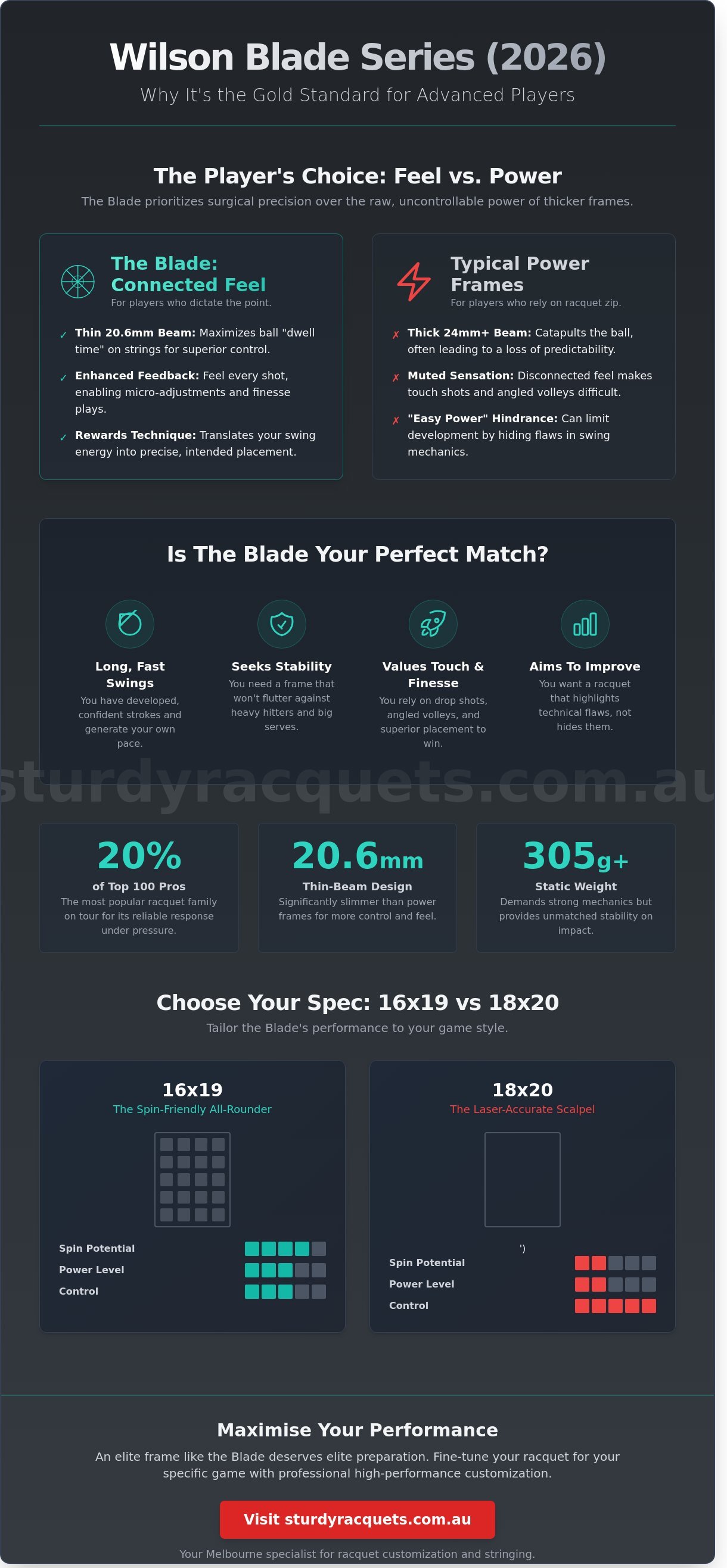
Why advanced players choose control over power
Advanced players often hear the same objection when considering this frame: "Isn't that racquet too hard to use?" It is a valid question. If you aren't hitting the center of the strings consistently, a control-oriented frame can feel demanding. However, for those with developed technique, this trade-off is the secret to high-level performance. When the ball is coming at you at 120 km/h, accuracy beats raw power every single time.
The 8. Wilson Blade Series: Why Advanced Players Love It is built on the philosophy that the player provides the power while the racquet provides the guidance. A smaller sweet spot, typically found on a 98-square-inch head, means there is less "trampoline effect" compared to oversized frames. When you swing with full intensity, you know exactly where the ball will land. This gives you the psychological freedom to aim for the lines rather than just playing it safe in the middle of the court.
Hitting a winner from the baseline requires more than just speed; it requires "plow-through." This refers to the racquet's ability to resist twisting and maintain its path through the contact zone. In high-level Australian club matches, you'll face heavy hitters who test your stability. A frame that lacks mass will flutter, but a precision-weighted racquet drives through the ball. This allows for aggressive, full-swing confidence even when you're pulled out wide on the defensive.
Precision in a high-velocity game
Advanced players need to feel the ball. They need to know exactly where it sits on the string bed for that split second of contact. Unlike many intermediate tennis racquets that feature thick beams and lightweight builds, these frames often sit around 305g to 320g unstrung. This extra mass is essential for redirecting pace.
The latest technical innovations in the V9 generation have improved torsional stability by 15% compared to previous iterations. This ensures the ball doesn't "hot launch" or fly long unexpectedly. You get a predictable launch angle every time you swing. This reliability is why the 8. Wilson Blade Series: Why Advanced Players Love It remains a staple on the professional tour and in competitive local tournaments.
The arm-friendly nature of thin beams
Competitive longevity is a major concern for serious players. Playing three sets on a hard court under the Australian sun takes a toll on the body. Many power-focused racquets have a stiffness rating (RA) above 70, which sends harsh vibrations directly into the elbow and wrist. This series typically maintains a lower RA rating, often measured between 60 and 64, which is significantly more forgiving on the joints.
A 21mm beam provides a flexible feel that dampens shock without losing the necessary feedback. You don't want a racquet that feels "mushy"; you want to feel the ball so you can execute delicate drop shots or sharp angles. When you're investing between A$380 and A$420 in a performance frame, you're investing in your ability to play pain-free for years. This series manages vibration through advanced carbon mapping, ensuring that players with joint sensitivity can still compete at their highest level without sacrificing the crisp feel required for elite play.
- Predictable Response: No sudden power surges during full swings.
- Enhanced Stability: The racquet stays firm against heavy serves.
- Joint Protection: Lower stiffness ratings reduce the risk of tennis elbow.
- Feedback: Clear communication from the strings to your hand.
Choosing your spec: 16x19 vs. 18x20 vs. 100
Selecting the right frame configuration is the most critical decision you'll make when upgrading to the latest 2026 models. The Blade isn't a one-size-fits-all racquet. It's a precision tool designed to be fine-tuned to your specific swing path and contact point. This versatility is a core reason for the 8. Wilson Blade Series: Why Advanced Players Love It, as it allows for a professional level of customisation straight off the shelf. Whether you're grinding out points from the baseline at your local Australian club or attacking the net, your choice of string pattern and head size will dictate your success on court.
The 16x19 version remains the most sought-after spec for the modern game. It provides a higher launch angle and easier access to depth, which is vital when you're pushed back deep behind the baseline. If you rely on heavy topspin to keep your opponents moving, this open pattern allows the strings to bite into the ball more effectively. In contrast, the 18x20 variant is the traditionalist's dream. It offers a denser, more consistent response across the entire hitting zone. This is the ultimate "flat" hitter?s tool for maximum directional control; it's designed for players who provide their own power and simply need the racquet to put the ball exactly where they aim.
For those who find the 98 square inch head size too demanding, the 100 square inch variant offers a 15% larger sweet spot. It's a more forgiving entry point for rising juniors or competitive club players who want the Blade feel without the high "shanking" penalty of a smaller head. It maintains the same 300g to 305g weight range but provides that extra bit of stability on off-centre hits during fast-paced rallies.
String pattern showdown
The 16x19 pattern increases the "snap-back" effect, where the main strings slide and spring back to generate massive topspin. This extra movement does mean you'll go through sets faster. Conversely, the 18x20 pattern offers superior string bed durability because the strings move less, reducing the friction that causes premature breakage. To get the most out of either setup, you must select the right high-quality strings for tennis players to complement the pattern. A thinner gauge poly works wonders in the 18x20, while a thicker, textured string suits the 16x19 perfectly.
Weight and balance considerations
Most advanced players gravitate toward the standard 305g unstrung weight, but the 2026 series also offers lighter 285g variants for easy customisation with lead tape. The 1-2 points head-light balance is a standout feature; it aids in net-play and quick volleys by making the frame feel "whippy" in the hand. You won't feel bogged down during long three-set matches in the Australian heat. We've seen that a swingweight hovering around 325 kgcm provides the best balance of stability and speed. This specific weight distribution reduces the impact of swingweight on late-match fatigue, ensuring your technique doesn't crumble when the score reaches 5-5 in the final set.
The 8. Wilson Blade Series: Why Advanced Players Love It comes down to this ability to match a frame to a player's physical needs and tactical style. When you find that perfect marriage of weight and string density, your confidence at the baseline will skyrocket.
Ready to upgrade your game with the latest 2026 technology? Shop the best performance tennis racquets in Australia and find your perfect spec today.
FAQ
Shop Control & Feel
Find your perfect Blade V10 racquet. Whether you're chasing pro-level precision or exploring the series for the first time, the 2026 Blade lineup has a frame for you.
Browse All Blade V10 Models
Share:
How to Stop Getting Blisters from New Tennis Shoes: The 2026 Player’s Guide
2026 Racket Technology: The Future of Racquet Sports Gear and Trends