



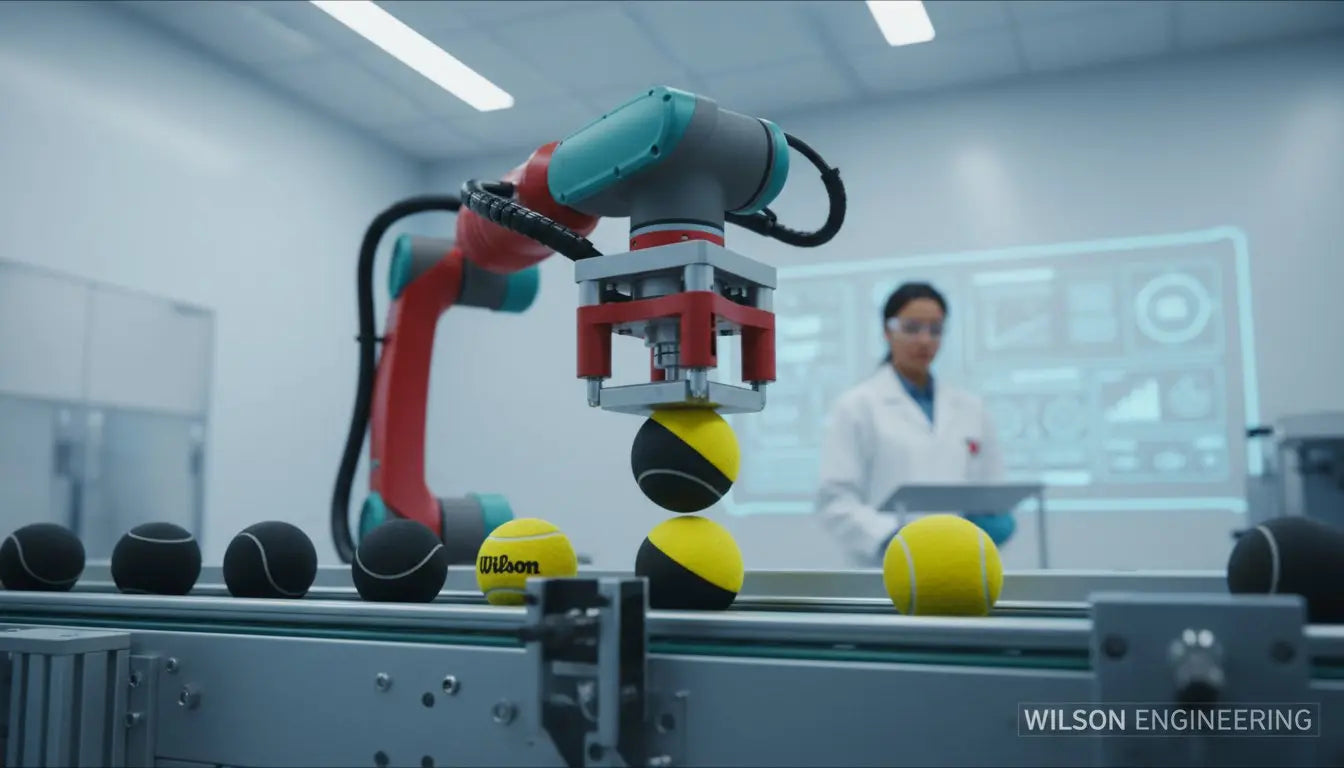
It's the third set on a scorching Saturday afternoon in Melbourne. You crack open a fresh can of Wilson Australian Open balls, expecting that perfect, crisp bounce. But by the fifth game, they already feel a bit soft, the pop is gone, and you're left wondering why they lose pressure so fast in the heat.
We've all felt that frustration. You invest in top-notch balls, only to have their performance dip mid-match, leaving you with an inconsistent game on our tough, gritty hard courts. This guide pulls back the curtain on the exceptional engineering packed into every single ball. You'll discover exactly why a premium ball holds its value and how to finally tell the difference between Extra Duty and Regular Duty felt. Get ready to appreciate your gear like never before as we explore The 24-Step Manufacturing Process of a Wilson Tennis Ball, a fantastic journey from raw rubber compound to the court-ready champion in your hand.
Key Takeaways
- Learn why a Wilson tennis ball isn't just made, but precisely engineered to meet strict ITF specifications for a perfect, consistent bounce.
- Explore 4. The 24-Step Manufacturing Process of a Wilson Tennis Ball to see how raw rubber and specialised felt are meticulously combined for ultimate performance.
- Discover how the manufacturing process creates a ball tough enough to resist "shredding" on abrasive Aussie hard courts and "core-splitting" in summer heat.
- Get expert tips to identify when a ball is past its prime and learn the best way to store your cans to maximise their lifespan.
The Science of the Bounce: Why Wilson Tennis Balls are Engineered, Not Just Made
Ever wondered what separates a top-notch Wilson tennis ball from a simple rubber toy? It?s not just the bright yellow felt. It's a precise science of pressure, weight, and rebound, all engineered to perfection. Before a single ball leaves Wilson?s global hub in Bangkok, which produces an incredible 100 million balls each year, it must meet a strict set of international standards. Achieving this level of quality isn't just about manufacturing; it's about mastering consistency, the single hardest metric to nail in mass production. This dedication to precision is the foundation of the 4. The 24-Step Manufacturing Process of a Wilson Tennis Ball, ensuring every shot you make is predictable and powerful.
The ITF Specification: The Rules of the Game
The International Tennis Federation (ITF) doesn't leave anything to chance. For a ball to be approved for tournament play, it must pass a rigorous battery of tests. These detailed Tennis ball specifications ensure a level playing field, whether you're at the Australian Open or your local club. A ball must have a diameter between 6.54 and 6.86 centimetres, a tiny tolerance of just 3.2 millimetres. Its weight must fall between 56.0 and 59.4 grams. Even a single gram outside this range can alter your swing speed and impact arm health over a long match. Finally, the rebound test: when dropped from a height of 254 cm (100 inches) onto a concrete surface, the ball must bounce back up between 135 and 147 cm.
Why the Factory Fresh Seal Matters
That satisfying "psssst" when you open a new can of Wilson balls is the sound of performance. It?s the sound of a perfectly pressurized environment. A tennis ball?s core is made of rubber, which is naturally permeable. Over time, the pressurised air inside (typically nitrogen) will slowly leak out. To combat this, Wilson cans are pressurized to around 14 psi. This external pressure creates an equilibrium, preventing the 18 psi of internal pressure in a professional ball from escaping before it reaches you. This seal is crucial for maintaining that lively "pop" off the strings. Looking ahead, Wilson is also committed to updating its packaging, with a goal to introduce fully recyclable, eco-friendly packaging across its performance ball line by 2026.
The Core Construction: Steps 1 to 12 of the Manufacturing Journey
Every powerful serve and crisp volley starts right here, with the heart of the tennis ball: the core. It?s a journey of transformation, turning raw, sticky rubber into a perfectly pressurised sphere. The entire process begins with a carefully guarded recipe. Wilson sources premium natural rubber, primarily from plantations in Thailand and Vietnam, and combines it with a proprietary blend of up to 11 different chemical additives. This isn't just any rubber; it's the foundation of the ball's performance.
This mix is fed into massive open mills, where powerful rollers chew, blend, and work the material in a process called "crushing." For several minutes, the compound is kneaded until it achieves a perfectly uniform, homogenous consistency. From there, an extruder machine shapes the warm, pliable rubber into a long, continuous rope, which is then precisely cut into small pucks called "slugs." Each slug is weighed to ensure it contains the exact amount of material needed for one half of a tennis ball core.
Molding the Shells: Where Precision Begins
The rubber slugs are placed into compression molds. For 90 seconds, they are subjected to intense heat (around 150�C) and pressure, transforming them into perfectly formed semi-circular shells. The precision here is exceptional; the thickness of each shell must be uniform to within a few microns. Any variation could lead to an imbalanced ball and an unpredictable bounce. After molding, the shells are cooled in a water bath, a critical step that sets the rubber?s "memory" and ensures they hold their perfect shape.
The Secret of the Pressurized Chamber
This is where the magic truly happens. Steps 9 through 11 of the 4. The 24-Step Manufacturing Process of a Wilson Tennis Ball are all about creating that signature bounce. A special vulcanizing adhesive is applied to the rim of each half-shell. Next, the two halves are joined together in a press. In this pressurised chamber, Wilson injects compressed air to an internal pressure of approximately 12 PSI. This internal pressure is the secret ingredient that dictates how high the ball bounces. For those keen on the physics, the University of Illinois has a fantastic explanation of The Science of the Bounce and how this pressure works. The halves are then heat-sealed, permanently trapping the air inside. The final step for the core is buffing, which roughens the smooth surface to create a sandpaper-like texture, preparing it for the next stage: felt application. Understanding this precision helps you appreciate why choosing the right ball from our fantastic range of Wilson tennis balls can make a real difference to your game.

The Magic of the Felt: Steps 13 to 24 and the Finishing Touches
Once the pressurised rubber core is sealed, the tennis ball is only halfway home. The next twelve steps transform it from a simple rubber sphere into the iconic fuzzy yellow ball we all know and love. This is where the real magic happens, defining everything from the ball's flight through the air to the incredible spin you can generate on a serve.
The journey begins with the felt, which isn't just any fabric. It?s a meticulously engineered blend of natural wool and nylon. The ratio of this blend is critical and tailored for different playing surfaces. For instance, Wilson?s premium US Open balls, designed for professional play, use a higher percentage of natural wool for a softer feel and superior playability. In contrast, extra-duty balls popular on Australia's hard courts often feature more nylon for enhanced durability against the abrasive surface.
To cover the spherical core perfectly, the felt is die-cut into a distinct "dumbbell" or "dog-bone" shape. This precise geometry is the secret to wrapping the core without any wrinkles or overlapping seams, ensuring a perfectly balanced and uniform surface.
Adhesive Coating and Automatic Felting
Attaching the felt is a high-tech, two-stage process. The rubber core is first coated in a special adhesive solution. Then, two of the dumbbell-shaped felt pieces are expertly wrapped around it by automated arms. These machines work with incredible precision. As detailed in a fantastic guide to The Manufacturing Process of a Tennis Ball from Popular Mechanics, the felt edges meet perfectly without overlapping. The ball is then vulcanised a second time, permanently bonding the felt to the core. To finish, the balls are put through a steam "tumble" phase, which fluffs the felt fibres (or "nap") to hide the seams and create that signature fuzzy texture.
The Logo Stamping: More Than Just Branding
The final steps in the 4. The 24-Step Manufacturing Process of a Wilson Tennis Ball are all about quality control and finishing touches. The iconic Wilson logo is stamped on, but the ink used is specially formulated. It cannot alter the felt's friction coefficient or add measurable weight, which could affect the ball's performance. Every single ball then undergoes a final quality control check to ensure it meets strict specifications for weight (between 56.0 and 59.4 grams) and bounce (rebounding 135 to 147 cm when dropped from a height of 254 cm). Balls that pass are then placed into cans, which are pressurised to 14 psi and vacuum-sealed to preserve their internal pressure until you're ready to play.
That "fuzz" does more than just look good. It's an aerodynamic powerhouse. The nap creates a thin boundary layer of air that travels with the ball, reducing drag and allowing for a more stable flight. It also gives your racquet strings something to bite into, which is how top players generate massive amounts of spin. From a simple rubber slug to a court-ready weapon, the 4. The 24-Step Manufacturing Process of a Wilson Tennis Ball is a top-notch example of precision engineering.
Why Manufacturing Consistency Matters for Australian Players
You've seen the pros on TV, but what does a tennis ball's journey from raw rubber to the court mean for your weekend match? A lot, actually. Especially in Australia. Our tough courts and wild weather demand a ball that?s built with military-grade precision. An inconsistent ball isn't just frustrating; it can cost you points. Those "unforced mistakes" might not be your fault at all if the ball's bounce is unpredictable.
That's why 4. The 24-Step Manufacturing Process of a Wilson Tennis Ball is more than just a factory procedure. It's your insurance policy against erratic bounces and equipment failure. For Aussie players, two factors are absolutely critical: surviving our courts and withstanding our heat.
Most local club courts in Australia are hard courts, which are notoriously abrasive. They act like sandpaper on the ball's felt, "shredding" it over a few sets. This is where the specific design of Wilson's Extra Duty felt proves its worth. It?s engineered with a higher nylon content specifically to resist this abrasion, ensuring the ball plays consistently for longer. A cheaper ball might feel fine for the first few games, but it will quickly fluff up, slow down, and lose its consistent bounce.
Surviving the Victorian Climate
Ever played on a 35�C day at the Geelong Rd Tennis Club? That intense heat does wild things to a tennis ball. The air inside expands, increasing the internal pressure by up to 8%. A poorly made ball with weak seams can literally split apart. Wilson's meticulous 24-step bonding and vulcanisation process creates a core that can handle this thermal expansion. Furthermore, their Bangkok factory runs extensive humidity tests to ensure the felt doesn't absorb excess moisture on a muggy Melbourne day, which keeps the ball's weight and flight path true.
Extra Duty vs. Regular Duty: Factory Differences
The choice between "Extra Duty" and "Regular Duty" balls comes down to a key decision made at the factory: the felt composition. It?s not just marketing; it?s a specific engineering choice for different court surfaces.
- Extra Duty: The felt blend contains a significantly higher percentage of interlocking nylon fibres. This creates a more durable, compact felt that stands up to the punishing friction of hard courts.
- Regular Duty: This felt uses more natural wool. The wool fibres are designed to fluff up, which helps the ball "bite" into the loose surface of clay or grab the blades of grass courts for better control. On a hard court, this felt would be destroyed in under an hour.
So, which one should you buy for your local court in Brooklyn? Since nearly all courts in the area are hard courts, Wilson Extra Duty balls are the top recommendation from the team at Sturdy Racquets. They simply last longer and perform better under our local conditions.
Ultimately, a consistent manufacturing process eliminates variables. It means the ball you open today will fly, bounce, and feel just like the one you open next month. This reliability lets you build muscle memory and trust your shots, knowing the equipment won't let you down. It's how you turn a rally into a winning point.
Ready to feel the difference a premium, consistently made ball can make? Shop our expert-recommended range of Wilson Extra Duty balls and give your game the reliability it deserves.
From the Factory Floor to Your Forehand: Getting the Most Out of Your Gear
Understanding 4. The 24-Step Manufacturing Process of a Wilson Tennis Ball reveals the incredible precision that goes into every can. From the rubber core to the final felt application, each ball is engineered for peak performance. But once you pop that can, the clock starts ticking. A ball's lifespan is finite, affected by everything from court surface to air temperature. Here?s our expert advice on how to identify a worn-out ball, extend the life of a new one, and ensure you?re always playing with the best gear.
A "dead" ball feels flat off the racquet, has a lower bounce, and can even lead to technique changes as you overcompensate for the lack of pop. Before you play, give your balls a quick check. A fresh ball should feel firm with very little give when squeezed. If you can easily press your thumb into it, its internal pressure has likely dropped below the optimal 12-14 psi range. You can also drop the ball from head height onto a hard surface; a good ball should bounce back to your waist, while a dead one will struggle to reach your knees.
Expert Advice: Maximizing Ball Longevity
To keep that "fresh out of the can" feel, proper storage is crucial. The biggest enemy is temperature fluctuation. Never leave your tennis balls in a hot car, especially during a Victorian summer when interior temperatures can soar above 60�C. This extreme heat rapidly expands the air inside the ball, forcing it through the rubber core and permanently reducing its pressure. Keep them in your bag at a stable, cool room temperature. Pressure-saver canisters can also help. While they won't re-pressurize a dead ball, they maintain the existing pressure by equalizing the environment outside the ball, slowing the natural air loss by up to 40% between matches.
Playing with quality equipment is just one part of the game; being a responsible player is another. After going through 4. The 24-Step Manufacturing Process of a Wilson Tennis Ball, it?s a shame to see them end up in landfill. In Australia, over 10 million tennis balls are disposed of each year. Thankfully, programs like Game On Recycling are making a difference. You can drop off your used balls at participating clubs and retailers across the country, where they are collected and repurposed into materials for new tennis courts and playground surfaces.
Finally, where you buy your balls matters. Big-box retailers might have older stock that has been sitting in a warehouse for months, slowly losing pressure even inside the can. As a specialist tennis store, Sturdy Racquets guarantees "factory fresh" stock. We have a high turnover and a direct supply chain, ensuring the Wilson balls you buy from us deliver the consistent bounce and feel their creators intended.
Shop the 2026 Wilson Range at Sturdy Racquets
Ready to feel the difference? We stock the complete 2026 Wilson range, including the iconic Wilson US Open balls, the official choice for grand slam glory, and the durable Wilson Championship balls, perfect for club matches and intense practice sessions. Our knowledgeable team is here to help you choose the right ball for your game and court surface. We are the one-stop shop for Melbourne?s passionate tennis community, offering expert advice and the best gear. Avoid Unforced Mistakes-Shop our Wilson Ball Range Now.
Put Wilson's 24-Step Quality to the Test
The journey of a Wilson tennis ball from raw rubber to your racquet is a testament to precision engineering. It's not just a ball; it's the result of a meticulous system designed for consistent performance. Understanding the intricate details of 4. The 24-Step Manufacturing Process of a Wilson Tennis Ball, from the two-piece core construction to the final felt application, gives you a new appreciation for the gear that fuels your passion. This top-notch consistency is what allows Australian players to trust every serve, volley, and groundstroke.
Ready to feel the difference that 24 steps of quality make? As an authorized Wilson retailer, we guarantee you get that genuine, factory-fresh performance in every can. Get knowledgeable, friendly advice from our Brooklyn specialist team and enjoy fast shipping across Australia from our Victoria hub.
Upgrade your game with Factory-Fresh Wilson Tennis Balls and experience that perfect, reliable bounce for yourself. It's time to play with complete confidence.
Frequently Asked Questions
How many steps are in the Wilson tennis ball manufacturing process?
The Wilson tennis ball manufacturing process involves 24 distinct steps to ensure tournament-quality performance. This complex procedure begins with mixing the rubber for the core and moves through moulding, buffing, and felt application. Each stage, including the final logo stamping and pressurization, is meticulously controlled. This is why the 24-step manufacturing process of a Wilson tennis ball is trusted by professionals and clubs across Australia for its fantastic consistency and durability.
Why are tennis balls pressurized in the factory?
Tennis balls are pressurized in the factory to create their signature bounce. The hollow rubber core is injected with pressurized air, typically around 12 psi above atmospheric pressure, which makes the ball firm and lively. This internal pressure is also why a new can of balls is pressurized. It prevents the air from leaking out of the balls before you're ready to hit the court, ensuring they are perfectly fresh for your first serve.
What is the difference between Wilson Extra Duty and Regular Duty balls?
The main difference between Wilson Extra Duty and Regular Duty balls is the felt's durability, designed for different court surfaces. Extra Duty felt is thicker and woven with more wool, making it perfect for the abrasive, hard courts common in Australia. Regular Duty felt is designed for softer surfaces like clay or indoor courts, as it's less likely to pick up dirt and become heavy. Choosing the right ball for your court is a top tip for better play.
Where are Wilson tennis balls actually made?
The majority of Wilson tennis balls are made at Wilson's dedicated factory in Thailand. Since 1972, this facility has been the global hub for producing the high-performance balls used at events like the Australian Open and US Open. Although Wilson is an American company, this Thailand plant is where the 24-step manufacturing process of a Wilson tennis ball is expertly carried out, guaranteeing exceptional quality for players worldwide.
How long do Wilson tennis balls stay fresh in the can?
An unopened, pressurized can of Wilson tennis balls will stay fresh for up to five years from its manufacture date. The can's internal pressure matches the balls', preventing any loss of bounce while sealed. Once you pop the top, however, the clock starts ticking. For competitive matches, a new can is best, but social players can typically get 2-3 sessions of good play before the balls start to feel flat and lose their pop.
Can you recycle used Wilson tennis balls in Australia?
Yes, you can recycle used tennis balls in Australia through specialised programs, which is great news for the environment. You can't put them in your kerbside recycling bin, but national initiatives like Game On Recycling have collection points at many tennis clubs and centres. These programs repurpose the old balls into materials for playgrounds and sporting surfaces, giving them a fantastic second life and keeping them out of landfill.
Why does the felt on my tennis ball get fluffy after a few games?
The felt on your tennis ball gets fluffy because the impact from your racquet strings and the court surface breaks and raises the felt's woven fibres. This "fluffing up" is a normal part of wear and tear. As the ball gets fluffier, it creates more air resistance, which slows it down slightly and can lower its bounce. This is one of the main reasons professional players change balls so frequently during a match to maintain consistent speed and bounce.
How does heat affect the bounce of a Wilson tennis ball?
Heat makes a Wilson tennis ball bounce higher and faster by increasing its internal air pressure. On a hot summer day in Sydney, the air molecules inside the ball expand, making it livelier. This is based on a principle from physics called Boyle's Law. Conversely, playing on a cold evening in Hobart will cause the internal pressure to drop, making the ball feel heavier, less responsive, and bounce significantly lower than it would in the heat.
Share:
How Wilson Became One of the Most Trusted Tennis Brands in the World
The Engineering Behind Wilson Racquet Frames: A 2026 Technical Deep-Dive