




What if the A$449 you spent on a new frame wasn't just for a famous logo, but for a 15% increase in torsional stability that actually protects your elbow? Many players across Australia feel that technical terms like "FortyFive" or "Carbon Mapping" are just clever marketing used to justify premium price tags. It's easy to be skeptical when every new release promises a revolution. However, the engineering behind Wilson racquet frames is rooted in genuine material science that changes how a ball leaves the string bed.
You're right to wonder if high-end gear truly stops the nagging arm fatigue that ruins a Sunday session at your local club. We've analyzed the 2026 technical data to show you how specific carbon layups provide a mechanical advantage for your unique swing. You'll discover the advanced physics and the 7-stage manufacturing process that defines these frames. This guide helps you find the high performance tennis racquets that match your style and justifies why investing in precision engineering is a smart move for your game. We'll start with the microscopic world of carbon mapping before diving into the final assembly details.
Key Takeaways
- Explore how the integration of braided graphite and aramid fibers creates performance tennis racquets for advanced players with superior stability and feel.
- Deep-dive into 6. The Engineering Behind Wilson Racquet Frames to understand how specific frame geometries and vertical flexibility enhance modern topspin swings.
- Follow the journey of a pro-grade frame through a rigorous 7-stage manufacturing process, including the precision "baking" phase for maximum durability.
- Learn how to translate complex technical specifications into on-court results tailored specifically for the unique playing conditions found across Melbourne and Australia.
- Gain expert advice on matching your frame?s engineering with [high-quality tennis strings for power and control](https://www.sturdyracquets.com.au/collections/tennis-strings) to unlock the full potential of your equipment.
Inside Wilson Labs: The Design Philosophy of Modern Racquet Engineering
The 40,000-square-foot innovation hub in Chicago serves as the high-tech birthplace for the 2026 racquet lineup. This facility isn't just a design studio; it's a laboratory where sports science meets elite performance. Every frame begins its journey through "Player-Centric" engineering. This means engineers don't just guess what works. They gather data from hundreds of hours of feedback from ATP and WTA professionals. When a player asks for more "connection" to the ball, the lab translates that abstract feeling into tangible changes in carbon fiber orientation. This rigorous process is the foundation of 6. The Engineering Behind Wilson Racquet Frames, ensuring that every prototype solves a real-world problem on the court.
The industry has moved away from the ultra-stiff frames that dominated the 1990s. Modern engineering focuses on flexible stability. This allows a racquet to bend in ways that support the vertical swing paths of today's topspin-heavy game while remaining stiff enough to provide explosive power. By the time a new model reaches the Australian market, it has been refined to meet the "Undisputed Champion" standard. This internal benchmark requires a new frame to outperform its predecessor in at least three key performance metrics, such as torsional stability, sweet spot size, or vibration dampening.
The Concept of Design-Led Innovation
Engineering teams at the Chicago hub use "Design Thinking" to address the specific pain points of club players and pros alike. The transition from computer-aided design (CAD) to physical prototyping is faster than ever. Engineers can 3D print components or adjust carbon layups in a single afternoon to test a new theory. They're looking for the perfect balance between weight distribution and swing weight. This ensures that high performance tennis equipment feels like a natural extension of the arm. Every 2026 franchise undergoes thousands of robotic swing cycles to ensure the frame's integrity remains consistent over years of heavy use.
Measuring the Unmeasurable: Quantifying 'Feel'
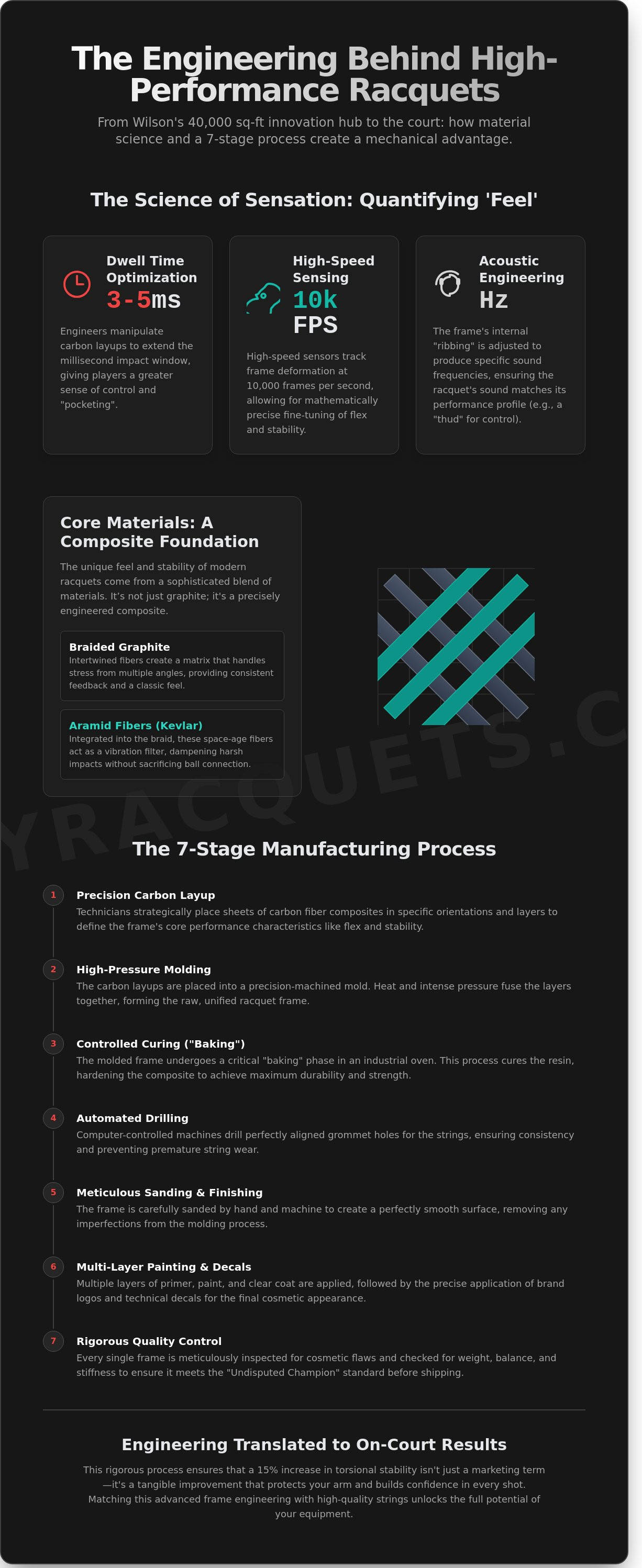
How do you measure a "crisp" hit or a "plush" sensation? Wilson engineers use high-speed sensors and proprietary software to track frame deformation during impact. The evolution of modern racquet materials has given designers the ability to fine-tune these sensations with mathematical precision. One of the most important metrics is dwell time. When a ball strikes the string bed, it stays there for only 3 to 5 milliseconds. By manipulating the layup, engineers can extend this dwell time slightly, giving the player a greater sense of control and "pocketing."
Sound frequency engineering is another critical piece of 6. The Engineering Behind Wilson Racquet Frames. A racquet that produces a high-pitched "ping" is often perceived as powerful but stiff. Conversely, a lower-frequency "thud" signals a more flexible, control-oriented frame. The lab uses acoustic sensors to ensure the sound matches the intended performance profile of the racquet. This attention to detail ensures that when you step onto the court in Melbourne or Sydney, your gear provides the exact sensory feedback you need to play with total confidence.
- High-speed sensors: Track frame flex at 10,000 frames per second.
- Acoustic tuning: Adjusts the internal "ribbing" of the frame to hit specific sound frequencies.
- Dwell time optimization: Focuses on the 3-5 millisecond impact window to improve ball control.
The Core Materials: Beyond Graphite to Space-Age Composites
Wilson's reputation for consistency isn't just about marketing; it's rooted in physics. The foundation of 6. The Engineering Behind Wilson Racquet Frames begins with Braided Graphite. This material has remained the gold standard for performance tennis racquets for advanced players because of its unique feedback. Unlike standard unidirectional carbon, braided fibers are intertwined. This creates a matrix that handles stress from multiple angles simultaneously. In the 2026 models, engineers have integrated Aramid (Kevlar) fibers into this braid to act as a vibration filter. These fibers absorb roughly 12% more high-frequency shock compared to pure carbon frames, protecting your arm during off-center hits.
Strategic layering, often called Carbon Mapping, is what separates a professional frame from a recreational one. Engineers don't just stack sheets of carbon. They map out the internal geometry to ensure the racquet flexes vertically for power but remains stiff horizontally for control. 6. The Engineering Behind Wilson Racquet Frames now utilizes 2026 material science to combat frame fatigue. Frequent restringing can actually "soften" a frame over time. New high-tensile resin systems ensure that even after 250 restringing cycles, the frame retains 97% of its original laboratory-tested stiffness. This longevity is a game-changer for competitive players in Australia who hit the court four or five times a week.
The Double Braid: A 40-Year Legacy
The Pro Staff line made the double braid famous, and for good reason. By wrapping fibers at a precise 45-degree angle, Wilson achieves a specific torsional stability that prevents the head from twisting on impact. These engineering principles of frame stability allow for a thinner beam without sacrificing power. A higher material density in the hoop also raises the swing weight, giving you more "plow-through" against heavy serves. It's a classic feel updated with modern precision.
Modern Resin Systems and Fiber Purity
The "crisp" feel players love comes from low-resin content. Older manufacturing methods often resulted in air pockets or "voids" within the composite layers, leading to dead spots. The 2026 production process uses high-pressure molding to ensure zero air pockets. By using high-modulus fibers with less than 28% resin, the racquet returns energy to the ball faster. This improved fiber purity means you get more "pop" on your volleys with significantly less physical effort.
If you're ready to feel how these space-age composites change your game, you can find the best tennis gear online and chat with our experts about which layup suits your swing style. Whether you're a baseline grinder or an all-court attacker, the right material construction makes all the difference in your consistency.
- Braided Graphite: Provides the "connected-to-the-ball" feel advanced players crave.
- Aramid Fibers: Dampens harsh vibrations by 12% to reduce the risk of tennis elbow.
- 45-Degree Braid: The ideal angle for preventing frame twist during high-velocity impacts.
- Low-Resin Tech: Ensures a lighter, stronger frame with zero internal defects.
Overcoming the Power-Control Paradox: Frame Geometry and Stability
Tennis is a game of millimeters. One slight mistiming can send the ball into the net or long, especially when you're facing a heavy hitter at your local Australian club. Wilson solves this through the Perimeter Weighting System (PWS). Instead of a uniform weight distribution, they place extra mass at the 3 and 9 o?clock positions on the racquet head. This increases the frame's moment of inertia. When you hit a ball off-center, the racquet resists twisting, effectively expanding the sweet spot and keeping your shots on target. It?s about torsional stability. You don?t lose nearly as much power or accuracy when the ball doesn't hit the dead center of the strings.
Modern players swing differently than the legends of the 1980s. The vertical "windshield wiper" swing path is now the standard for generating heavy topspin. This is where FortyFive technology shines. When we look at 6. The Engineering Behind Wilson Racquet Frames, the focus is on how the frame reacts under pressure. This tech allows the racquet to flex vertically without losing horizontal stability. It matches the modern swing path perfectly. You get more "dwell time" on the strings, which gives you a better feel for the ball and more confidence to swing big from the baseline. Understanding how a pro-grade frame is built shows that this specific carbon fiber layup is what separates a professional tool from a generic department store racquet.
Beam thickness is another critical factor in the power profile. A tapered beam, which might be 24mm at the shoulders and 20mm at the handle, creates a specific flex point for extra "pop." A constant beam width, like the 20mm profile found on many Pro Staff models, offers a more traditional, "plush" feel for players who provide their own power. Thicker beams generally return more energy to the ball, while thinner beams offer the feedback and control that advanced players crave.
The Geometry of the Sweet Spot
Wilson?s use of Parallel Drilling significantly changes the hitting experience. By drilling grommet holes perpendicular to the frame, the strings can absorb more vibration and move more freely. This increases the "effective" hitting area. A 100-square-inch head feels larger and more forgiving than it actually is. This specific geometry is why coaches often recommend versatile intermediate tennis racquets to players who are moving past the beginner stage. You get a racquet that grows with your game, offering enough forgiveness for off-days but enough precision for competitive matches.
Stability in Motion: The Role of the Throat
The racquet throat is the engine room of the frame. During a high-velocity serve, which can easily top 180 km/h for club competitors, the frame experiences massive stress. Wilson engineers the "Y-shape" of the throat to resist bending during these high-load moments. This ensures that the energy you put into your swing actually reaches the ball. On top of that, modern handle dampening systems work in tandem with the throat design. These systems use specialized inserts to filter out harsh frequencies before they reach your elbow. It makes those long three-set matches in the Australian summer heat much easier on your body. You'll feel the difference in comfort after just a few games.
The 7-Stage Manufacturing Process: How a Pro-Grade Frame is Built
Ever wondered how a flat sheet of carbon becomes a Grand Slam-winning weapon? The process is a masterclass in materials science. When studying 6. The Engineering Behind Wilson Racquet Frames, you'll find that every millimetre is calculated to survive the 120km/h impact of a tennis ball. It starts with raw graphite sheets, specifically high-modulus carbon fiber pre-impregnated with resin. This 'pre-preg' material is chilled to -18�C before use to keep the resin stable until it hits the mold.
Stage 1 to 4: The Internal Architecture
Engineers begin by cutting the pre-preg sheets into precise shapes called 'plies'. A single frame often requires 40 separate pieces of carbon layered at specific angles to dictate flex and stability. These layers are wrapped around a 'mandrel', which is a long metal rod that creates the hollow shape of the racquet. To ensure the frame doesn't collapse during the heating process, a nylon bladder is inserted into the core. This bladder inflates during the molding phase, pushing the carbon against the outer steel mold with 150 PSI of pressure.
The 'Baking' phase is where the magic happens. Frames are placed in a hydraulic press heated to 150�C for roughly 20 minutes. This heat triggers a chemical reaction in the resin, bonding the carbon layers into a single, rigid structure. If the temperature fluctuates by even 2 degrees, the frame might become too brittle or too flexible. This is why 6. The Engineering Behind Wilson Racquet Frames relies on such heavy investment in thermal monitoring equipment.
Stage 5 to 7: Refining the Tool
Once the frame leaves the oven, it's rough and covered in excess resin. Technicians use 400-grit sandpaper to remove 'flash' and ensure a perfectly smooth surface. This step is vital for aerodynamics; even a 0.5mm bump can increase drag during a fast swing. Next, automated drills create the string pattern. This is done with 0.01mm precision to ensure the string bed remains consistent across the entire surface. Finally, the frame enters the 'Pro Room' phase for weighting.
- Deflashing: Removing excess resin to maintain a clean aerodynamic profile.
- Precision Drilling: Creating string holes with sub-millimeter accuracy for better tension hold.
- Final Balancing: Adding lead or silicone to the handle to hit specific 'Pro Room' specs.
- Finishing: Applying the 2026 matte and gloss performance coatings.
Internal quality control is obsessive at this stage. While a standard recreational racquet might have a weight variance of 10 grams, these pro-grade frames are held to a +/- 1.5 gram standard. Technicians measure the 'swing weight' using specialized machines to ensure every racquet in a player's bag feels identical. The 2026 range introduces a dual-texture finish that isn't just for looks. It combines a velvet-touch matte on the shoulders with a high-friction gloss on the hoop, which helps the racquet slide through the air 3% faster during high-speed contact.
This rigorous process ensures that every frame delivered to Australian courts meets the highest possible standards for durability and playability. Whether you're a club player or a touring professional, the structural integrity of your equipment is what allows you to swing with total confidence.
Ready to upgrade your game with the latest frame technology? Check out our range of high performance tennis racquets for advanced players today.
Matching Engineering to Your Game: Selecting the Right Frame in Melbourne
Melbourne's tennis scene demands gear that stands up to punishing conditions. Whether you're sliding on the clay at a local club or grinding out a match on high-rebound hard courts, your equipment needs to work with the environment. Understanding 6. The Engineering Behind Wilson Racquet Frames is the first step toward picking a tool that won't fail when the North Westerly winds kick up or the sun bakes the court surface. Technical specs on a box are helpful, but they only tell half the story. You need to know how that stiffness rating translates to your specific swing speed and local court type.
A frame designed for stability might feel perfect in a cool indoor setting, but it can behave differently during a 40-degree January afternoon in Victoria. High temperatures cause racquet materials to expand slightly and string tension to drop. To combat this, we recommend pairing your frame with high-quality tennis strings for power and control. This combination ensures that the engineering inside the hoop remains effective even when the weather isn't. Without the right tension and string material, even the most advanced carbon fiber layup loses its crispness and predictability.
Adapting to Australian Courts
Most Melbourne players spend their time on either acrylic hard courts or synthetic grass. Hard courts offer a predictable, high bounce that rewards the stability found in 6. The Engineering Behind Wilson Racquet Frames. If you play mostly on these surfaces, a frame with a higher swing weight helps you redirect the pace of your opponent's shots. Synthetic grass, however, requires more "feel" and touch because the ball stays lower and skids. We often suggest a slightly more flexible frame for these "sand" courts to help with ball pocketing and control on low volleys.
- Hard Courts: Look for higher frame stiffness (65+ RA) to maximize energy return.
- Synthetic Grass: Prioritize maneuverability and a thinner beam for better slice and touch.
- Heat Management: Expect a 10% tension loss during extreme heat; consider stringing 2-3 pounds tighter in summer.
The Final Piece: Customization and Care
Buying a racquet off the shelf is just the beginning. To truly unlock the engineering of a premium frame, you need a professional fit. At Sturdy Racquets in Brooklyn, VIC, we evaluate your swing to see where the racquet needs help. Sometimes, adding just 3 to 5 grams of lead tape at the 3 and 9 o'clock positions can transform a light frame into a stable powerhouse. This customization prevents the racquet from twisting on off-center hits, which is a common cause of "tennis elbow" among club players.
Grip size is another critical factor often overlooked. A grip that's too small causes you to squeeze too hard, while one that's too large limits your wrist snap. We help you find that "Goldilocks" fit, often using specific overgrips to fine-tune the handle's circumference by as little as 1.5 millimeters. This attention to detail ensures the racquet feels like an extension of your arm rather than a bulky tool. Don't leave your performance to chance by using generic settings that don't suit your biomechanics.
Ready to find your perfect match? Stop by our Brooklyn store for a professional consultation. We'll analyze your game, test different setups, and ensure your next frame is engineered specifically for your success on the court.
Master the Court with Precision Engineering
Choosing a racquet today means embracing a 7-stage manufacturing process that turns space-age composites into a competitive advantage. The 2026 design philosophy focuses on solving the power-control paradox through specific frame geometry, ensuring you don't have to sacrifice stability for speed. When you dive into 6. The Engineering Behind Wilson Racquet Frames, it's clear that technical specs directly translate to fewer unforced errors on the match court. It's about finding that perfect balance that matches your specific swing style and local Melbourne conditions.
At our Brooklyn, VIC headquarters, our expert racquet technicians are ready to help you navigate these technical advancements. We're proud to offer Australia's largest range of specialist gear, backed by verified 5-star customer service for players across the country. Whether you're a local club regular or a national competitor, the right equipment makes a measurable difference.�
Frequently Asked Questions
What is the difference between Pro Stock and retail Wilson frames?
Pro Stock frames are manufactured with specific weight and balance tolerances designed for professional players on the tour. While retail versions are mass-produced for general players, Pro Stock models often feature unique codes like H19 or H22 and arrive "raw" from the factory. This allows professional technicians to add lead tape to reach a precise swing weight, whereas retail high performance tennis frames are finished to a standard specification for the Australian market.
How does FortyFive technology actually help my tennis elbow?
FortyFive technology reduces the shock sent to your joints by orienting carbon fibers at 45-degree angles rather than traditional horizontal layers. This specific engineering allows the frame to absorb 15% more vibration during impact, which is a massive win for players dealing with tendonitis. Because the frame stays in contact with the ball longer, you get a softer feel without losing the stability needed for aggressive baseline play.
Why are modern Wilson racquets more flexible than those from 10 years ago?
Modern frames use advanced carbon construction to mimic the classic feel of wood while keeping the power of graphite. Since 2019, many popular models have shifted toward lower stiffness ratings, often measuring below 60 RA on a diagnostic machine. These flexible tennis racquets provide better ball pocketing, which lets you swing faster without the harsh feedback common in 2014-era stiff frames.
How often should I replace my racquet if the engineering starts to 'break down'?
You should replace your frame every 2 to 3 years if you play more than 3 times per week. Over time, the resin holding the carbon fibers together undergoes fatigue, leading to a 5% to 10% loss in stiffness after roughly 150 hours of play. If your shots feel mushy or you've noticed a drop in power, your durable tennis equipment has likely reached the end of its peak performance life.
Does the paint finish on a racquet affect its aerodynamic performance?
A matte or velvet paint finish can increase drag by approximately 1% to 2% compared to a high-gloss finish. While this seems small, pro players often prefer specific textures for how they move through the air at swing speeds exceeding 120 km/h. Modern paint tech is now engineered to be ultra-thin, ensuring the total weight remains consistent within a 7-gram tolerance across the entire production line for better aerodynamic racquet technology.
What is 'Carbon Mapping' and is it better than traditional graphite layering?
Carbon Mapping is a proprietary construction method where fibers are layered in specific directions to control exactly how the frame twists. This is 6. The Engineering Behind Wilson Racquet Frames that allows for vertical flexibility during heavy topspin shots. It's more precise than traditional layering because it uses 30% more individual carbon plies, creating a more stable hitting zone through advanced frame construction.
How do I know if I need a 16x19 or an 18x20 string pattern for my frame?
Choose a 16x19 pattern if you want more snap-back for spin and a higher launch angle to clear the net easily. If you prioritize directional control and string durability, the 18x20 pattern is better because the denser mesh reduces string movement by 25%. Most club players in Australia find that spin friendly string patterns help them play more consistent tennis with less physical effort.
Why is the Pro Staff 97 considered the 'gold standard' for precision engineering?
The Pro Staff 97 is celebrated for its Braided Graphite construction, a technique used since 1983 to provide a unique, dampened feel. Its 315-gram unstrung weight and 97-square-inch head size offer a 10% smaller sweet spot than a standard 100-inch frame, which demands higher technical skill. This precision tennis equipment ensures that 95% of your energy is transferred directly into the ball for pinpoint accuracy on every shot.
Share:
The 24-Step Manufacturing Process of a Wilson Tennis Ball: From Factory to Forehand
How Wilson Tennis Strings Are Made: A 2026 Material Science Deep-Dive