


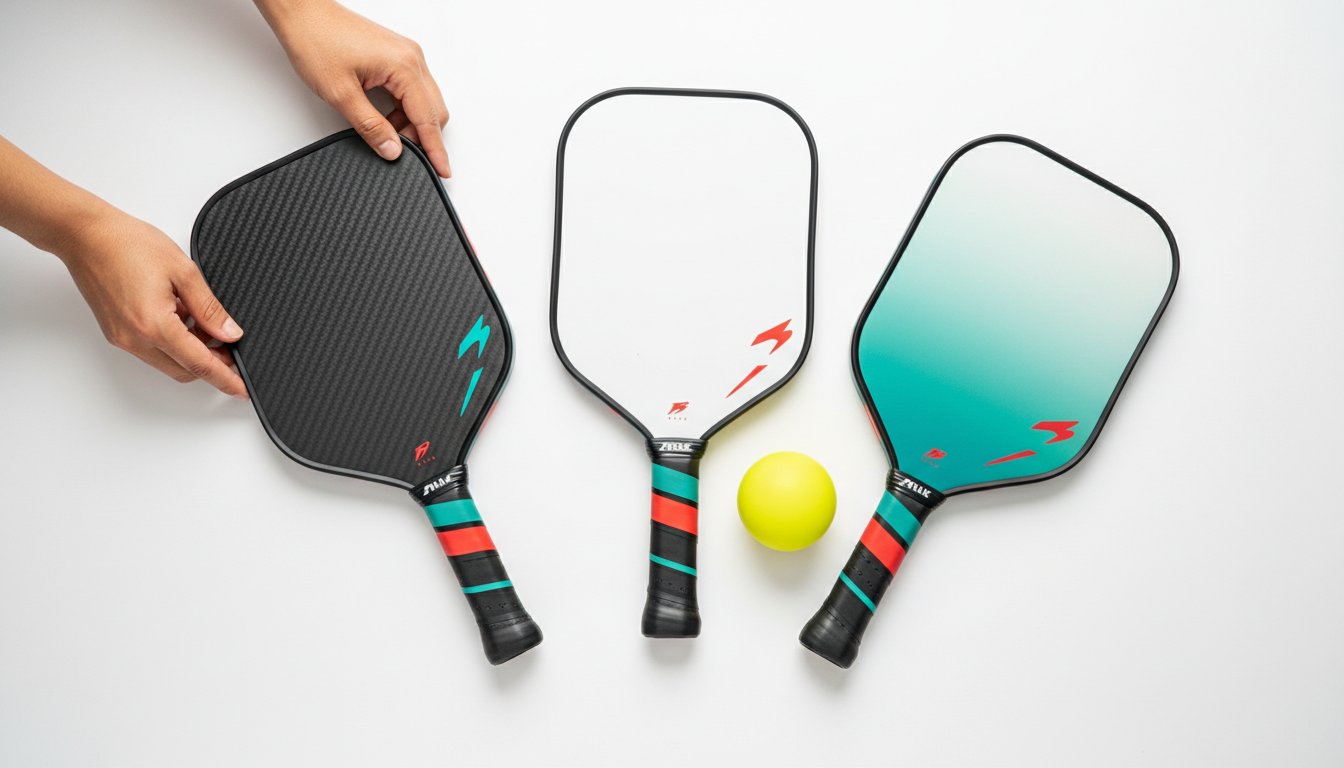
That A$60 pickleball paddle from the big department store isn't a bargain; it's a barrier that could stall your progress before you even learn to dink. We get it. When you're new to the game, the jargon about carbon fiber faces and polymer cores is confusing, and the fear of overspending on the wrong gear is real. You just want something that feels good and helps you hit the ball over the net, without having to wait weeks for an expensive US import.
This guide is here to change that. We'll show you why investing between A$80 and A$150 is the smartest move for any new player, unlocking a paddle with a huge, forgiving sweet spot that builds confidence with every shot. Consider this your definitive list of the best pickleball paddles for beginners Australia 2026 has to offer, all USAPA-approved and ready for club play. We'll break down our top-rated paddles and explain exactly what you get for your money, ensuring you start your pickleball journey with fantastic gear you can trust.
Key Takeaways
- Learn why spending a little more than A$30 on your first paddle is the most important investment you can make to fast-track your skills and avoid common frustrations.
- Understand the two key features of a beginner-friendly paddle-the core and the shape-to ensure you choose one with a large, forgiving sweet spot for better shots.
- Discover whether a powerful fiberglass or a control-oriented carbon fiber surface is the right choice for your game and Australian court conditions.
- Get our expert verdict on the best pickleball paddles for beginners australia 2026, including our top recommendation for the best all-around value under A$100.
Why Your First Pickleball Paddle is Your Most Important Investment
Welcome to the court! By 2026, the pickleball boom has well and truly swept across Australia, turning local parks and tennis clubs into buzzing hubs of dinks, volleys, and friendly competition. This incredible growth means that finding high-quality, entry-level gear is easier and more affordable than ever. But your first paddle isn't just a piece of equipment; it's your partner in learning the game. Choosing the right one sets the foundation for your skills, your enjoyment, and even your long-term health on the court.
To get a better sense of what separates a great beginner paddle from a poor one, check out this fantastic buying guide:
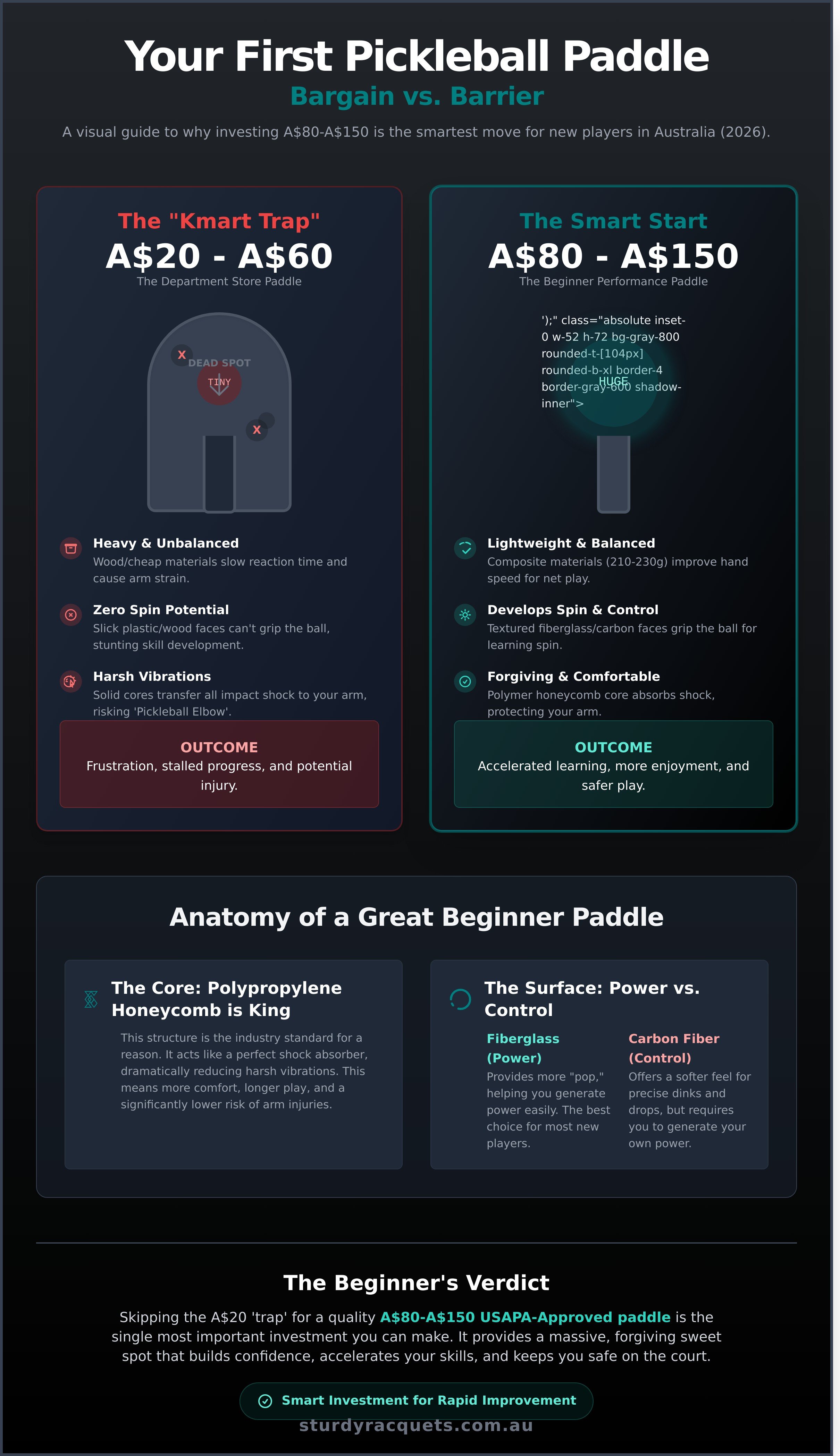
Many new players fall into the 'Kmart Trap'. They see a A$20 wooden paddle and think, "It's just to get started." This is a critical mistake. These paddles are often heavy, poorly balanced, and have zero technology to help you. They actually stunt your skill development by making it harder to control the ball, generate power, and feel your shots. Instead of learning, you end up fighting your own gear.
The sweet spot is what we call the 'Beginner Performance Window'. For those searching for the best pickleball paddles for beginners australia 2026, this is typically a paddle in the A$70 to A$150 price range. In this bracket, you get access to modern materials like polymer honeycomb cores and composite faces without paying for elite-level customisation you don't need yet. A paddle in this window gives you a massive advantage in playability and feel, accelerating your learning curve from day one. Plus, a quality paddle is a smart investment in your health. Its superior vibration dampening significantly reduces the shock transferred to your arm, helping to prevent common injuries like 'Pickleball Elbow'.
Pickleball in Australia: From Backyard to Brooklyn
The sport's journey has been remarkable. From its origins as a backyard game, which you can Learn about the history of pickleball to explore, it has exploded globally. Here in Australia, from local clubs in Brooklyn, Victoria, to new courts in Perth, the community is thriving. This social growth means you'll play on varied surfaces. A well-made paddle performs consistently everywhere. At Sturdy Racquets, we?re passionate about fuelling this local growth and helping every new player start their journey with confidence.
The Hidden Cost of 'Cheap' Gear
So, what makes a A$20 paddle so different from a A$90 one? It comes down to technology and materials that directly impact how you play. Consider these key differences:
- Weight & Speed: Heavy wooden paddles slow your reaction time at the net. A lighter composite paddle (typically 210-230 grams) improves your hand speed, which is crucial for fast kitchen exchanges.
- Spin & Control: Cheap plastic or wood paddles have a smooth, slick face. This makes it nearly impossible to learn the fundamentals of spin. A quality beginner paddle has a textured graphite or fibreglass surface that grips the ball, allowing you to start developing topspin on your drives and backspin on your dinks.
A 'dead spot' in a budget paddle is an area on the face, usually near the edges, where the ball loses almost all its energy upon impact, while a polymer core provides a consistent and forgiving response across a much larger surface.
The Anatomy of a Beginner-Friendly Paddle: What Actually Matters?
Walking into the world of pickleball paddles can feel overwhelming. You'll hear terms like 'thermoformed', 'T700 carbon', and 'foam-injected perimeter'. Forget all that for now. To find the best pickleball paddles for beginners Australia 2026, you only need to focus on four core elements that deliver comfort, control, and confidence from your very first game.
Let's break down what truly makes a fantastic beginner paddle.
- The Core: Polypropylene Honeycomb is King. By 2026, virtually every quality paddle is built around a polypropylene honeycomb core, and for good reason. This structure acts like a perfect shock absorber, reducing harsh vibrations on your arm and elbow. A comfortable paddle means you can stay on the court longer and get a real workout without next-day soreness. It also provides a consistent 'pop', helping you get the ball over the net with less effort.
- The Shape: Go Wide, Not Long. Paddles come in two main shapes: 'Widebody' (the traditional, squarer shape) and 'Elongated' (a longer, narrower design). For new players, a widebody paddle is a non-negotiable advantage. It provides a much larger and more forgiving hitting area, which is essential while you're still developing your hand-eye coordination.
- The Grip: Your Connection to the Paddle. A standard grip length of at least 5 inches (12.7 cm) gives you enough 'real estate' for a comfortable hold. If you're coming from tennis, look for a 5.25-inch handle or longer to easily accommodate a two-handed backhand.
- The Weight: The Australian 'Goldilocks Zone'. We've found the perfect weight class for Australian beginners is between 7.5 and 8.2 ounces (approx. 212 to 232 grams). This range offers enough mass to generate easy power without being so heavy that it causes fatigue or slows down your reaction time at the net. It?s the ideal balance for learning the game.
Understanding the 'Sweet Spot'
The 'sweet spot' is the area on the paddle face that gives you the best response and power with the least vibration. Hitting outside of it can feel dead and send the ball flying off-course. A thicker 16mm core, now the standard for beginner-to-intermediate paddles, significantly enlarges this sweet spot. It creates a 'plush', controlled feel that absorbs impact and forgives off-centre hits, making your learning curve much smoother than with a thinner 13mm paddle.
Surface Materials: Fiberglass vs. Carbon Fiber
The paddle's face material is what dictates its power and control. For a beginner, the choice is simple. A Fiberglass (or Composite) surface is your best friend. It has more flex, which creates a trampoline effect that easily 'pops' the ball over the net. This is perfect when you're focused on just making consistent contact.
Carbon Fiber surfaces offer more stiffness and grit, giving experienced players exceptional control and spin potential. The latest trend in 2026 is 'Raw Carbon Fiber', which provides incredible spin. Is it great? Absolutely. Is it necessary for your first 50 hours of play? Definitely not. Stick with a durable fiberglass face to build your fundamentals first. Once you're confident in your game, you can explore our advanced carbon fiber paddles to take your skills to the next level.
Fiberglass vs. Carbon Fiber: Which Surface Wins for New Players?
Choosing your first paddle surface is a huge decision. It directly impacts how the ball feels, how much power you can generate, and how quickly you develop control. Think of it as choosing your weapon: one is built for explosive power, the other for surgical precision. For new players, the choice between a fiberglass (also called composite) and a carbon fiber face often comes down to your natural athletic style and budget.
Let's break down the real-world differences. A fiberglass paddle face has more flex. On impact, it acts like a tiny trampoline, launching the ball with extra pace. This is fantastic for beginners who are still developing the mechanics for a powerful, deep serve. In contrast, a carbon fiber face is much stiffer. It absorbs more of the ball's energy, meaning the ball stays on the paddle face a fraction of a second longer. This increased "dwell time" gives you a superior sense of control for dinks and placement shots at the kitchen line.
The Power of Fiberglass (Composite)
The 'trampoline effect' from a fiberglass face is a beginner's best friend. It helps you get the ball over the net and deep into your opponent's court, even when your swing isn't perfect. This forgiving power makes the game more fun from day one. Don't mistake fiberglass for being 'cheap'; modern composite paddles are engineered materials that must meet strict standards set by organisations like USA Pickleball. For 2026, fantastic options like the Sturdy Ignite G-100 (A$129) offer a premium honeycomb core with a responsive fiberglass surface, delivering performance well above their price tag.
The Control of Carbon Fiber
If you're coming to pickleball from a sport like tennis or squash, you probably already generate plenty of power. In that case, carbon fiber might be your perfect match. Its rigid surface tames the ball, giving you the pinpoint accuracy needed for a strategic game. This stiffness also dampens vibrations more effectively, making it a top choice for players with a history of tennis elbow or sensitive joints. Advanced 2026 raw carbon friction surfaces now feature a micro-textured weave, allowing the paddle face to grip the ball for longer and generate sensational spin on serves and cuts.
So, which one holds up better? Here in Australia, our gear faces a tough trial by fire (and sun). High-grade carbon fiber is inherently more resistant to scratches from our unforgiving hard courts. However, both quality fiberglass and carbon paddles now come with UV-resistant coatings and durable edge guards. For the price-to-performance ratio in your first 6 to 12 months, fiberglass is the clear winner. A top-tier fiberglass paddle from our 2026 range will cost between A$90 and A$150, giving you all the tools you need to learn the game. This value makes it a leading choice for the best pickleball paddles for beginners australia 2026.
Eventually, you'll know it's time to upgrade. Here are the signs you've outgrown your first paddle:
- Your shots are consistently flying long. You're now generating your own power and the paddle's 'trampoline effect' is too much.
- You crave more feel at the net. You're trying to execute delicate dinks and drops, but the ball feels like it's popping off the face too quickly.
- You want to add serious spin. You're ready to start shaping your shots and need the grip of a raw carbon fiber surface to do it.
When you start feeling these things, you're no longer a beginner. You're an improving player ready to invest in gear that matches your new skills. And we'll be here to help you make that next step.
Top 5 Beginner Pickleball Paddles in Australia for 2026
Getting started in pickleball is exciting, but choosing the right gear can feel overwhelming. Don't worry, we've done the hard work for you. Our team has hit the courts and tested dozens of models to find the absolute best pickleball paddles for beginners Australia 2026. This list focuses on what matters most when you're new: a large sweet spot, great value for money, and technology that helps you learn the game faster.
1. HUSTL Prodigy: The Best All-Rounder
Price: A$99
Best for: Overall value and local support.
Born right here in Australia, the HUSTL Prodigy is a fantastic choice for your first paddle. It's built with a reliable polymer honeycomb core and a forgiving fibreglass face, giving you a perfect blend of control for dinks at the net and enough pop for serves. What we love most is the local advantage. With an Aussie-based company, warranty claims and support are fast and hassle-free. It?s the top value-for-money paddle on our list.
2. The Advanced Core Paddle: Pro-Level Tech on a Budget
Price: Approx. A$120
Best for: Players who want a paddle that will grow with their skills.
This paddle brings elite engineering down to an accessible price point. It features a high-quality polymer core, similar to the advanced technology found in premium-priced professional models. This gives you a consistent feel across the entire face, which is critical for developing muscle memory. It?s a paddle that won?t just get you started; it will help you master the game.
3. Selkirk SLK Latitude 2.0: The Ultimate Forgiveness
Price: Approx. A$110
Best for: Building confidence and consistency.
If you're worried about mishits, the Selkirk SLK Latitude 2.0 is your best friend. Its key feature is a massive sweet spot, thanks to its wide 8.25-inch face. This extra surface area means even off-centre shots feel solid and go where you want them to. Selkirk's G4 Graphite face adds a layer of control, helping you place the ball with confidence from your very first rally.
4. Standout RC2: Learn to Spin Like a Pro
Price: Approx. A$160
Best for: Ambitious beginners focused on developing spin.
For the beginner who's serious about developing an advanced game, the Standout RC2 is a premium starting point. It features an elite-level raw carbon fibre face, a surface material usually reserved for advanced paddles. This gritty texture grabs the ball, making it much easier to learn topspin serves and cutting slices. It's a smart investment that prepares you for the modern, spin-focused style of pickleball.
5. Head Radical Elite: The Tennis Player's Choice
Price: Approx. A$130
Best for: Former tennis or squash players.
Coming from another racquet sport? The Head Radical Elite will feel instantly familiar. It uses Head?s Dynamic Power Shape, which creates a larger sweet spot higher up the face, much like a tennis racquet. The handle is also shaped for an easy transition, and its composite hitting surface provides plenty of power to put away volleys. It?s the smoothest way for racquet sport veterans to get into pickleball.
Aussie Brands vs. Global Giants
Choosing between a local hero like HUSTL and established global leaders can be tough. Supporting an Aussie brand means you get incredible local customer service and speedy warranty support. However, global giants remain the gold standard for USAPA (USA Pickleball) approval, which is essential for tournament play. They invest millions in R&D, ensuring their paddles are at the forefront of technology. Luckily, you don't have to choose just one type. View our full Pickleball Equipment range here to see the best of both worlds.
USAPA Approval: Why It Matters for 2026
Starting in 2026, USA Pickleball is tightening its rules on paddle surface 'grit' and deflection to ensure fair play. Playing with a non-approved paddle in a sanctioned Australian tournament could get you disqualified. You can check if a paddle is legal by looking for the "USAPA Approved" mark on its face. The great news? Every single paddle we stock at Sturdy Racquets is fully vetted to meet current and upcoming 2026 club and tournament standards, so you can buy with total confidence.
Ready to find your perfect match? Explore our hand-picked collection of beginner paddles and start your pickleball journey today!
Beyond the Paddle: Essential Gear to Start Your Pickleball Journey
You've got your new paddle, and you're ready to hit the court. Fantastic! But your paddle is only part of the equation. Equipping yourself with the right supporting gear doesn't just make the game more enjoyable; it keeps you safe, improves your performance, and ensures your equipment lasts. Think of it as the difference between a fun hobby and a frustrating, injury-prone afternoon.
Footwear: The Most Underrated Piece of Gear
Let's get one thing straight: your running shoes are a recipe for disaster on a pickleball court. They are designed for one thing, forward motion. All that soft cushioning is great for jogging in a straight line, but it offers zero stability for the rapid, side-to-side movements pickleball demands. Wearing them is one of the fastest ways to roll an ankle.
Court shoes, on the other hand, are built with reinforced sidewalls for lateral support. They have a lower profile and a more durable outsole designed to grip hard courts during quick pivots and lunges. Top-tier brands like ASICS and New Balance have been perfecting this technology for decades. Investing in a proper pair is the single best decision you can make after choosing your paddle. You wouldn't run a marathon in hiking boots, so don't play pickleball in runners. Ready to protect your ankles and improve your footwork? Explore our Tennis and Court Shoe collection.
After your shoes, consider the ball itself. In Australia, you'll almost exclusively be playing on outdoor courts. This makes your choice simple: you need outdoor pickleballs. Here?s the difference:
- Outdoor Balls: Made from harder, smoother plastic with 40 smaller, drilled holes. This design helps them resist wind and provides a consistent, fast bounce on asphalt or concrete courts.
- Indoor Balls: Made from softer plastic with 26 larger, moulded holes. They are lighter and easier to control but are useless in even a slight breeze.
Grabbing a three-pack of a reputable outdoor ball like the Franklin X-40 is a perfect start. Finally, don't forget protective eyewear to guard against high-bouncing balls and a sturdy court bag to keep your new paddle safe from scratches and dings.
Feeling overwhelmed? That's where we come in. Nothing beats hands-on experience, which is why we invite you to our Brooklyn, Victoria store. You can feel the gear, get expert advice, and even demo paddles. Our team helps players cut through the noise to find the best pickleball paddles for beginners australia 2026 by letting you try them before you buy. It?s the smartest way to invest in your new favourite sport.
Joining the Sturdy Racquets Community
Our Brooklyn store is more than just a shop; it?s a hub for racquet sport enthusiasts. Our team lives and breathes this stuff. We offer professional advice tailored to your game, from choosing your first paddle to advanced customisation services. We're here to help you get the most out of every game. Avoid unforced mistakes-join our community for the latest 2026 gear drops and advice!
Find Your Winning Edge for 2026
Choosing your first pickleball paddle doesn't have to be complicated. Remember the key takeaways from this guide: a larger sweet spot offers more forgiveness, and a fiberglass surface provides the perfect blend of power and control for learning the game. Armed with this knowledge, you're now ready to find the best pickleball paddles for beginners australia 2026 and start your journey with the right gear in hand.
At Sturdy Racquets, we're passionate about helping you succeed. Get expert advice from our team at the Brooklyn, VIC specialist store and shop with confidence, knowing we are an authorized dealer for top brands like JOOLA, Selkirk, and HUSTL. Ready to make your first serve a great one? Shop the best 2026 beginner pickleball paddles at Sturdy Racquets and get fast, Australia-wide shipping on all the latest gear. We can't wait to see you on the court!
Frequently Asked Questions
What is the best weight for a beginner pickleball paddle?
The best weight for a beginner's pickleball paddle is a mid-weight one, typically between 7.3 to 8.4 ounces (207 to 238 grams). This range provides a fantastic blend of power for your shots and control for your dinks, which is perfect when you're just starting out. Heavier paddles can cause arm fatigue, while lighter ones may not offer enough power. A mid-weight paddle is the ideal starting point to develop your skills comfortably.
Are expensive pickleball paddles worth it for beginners in 2026?
No, expensive paddles aren't necessary for beginners. A top-notch beginner paddle generally costs between A$80 and A$150, offering excellent durability and all-around performance. Premium paddles over A$250 often feature advanced carbon fibre surfaces for maximum spin, a feature most new players won't fully utilise. It's smarter to master the basics with a quality, affordable paddle and upgrade once your game progresses.
How long does a beginner pickleball paddle typically last?
A quality beginner pickleball paddle typically lasts between one to three years. Its lifespan really depends on your frequency of play. For someone playing 1-2 times per week, a paddle can easily last over two years. You'll know it's time for a new one when the core softens and you notice "dead spots" or a significant loss of pop. When choosing the best pickleball paddles for beginners australia 2026, we always factor in durability.
Can I use a tennis racquet for pickleball?
No, you cannot use a tennis racquet for pickleball under any official rules. The game's regulations, followed across Australia, require a solid paddle with a non-strung surface. A tennis racquet's strings would generate far too much power and is illegal for tournament or regular play. Using the correct, approved pickleball paddle ensures a fair, safe, and enjoyable game for everyone on the court.
What is the difference between indoor and outdoor pickleball paddles?
There is no official difference between indoor and outdoor pickleball paddles; the difference is in the balls. Outdoor pickleballs are made of harder plastic and have around 40 smaller holes to minimise wind interference. Indoor balls are softer with about 26 larger holes. Your paddle choice should be based on its weight, grip, and material, as any approved paddle works perfectly in both environments.
Is there a difference between a pickleball 'racket' and a 'paddle'?
Yes, the correct official term for the equipment used in pickleball is 'paddle'. While the terms are often used interchangeably, 'racquets' technically have strings, like those used in tennis or squash. Pickleball paddles feature a solid, non-strung hitting surface. Using the term 'paddle' is a small detail, but it's the proper terminology within the sport's community and shows you know your stuff!
Do I need a special grip for my beginner paddle?
Most beginner paddles come with a great all-purpose factory grip, so you won't need a special one right away. These standard grips are designed for comfort and are perfectly suitable for new players. As you play more, you might add an overgrip for around A$5-A$10. An overgrip can enhance tackiness, absorb sweat, or build up the grip size for a more customised and comfortable feel.
Where can I test pickleball paddles in Melbourne?
You can test pickleball paddles at dedicated pickleball clubs and specialist racquet sport retailers across Melbourne. Many local clubs, such as those affiliated with Pickleball Victoria, host demo days where you can try various paddles. Specialist stores, including our own Sturdy Racquets showroom, also offer fantastic demo programs. Trying a paddle before you buy is the best way to ensure it feels right for your playing style.
Share:
How to Choose a Pickleball Paddle: The 2026 Australian Expert Guide
Pickleball Paddle Weight Guide: How to Choose Your Perfect Match in 2026