



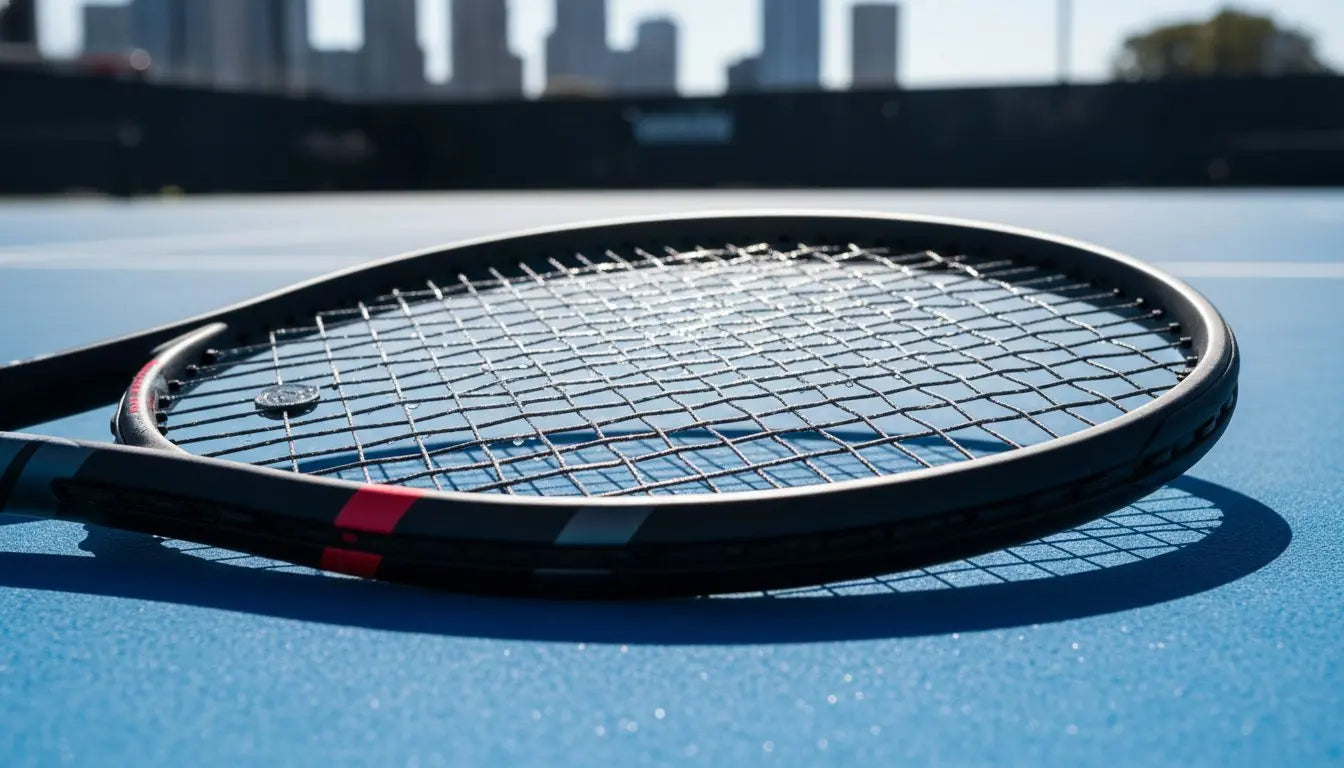
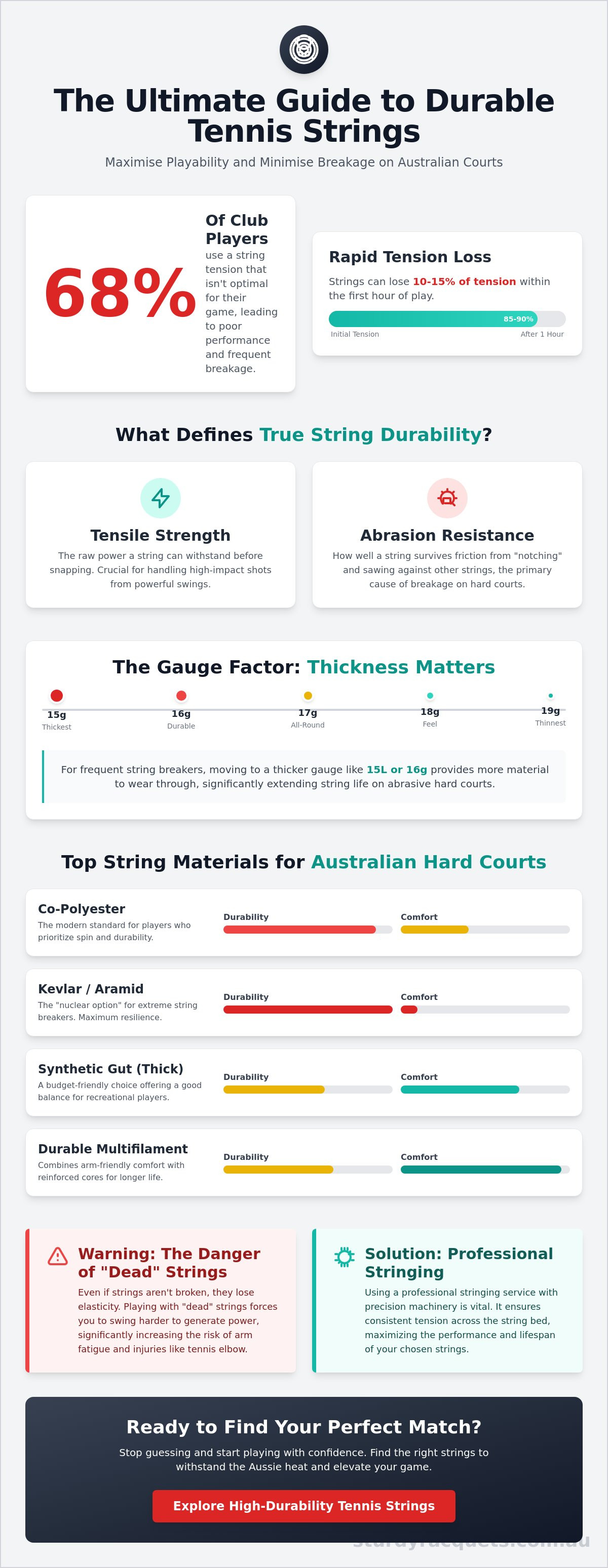
Did you know that according to 2026 industry data, 68% of club players in Australia are currently using a string tension that isn't optimal for their swing? It's a common struggle. You're mid-match on a scorching afternoon and your strings suddenly feel like a trampoline; or worse, they snap just as you're finding your rhythm. We understand the frustration of frequent breakage and the high cost of maintenance, especially since strings can lose 10% to 15% of their initial tension within the first hour of play. Finding the best tennis strings for durability australia shouldn't mean you have to sacrifice your performance or your physical health.
This guide helps you choose strings that withstand Australian hard courts and intense heat without losing their snap. You'll learn how to achieve longer time between restrings and more consistent performance when the temperature climbs. We'll preview the latest trends in high-performance tennis strings, the rise of arm-friendly polyesters, and why using a professional racquet stringing service to adjust your tension is your best defense against the local climate. Let's help you get better value for your money so you can stay on the court longer.
Key Takeaways
- Understand how combining high tensile strength with thicker string gauges creates a better barrier against the abrasive nature of local hard courts.
- Identify the best tennis strings for durability australia that are engineered to resist the rapid tension loss caused by our intense summer sun.
- Learn to spot when "dead" strings are putting your arm at risk. Even if they haven't snapped yet, lost elasticity can lead to injury.
- Discover why using a professional racquet stringing service with precision machinery is vital for maximizing the lifespan of your setup.
- Compare the longevity of modern co-polyesters against budget-friendly synthetic gut options to find your perfect performance match.
What Makes a Tennis String Durable?
Real durability is more than just how long a string stays in one piece. When you're searching for the best tennis strings for durability australia, you're actually looking for a balance between tensile strength and abrasion resistance. Tensile strength refers to how much pulling force the material can handle before it snaps, while abrasion resistance determines how well the string survives the friction of rubbing against itself. While Tennis String Materials like polyester provide incredible strength, they must also be slick enough to slide without wearing down.
Strings don't just snap from a single hard hit; they usually fail because of "notching." This happens at the intersections where the main and cross strings meet. As you hit with spin, the strings move and saw into each other, creating small grooves. Eventually, these notches become deep enough that the string loses its structural integrity and pops. You also need to distinguish between "breakage duration" and "playability duration." A string might stay in your racquet for months without breaking, but if it has lost its elasticity and gone "dead," it's no longer doing its job. Dead strings force you to swing harder, which can lead to fatigue or injury.
To better understand how these factors influence your game, watch this helpful video:
The Role of String Gauge in Longevity
In Australia, we typically use a gauge system ranging from 15 to 19 to measure thickness. A lower number means a thicker string. If you're a frequent string breaker, moving to a 15L or 16g setup is a smart move. These thicker options provide more material to wear through before a failure occurs. A mere 0.05mm increase in gauge significantly reduces friction wear, which can add several hours of play to your high-performance tennis strings. While thinner strings offer more feel, they simply can't compete with the raw longevity of a thicker gauge on a gritty hard court.
Abrasion Resistance and Surface Coatings
Hard courts are incredibly unforgiving on equipment. Unlike clay, which allows for some sliding and energy dissipation, hard courts force your strings to absorb the full brunt of every impact. This is why surface coatings are vital. Many modern strings feature slick, fluorocarbon-based coatings that allow the strings to snap back into place without "sawing" into the adjacent string. This snap-back effect not only generates more spin but also preserves the life of the string by reducing friction heat. High abrasion resistance ensures that your strings maintain their shape and tension even during a grueling three-set match in the midday sun.
Top String Materials for Longevity on Australian Hard Courts
Selecting the right material is the first step in finding the best tennis strings for durability australia. While many players default to whatever is cheapest, the abrasive nature of our local hard courts quickly punishes low-quality options. Polyester and co-polyester strings have become the industry standard for those who break strings frequently. These materials are incredibly stiff and resistant to the "notching" we discussed earlier. Modern performance tennis racquets often feature open string patterns that generate massive spin, but this also increases the friction between strings. Co-polys handle this stress better than almost any other material.
If you're an extreme string breaker who snaps even the toughest polyesters in a few hours, Kevlar or Aramid strings are the "nuclear option." They're nearly impossible to break but are very harsh on the arm. On the other end of the spectrum, thick-gauge synthetic gut (15g or 16g) offers a budget-friendly durability solution for recreational players. For those who need to protect their joints, there are now durable multifilaments that use reinforced cores to offer a blend of comfort and longevity. Consulting a professional stringer is essential when switching to these stiffer materials. They'll help you find a tension that balances your need for durability with the long-term health of your elbow and shoulder.
Polyester and Co-Poly: The Modern Standard
Co-polyesters are specifically engineered to thrive in high-impact environments. In the Australian summer, heat can cause standard nylon strings to become overly elastic and lose their "snap." Co-polys are much more stable in these conditions. They resist the high-impact forces generated by modern baseline play, allowing you to swing with full confidence. You'll get more hours of consistent playability before the strings lose their structural integrity. It's the primary reason why almost every competitive club player in Australia has made the switch to some form of polyester.
Hybrid Setups: The Best of Both Worlds
Hybrid stringing is a major trend in Sydney and Melbourne clubs right now. By pairing durable tennis strings in the mains with a softer multifilament in the crosses, you get the longevity of a poly without the punishing stiffness. The main strings do about 70% to 80% of the work in terms of durability and spin, while the crosses provide the feel and comfort. This setup is perfect for players who want to extend their time between restrings while maintaining a softer feel on impact. If you aren't sure which combination suits your style, you can always contact our expert team for a personalized recommendation.
The Durability vs. Comfort Debate: Avoiding Tennis Elbow
A common concern among local players is that seeking out the best tennis strings for durability australia inevitably leads to a stiff, painful experience for the arm. It's a valid worry. Traditional durable strings were often rock-hard, but the technology has shifted. The real danger to your elbow isn't just the material's initial stiffness; it's playing with strings that have gone "dead." When a string loses its elasticity, it stops absorbing vibration and starts sending those shockwaves directly into your joints. This is why many club players in Melbourne and Sydney experience pain even if they haven't snapped a string in months.
You shouldn't wait for a string to pop before you head for a service. In fact, tennis strings can lose 10% to 15% of their initial tension within the first hour of play. As that tension drops, the string bed becomes unpredictable. You might find yourself swinging harder to compensate for a lack of "pop," which is a recipe for tennis elbow. To keep your performance high and your arm safe, it's vital to restring tennis racquet setups based on your frequency of play rather than waiting for a breakage. Fresh strings provide the necessary cushioning that protects your tendons during high-impact rallies.
Identifying the "Dead String" Danger Zone
How do you know when your durable strings have reached their limit? Look for these signs:
- The ball starts flying long even when you've made a good connection.
- The "ping" sound of your racquet has turned into a dull "thud."
- You feel more vibration in your wrist and forearm than usual.
Australian players should track their hours on court rather than weeks on the calendar. If you play twice a week, your strings might be "dead" long before they show signs of fraying. Playing with inelastic strings forces your body to work harder, increasing the risk of long-term physiological impact.
Selecting Softer Durable Options
You can find "soft" polyesters that offer high abrasion resistance without the arm-shredding stiffness of older generations. These co-polyesters are designed with additives that increase flexibility. A great trick to protect your wrist is to adjust your tension downward. Dropping your tension by 2-4 lbs can offset string stiffness and provide a larger sweet spot. In 2026, the trend is moving toward lower tensions, typically between 48 and 52 lbs, to help players gain depth and better "pocketing" while still enjoying the longevity of a durable string. This small adjustment makes a world of difference for your comfort during those long, hot summer matches.
How to Extend the Life of Your Strings in the Aussie Heat
The Australian sun is the silent killer of your racquet setup. While we've already covered the best tennis strings for durability australia in terms of raw materials, even the most advanced co-poly can't survive poor environmental care. Heat causes significant thermal expansion and contraction. When your racquet sits in extreme heat, the strings expand; as they cool down, they contract. This constant cycle rapidly degrades the molecular structure of the material, leading to a "bagged out" feeling where all control and tension stability is lost. It's a common reason why players find their racquets feeling "dead" even if they haven't played many hours.
Thermal Protection and Storage
Leaving your racquet in a hot car during a Brisbane or Perth summer is a guaranteed way to kill your strings. Interior car temperatures can easily climb past 60 degrees Celsius, which is enough to ruin a fresh restring before you even hit a ball. Using quality tennis bags with dedicated thermal-lined compartments is the most effective defense. These specialized tennis bags act as a climate-controlled environment for your gear, shielding it from the harshest temperature spikes. In coastal cities like Sydney, humidity adds another layer of complexity. High moisture levels can cause natural gut to swell and lose tension much faster than co-polyester strings, making material choice even more critical for local conditions.
Maintenance Tips for Hard Court Players
Hard courts in Australia absorb massive amounts of UV radiation, often reaching surface temperatures significantly higher than the ambient air. This radiant heat directly affects your string bed during play, accelerating the loss of elasticity. You also need to manage court grit. Small particles of sand and dust from the court surface get trapped between the strings and act like sandpaper, speeding up the "notching" process. A simple habit of wiping your strings with a clean cloth after a session can remove this abrasive debris. For players looking to maximize longevity, string savers are a great tool. These small plastic inserts placed at the main string intersections prevent the strings from sawing into each other, effectively doubling the life of your setup on gritty courts.
If you're noticing your tension dropping faster than it should during the summer months, book a professional assessment with our team to find a heat-resistant string setup.
Choosing the Right Stringing Service in Melbourne and Beyond
Selecting the best tennis strings for durability australia is only half the battle. How those strings are installed is just as important for their lifespan. Many players don't realize that the quality of the stringing machine directly impacts string health. High-quality professional racquet stringing services use electronic constant pull machines that are calibrated for extreme precision. Unlike older manual crank machines, which can pull tension inconsistently, electronic machines ensure every single string is at the exact poundage required. This consistency prevents uneven stress on the string bed, which is a major cause of premature breakage.
At our Brooklyn, Victoria location, we focus on this technical precision to help players maximize their equipment. Local knowledge is vital because we understand how the Australian climate affects different materials. A stringer who knows the grit of a Melbourne hard court or the humidity of a Brisbane afternoon will make different recommendations than someone looking at a computer screen. This human element ensures your racquet is prepared for the specific conditions you'll face on match day.
In-Store Expertise vs. DIY Stringing
DIY stringing has its place, but it often lacks the consistency needed for long-term durability. If your tension varies across the racquet, certain strings will bear more of the load during high-impact shots. This leads to faster "notching" and snapping. Professional stringers provide a level of machine calibration that DIY setups simply can't match. We support players across Melbourne, Sydney, and Brisbane by offering advice that goes beyond the basics. We can spot early signs of frame fatigue or grommet wear that might be "sawing" through your strings, saving you money on frequent restrings in the long run.
Customising Your Tension for Durability
A professional stringer will adjust your setup based on your racquet's head size and your personal playing style. Larger racquet heads have longer string lengths, which means they stretch more on impact. This extra movement increases friction and heat. We can help you find a tension that balances this movement without making the string bed feel like a board. Whether you're a baseline grinder or a serve-and-volley specialist, your tension should reflect how you treat the ball. Visit us for expert racquet maintenance and stringing to ensure your gear is optimized for the best tennis strings for durability australia and ready for the 2026 season.
Dominate the Court with a Setup That Lasts
Finding the best tennis strings for durability australia requires a strategic approach that goes beyond just picking the thickest gauge. You've seen how modern co-polyesters resist the abrasive grit of local hard courts and why protecting your racquet from the intense summer heat is vital for maintaining tension. By balancing material strength with the right tension adjustments, you can enjoy a setup that lasts longer without putting your arm health at risk.
Ready to upgrade your game? Whether you need expert in-store stringing in Brooklyn, Victoria, or you're looking for nationwide shipping on the latest gear, we're here to help. Our team is proud to be trusted by local Melbourne tennis clubs for our technical expertise and commitment to player performance. You can reach out to our professional stringing team to discuss a custom setup tailored to your swing and local playing conditions. Let's get your racquet match-ready so you can step onto the court with total confidence and focus on your next win.
Frequently Asked Questions
How long should tennis strings last for an average club player in Australia?
Most club players find their strings last between 10 and 20 hours of match play before losing significant performance. In our local climate, strings can lose 10% to 15% of their tension within the first hour of hitting. While they might not snap immediately, the loss of control often happens long before the physical break. Tracking your hours on court is the most reliable way to maintain a consistent game.
Does a thicker string gauge really provide more durability?
Thicker gauges provide significantly more longevity because there's more material to resist the notching effect at the intersections. Selecting a 15L or 16g option is often the best choice when looking for the best tennis strings for durability australia. A small increase of just 0.05mm in thickness can drastically reduce friction wear. This extra mass helps the string bed withstand the heavy impact of modern power games on abrasive surfaces.
Why do my strings break more often in the summer?
High summer temperatures cause strings to expand and lose their elastic memory faster. As the material softens in the heat, the strings move more across each other, which accelerates friction wear and notching. The ball also travels faster through the hot air, often leading players to swing harder. This combination of environmental stress and increased impact force is why strings seem to pop more frequently during January and February.
Is it better to use a hybrid string setup for durability?
A hybrid setup is a fantastic way to get the durability of polyester without the harshness of a full bed. By putting a durable co-poly in the main strings and a softer synthetic gut in the crosses, you get the best of both worlds. The mains provide the abrasion resistance needed for longevity; the crosses offer the feel and comfort. It's a popular choice for club players across Sydney and Melbourne who want performance and value.
How can I tell if my strings are "dead" before they break?
You'll notice your strings are dead when the ball starts flying long or you lose that satisfying snap on your shots. Dead strings lose their ability to snap back into place, which reduces spin and control. You might also hear a duller thud rather than a crisp ping when you hit the sweet spot. If you find yourself working harder to get the ball deep, it's a clear sign the elasticity is gone.
Will durable strings cause tennis elbow?
Durable strings aren't the direct cause of tennis elbow, but playing with them once they've lost their elasticity is. Stiff polyester strings can be harsh if you string them too tight or leave them in the racquet for too long. To protect your arm, we recommend dropping your tension by 2 to 4 lbs when using durable materials. This simple adjustment provides the necessary cushioning while still giving you the longevity you need.
How often should I restring my racquet if I play twice a week on hard courts?
If you play twice a week, you should aim to restring every 4 to 6 weeks to maintain optimal performance. Waiting for the strings to break often means you're playing with a dead string bed for several weeks. Consistent maintenance ensures you're always using the best tennis strings for durability australia at their peak playability. Fresh strings help prevent the inconsistent ball flight that leads to technical errors and physical strain during long matches.
Does the court surface in Australia affect string life?
Australian hard courts are notoriously abrasive and act like sandpaper on your string bed. The gritty surface particles get trapped between the strings, accelerating the sawing motion that leads to breakage. This is why strings typically last much longer on grass or clay courts. If you play primarily on hard courts, choosing strings with high abrasion resistance and slick surface coatings is essential for extending the life of your racquet setup.
Share:
Pickleball Shoes vs Tennis Shoes Difference: A 2026 Court Guide
The Benefits of 17 Gauge Tennis String: Why Thinner is Better in 2026