



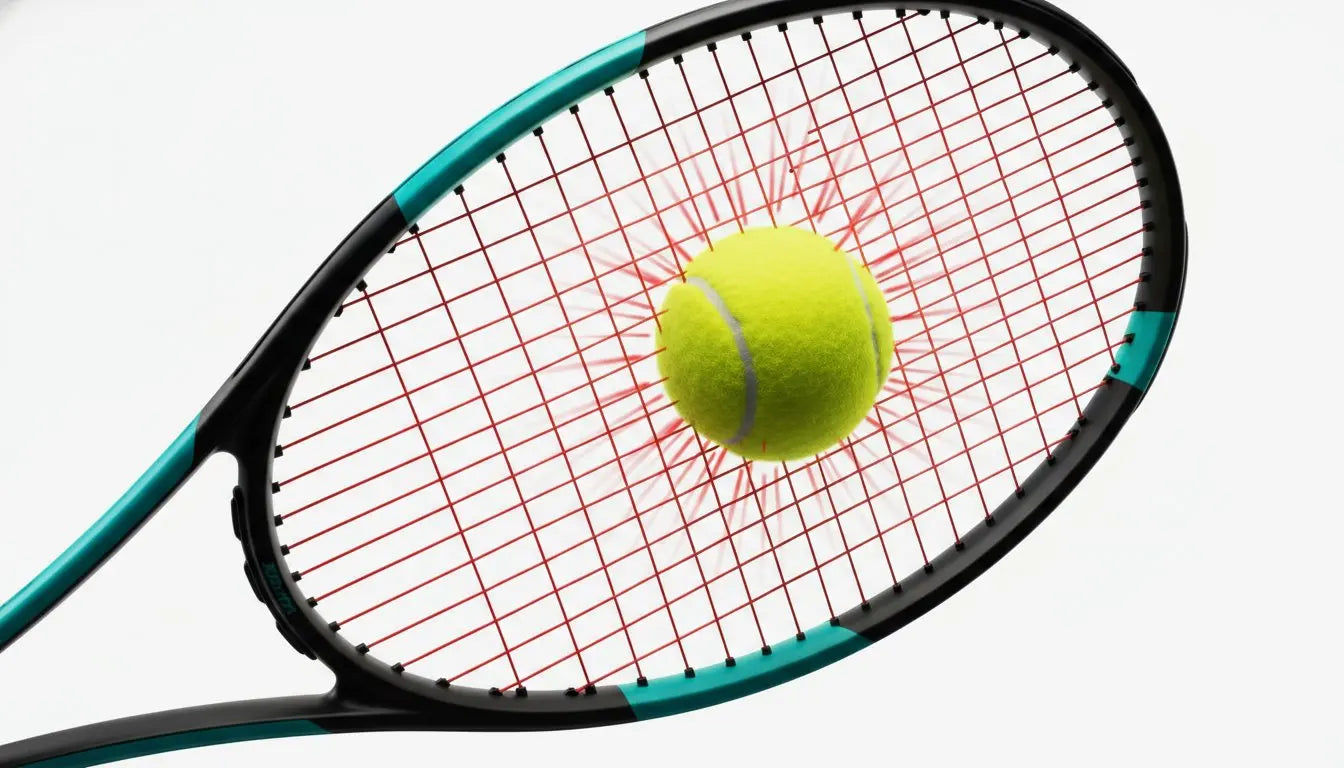
What if the secret to hitting with more "bite" isn't a brand new racquet, but a string that's thinner than a paperclip? You've likely felt that frustrating sensation where the ball slides off your strings instead of dipping safely inside the baseline. Understanding the benefits of 17 gauge tennis string can solve this, as thinner strings provide the snap-back you need for modern topspin. It's tough to play your best when your equipment feels stiff or gives you vague feedback, and we know that arm fatigue can turn a fun Saturday match into a chore.
The good news is that switching to this 1.25mm standard unlocks incredible "pocketing" for those delicate touch shots at the net. This guide explores how to maximize your power and comfort while navigating the common trade-offs in durability. You'll also learn how professional racquet stringing can help you find the perfect balance between control and feel for your next match. Whether you're looking for softer polyester or a crisp synthetic gut, choosing the right gauge is the fastest way to upgrade your performance on the court.
Key Takeaways
- Learn why the 1.25mm diameter has become the modern performance standard for players seeking a perfect balance of power and control.
- Discover the performance benefits of 17 gauge tennis string, including the "snap-back" effect that generates significantly more topspin.
- Understand how increased ball pocketing enhances your feel at the net and provides better feedback during high-intensity rallies.
- Identify whether a thinner gauge suits your specific playing style and how your racquet's string pattern influences your final choice.
- Get expert tips on optimizing your setup, including why a slight tension drop is recommended when switching to thinner strings.
Defining the Sweet Spot: What Makes 17 Gauge Tennis String Unique?
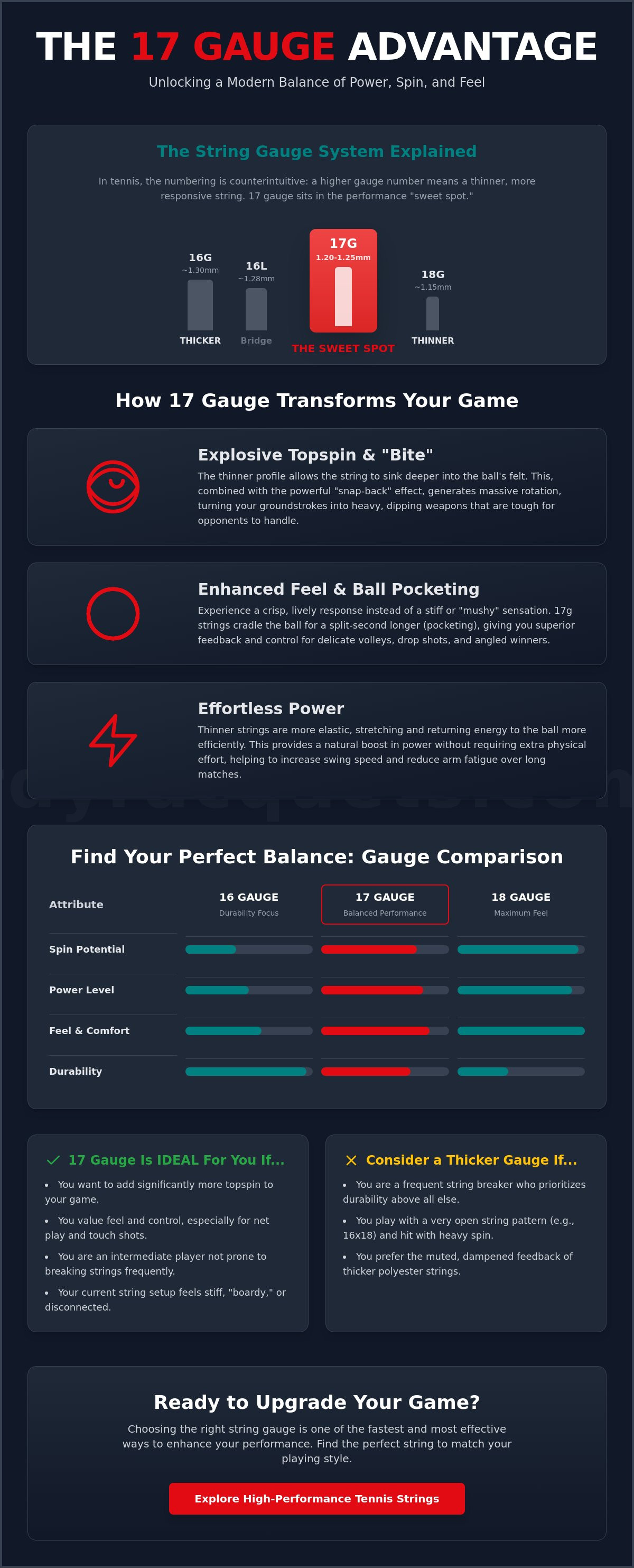
Understanding how string thickness works is the first step to mastering your equipment setup. In the tennis world, the numbering system is counterintuitive because higher numbers actually signify thinner material. This inverse relationship is why a 17 gauge string is significantly thinner than a 16 gauge, which is the traditional standard for durability. To understand the technical history of these measurements, you can explore the evolution of Tennis string gauge standards. One of the primary benefits of 17 gauge tennis string is that it sits in the "Goldilocks zone" of performance. It offers a more responsive feel than a 1.30mm string while maintaining better tension stability than ultra-thin 1.15mm options.
A standard 17 gauge string typically measures between 1.20mm and 1.25mm in diameter. This specific size has become the most popular choice for modern intermediate players who want a professional feel without breaking strings every hour. Essentially, 17 gauge represents the optimal balance between the heavy-duty durability of 1.30mm strings and the extreme, short-lived playability of 1.15mm alternatives.
To better understand this concept, watch this helpful video:
The Physics of String Diameter
The way a string interacts with the ball depends heavily on its surface area. Thinner strings have a smaller profile, which allows them to sink deeper into the felt of the tennis ball. This creates a "bite" that generates massive rotation for topspin players. Maximizing the benefits of 17 gauge tennis string also involves understanding elastic deformation. Thinner strings stretch and snap back more efficiently than thicker variants, providing a boost in power without needing extra effort from your arm. Because there's less material, you also reduce aerodynamic drag, helping you maintain a faster swing speed through the air.
Metric vs. Imperial: Navigating the Gauge System
Retailers and manufacturers often label products differently depending on their home region. While the Australian market usually refers to gauges, European brands often stick to millimetres. A true 17 gauge string typically falls between 1.20mm and 1.25mm. You'll often see "16L" on some packaging, which stands for "16 Light." This serves as a bridge between 16 and 17 gauge, usually measuring around 1.28mm. To ensure you're getting the right fit for your intermediate tennis racquets, always check the millimetre measurement printed on the back of the packet. Understanding these small differences ensures you don't accidentally buy a thicker string that dampens your feel on the court. Choosing from a wide range of high-quality tennis strings allows you to experiment until you find the exact diameter that matches your swing speed.
Performance Advantages: How 17 Gauge Strings Transform Your Game
When you step onto the court, the feedback you get from your racquet determines how much confidence you have in your shots. One of the primary benefits of 17 gauge tennis string is the immediate sense of connection to the ball. Unlike thicker 16 gauge options that can feel like hitting with a stiff board, 17 gauge strings provide a lively, crisp response. This enhanced feedback reduces that "mushy" sensation often found in thicker polyester setups, allowing you to feel exactly where the ball is on the string bed.
This liveliness comes from the "snap-back" effect. Because thinner strings have a smaller surface area, they experience less friction where they intersect. This allows the mains to slide out of position upon impact and then snap back into place with explosive force. This rapid movement is what generates heavy rotation, turning a standard groundstroke into a dipping ball that's difficult for your opponent to handle. You'll also notice a significant increase in ball pocketing. This is the feeling of the ball being cradled by the strings for a fraction of a second longer, which gives you better directional control on every swing.
From a physics perspective, thinner strings have a higher coefficient of restitution. This means they return more energy to the ball rather than absorbing it into the frame. The result is a noticeable increase in power potential without requiring you to swing harder. It's an efficient way to get more depth on your shots while maintaining a comfortable hitting experience.
Maximum Spin Potential and Ball Bite
Thinner strings are a game-changer for players using intermediate tennis racquets. These racquets often have open string patterns that perfectly complement the extra "bite" of a 1.25mm string. When the string digs into the ball's fuzz, it creates the high RPMs needed to keep aggressive shots inside the baseline. Most heavy topspin players prefer this gauge because it provides the perfect mechanical advantage for modern, vertical swing paths.
Improved Comfort and Arm Health
If you've ever dealt with arm fatigue or tennis elbow, your string gauge might be the culprit. Thicker strings are inherently stiffer and transmit more vibration and impact shock directly to your joints. Opting for high-quality tennis strings in a 17 gauge format can provide a much softer feel. This thinner profile allows you to drop your tension by a few pounds without losing total control, further protecting your arm. If you're struggling to find the right balance of comfort and performance, you can always reach out for expert racquet advice to help refine your setup.
The Durability vs. Playability Trade-off: 17g vs. 16g and 18g
Choosing the right string thickness is always a game of compromise. While a 16 gauge (1.30mm) string offers the most longevity for chronic string breakers, it often sacrifices the very "bite" that modern players crave. On the other end of the spectrum, 18 gauge (1.15mm) strings provide an almost addictive level of touch and spin, but they can snap in a single intense session. This is why the benefits of 17 gauge tennis string are so compelling for the average player. At 1.25mm, it provides a "Goldilocks" experience that roughly 90% of Australian club players find ideal for their weekly matches.
Economic factors play a role here too. You have to weigh the frequency of restringing your tennis racquet for optimal feel against the performance gains of thinner material. If you play twice a week and don't break strings every month, 17 gauge is your best bet. It maintains its "bounce" and elasticity far longer than ultra-thin variants while feeling much more responsive than thicker, dead-feeling alternatives. It hits that sweet spot where you don't feel like you're wasting money, but you aren't compromising on your game either.
Tension maintenance is another critical factor. Thinner strings have less physical material to resist the constant stress of impact. This means they generally lose their "spring" faster than a thick 16 gauge. However, because 17 gauge is the industry standard, modern manufacturing has improved its ability to hold tension compared to the strings of a decade ago. It provides a predictable decline in playability rather than a sudden loss of control.
Durability: When Does 17 Gauge Break?
Not all string breakage is equal. Heavy spin hitters often experience "notching," where the main strings saw into the cross strings during every hit. If you play in high humidity or use a racquet with an open string pattern, this friction increases. Flat hitters can often use 17 gauge for several months because they don't move the strings as much. One of the hidden benefits of 17 gauge tennis string is that it usually provides a warning by notching deeply before it actually snaps, so you aren't often left stranded mid-match without a backup.
Playability: The 18 Gauge Temptation
It's easy to be tempted by the razor-thin profile of 18 gauge (1.15mm). These strings are incredibly lively, but that energy can be difficult to harness in modern performance tennis racquets. The biggest downside is the rapid tension drop. Because there is less material to hold the load, 18 gauge strings tend to "go dead" much faster than 17 gauge. Unless you are a touch-oriented player who prioritizes feel above all else, the 1.25mm standard remains the smarter choice for consistent performance week after week.
Is 17 Gauge Right for You? Matching String to Your Playing Style
Finding your perfect string setup isn't a one-size-fits-all process. While we've discussed the technical benefits of 17 gauge tennis string, the real magic happens when you match that 1.25mm diameter to your specific player archetype. If you're an aggressive baseliner who thrives on heavy groundstrokes, you'll appreciate the extra snap-back. However, if you're a touch volleyer who lives at the net, the increased ball pocketing will give you the "feel" needed to drop the ball short with precision. Your racquet's head size also plays a role; larger heads create longer string mainlines that stretch more, making a thinner gauge feel even more elastic and powerful.
Your racquet's string pattern is the most critical technical factor in this decision. If you play with a dense 18x20 pattern, a thick 16 gauge string can often make the racquet feel "dead" or overly stiff. Switching to a 17 gauge string opens up the feel of a dense pattern, making it more forgiving on off-center hits. For those using a wide 16x19 pattern, a 17 gauge string will move much more freely. This is a dream for spin production, though you should be prepared for the strings to move and notch slightly faster than they would in a tighter bed.
Junior players should almost always lean toward thinner gauges. Because their muscles and joints are still developing, the reduced impact shock of a 1.25mm string is vital for long-term arm protection. It allows younger athletes to develop proper swing mechanics without fighting the harsh vibrations of a stiff, thick string bed.
The Spin Doctor: Baseliners and 17 Gauge
For the modern baseliner, the benefits of 17 gauge tennis string are largely centered on the launch angle. Thinner strings allow the ball to sink deeper into the bed, which naturally launches the ball at a higher trajectory. This extra height helps your shots clear the net with a safer margin before the topspin kicks in to bring the ball down. In the high-heat conditions often found across Australia, polyester strings can lose their "crispness" quickly. Opting for a 17 gauge poly allows you to maintain a lively feel even when the court temperatures rise, provided you adjust your tension slightly to compensate for the heat.
The Arm-Conscious Player
If you're a senior player returning to the game or someone prone to tendonitis, a 17 gauge multifilament is the gold standard for comfort. It mimics the softness of natural gut while remaining more budget-friendly. We often suggest a full-body approach to court comfort; pairing these thin, soft strings with comfortable tennis shoes creates a comprehensive strategy to reduce impact on your joints from the ground up. If you aren't sure which material will best suit your arm health, you can always get expert racquet advice to help you build the most comfortable setup possible.
Professional Stringing in Australia: Optimising Your 17 Gauge Setup
To truly unlock the benefits of 17 gauge tennis string, the quality of the installation is just as important as the string itself. Thinner strings are more sensitive to tension fluctuations during the stringing process. Using a professional electronic constant-pull machine is essential to ensure that every string is pulled to the exact kilogram requested. Unlike older manual crank machines, these professional tools compensate for the "creep" or stretch of the 1.25mm material. When you make the switch from a thicker 16 gauge, we recommend dropping your tension by 2 to 3 lbs. This adjustment accounts for the increased elasticity of the thinner profile, ensuring you don't end up with a string bed that feels like a wooden board.
Ask your stringer about a "pre-stretch" for your 17 gauge setup. This process involves pulling the string slightly beyond the target tension before releasing it back to the set weight. It's a fantastic way to settle the material and reduce the initial tension drop that happens in the first 24 hours. Local expertise in cities like Melbourne or Sydney is invaluable here. Professional stringers in these hubs understand how different brands of 1.25mm polyester react to the local climate, helping you get the most life out of your restring.
Australian Climate and String Tension
The Australian summer presents a unique challenge for thinner strings. High on-court temperatures cause the molecular structure of the string to relax, which leads to "bagging out" or a loss of control. If you play in the intense heat of Brisbane or Perth, you might need to string 1 to 2 lbs tighter than a player in the cooler Melbourne climate to compensate for this thermal expansion. Storing your gear in insulated tennis bags is a non-negotiable step to protect your investment. Leaving a freshly strung 17 gauge racquet in a hot car can ruin the tension in just a few hours, turning a high-performance setup into a mushy mess.
Customising Your Hybrid Setup
If you love the feel of 17 gauge but find you're breaking it too quickly, a hybrid setup is the perfect solution. Many club players use a 16 gauge polyester in the mains for durability and a 17 gauge synthetic gut or multifilament in the crosses for enhanced feel. This combination allows you to enjoy the benefits of 17 gauge tennis string where it matters most for touch shots and volleys. Before you head in for your next professional racquet stringing session, use this checklist:
- Check your grommets for sharp edges that might snap thin strings.
- Decide if you want a full bed or a hybrid mix.
- Confirm your tension drop of 2 to 3 lbs.
- Ask for a pre-stretch if using multifilament.
Take Control of Your Performance on Court
Transitioning to a thinner gauge is one of the most effective ways to transform your game. By embracing the 1.25mm standard, you gain access to the snap-back and ball bite necessary for heavy topspin. We've explored how these strings improve comfort for your arm and provide the crisp feedback that thicker alternatives often lack. Understanding the benefits of 17 gauge tennis string means you're no longer playing with equipment that holds you back. Instead, you're using a setup optimized for your specific swing and the unique Australian climate.
Our team provides expert in-store stringing in Melbourne for those who want a precision install. If you're elsewhere in the country, we offer Australia-wide shipping for all premium strings to keep your racquet in peak condition. We're proud to be a hub for a passionate community of racquet sports enthusiasts who are genuinely invested in your success. It's time to feel the difference for yourself. Book your professional racquet restringing service today and step onto the court with total confidence. We can't wait to see your game reach new heights!
Frequently Asked Questions
Is 17 gauge tennis string better than 16 gauge?
It depends on your priorities, but 17 gauge is generally better for players who want more spin and a softer feel. While 16 gauge strings are thicker and more durable, they often feel stiff and unresponsive. Choosing a 1.25mm string provides a lively response that helps you feel the ball better on every shot, making it the preferred choice for most modern club players.
How long does 17 gauge tennis string usually last?
Most intermediate players find that 17 gauge strings last between 10 and 20 hours of actual court time. If you hit with heavy topspin or use a racquet with a very open string pattern, you might snap them sooner due to increased friction. Flat hitters can often use them for several weeks before the tension drop makes a restring necessary for performance.
Does a thinner gauge string provide more power or control?
Thinner strings primarily provide more power and spin because they are more elastic than thicker variants. This elasticity allows the string bed to act like a trampoline, returning more energy to the ball. While power increases, you also gain a different type of control through better "ball pocketing," which helps you guide the ball with more precision during delicate touch shots.
Is 17 gauge string good for players with tennis elbow?
Yes, switching to a thinner gauge is a smart move for anyone struggling with arm pain. The benefits of 17 gauge tennis string include a more flexible hitting surface that absorbs more impact shock than a thick, rigid 16 gauge string. This reduction in vibration means less stress is transmitted to your tendons, allowing for a much more comfortable experience during long matches.
Should I lower my tension when switching to a 17 gauge string?
You should drop your tension by 2 to 3 lbs when moving from a 16 gauge to a 17 gauge setup. Because the thinner material is naturally more elastic, it can feel surprisingly tight if you stay at your old tension. This small adjustment ensures you maintain a comfortable "sweet spot" and fully enjoy the added power that a thinner diameter offers.
What is the difference between 17 and 17L gauge?
The "L" in 17L stands for "Light," which indicates the string is slightly thinner than a standard 17 gauge. While a typical 17 gauge measures 1.25mm, a 17L version usually sits around 1.20mm. This offers even more spin and feel, but it comes with a noticeable drop in durability, making it a niche choice for players who don't break strings often.
Which string pattern works best with 17 gauge strings?
Dense string patterns like 18x20 benefit the most from thinner strings because they prevent the racquet from feeling too stiff or "dead." However, open 16x19 patterns maximize the spin benefits of 17 gauge tennis string by allowing the strings to move and snap back more freely. Both setups work well; it just depends on whether you prioritize racquet feel or raw rotation.
Can I use 17 gauge strings in a high-tension racquet setup?
You can use them at higher tensions, but you'll likely see a decrease in the string's lifespan. High tension puts significant stress on the thinner 1.25mm material, which can lead to premature breakage, especially during off-center hits near the frame. If you prefer a very tight string bed, you might find that a 16L gauge provides a better balance of tension and durability.
Share:
Best Tennis Strings for Durability in Australia: 2026 Player Guide
DIY Tennis Racquet Grip Replacement: The Complete 2026 Pro Guide