



Most players think they should copy the exact string tension used by the pros, but that is often the quickest way to end up with a sore elbow and inconsistent depth. Professional customisation isn't about mimicking a superstar's setup; it's about correcting your racquet's factory flaws to match your unique swing. If you have ever felt your frame twisting on impact or struggled with a lack of control, the secret usually lies in the science of custom tennis racquet stringing. While ATP players at the Houston 2026 tournament generally prefer tensions around 45 to 50 lbs, your own ideal setup depends entirely on your mechanics and comfort.
We know how frustrating it is to feel like your gear is working against you rather than with you. You deserve a setup that offers that elusive perfect feel and helps you generate effortless spin. This guide will show you how to master the technical side of your equipment to unlock your full potential on the court. We will look at how to choose the best tennis strings for power and control, the impact of weight customisation, and the precise steps required to ensure your backup frames feel exactly like your primary racquet.
Key Takeaways
- Stop settling for generic factory setups and discover how tailored materials and gauges can transform your court performance.
- Master the "Tension Rule" to find your perfect balance between power and precision through professional custom tennis racquet stringing.
- Understand the difference between static weight and swingweight to ensure your racquet feels light in your hand but stable on impact.
- Learn how to adjust your racquet's balance point to suit your specific playing style, from baseline power to quick net reflexes.
- Find out how matching multiple racquets to identical specifications can eliminate inconsistency and boost your confidence during matches.
What is Custom Tennis Racquet Stringing and Why Does It Matter?
Custom tennis racquet stringing is the process of fine-tuning every variable of your setup to match how you actually play. It is the difference between wearing a tailored suit and a "one size fits all" poncho. By selecting a specific material, tension, and gauge, you can compensate for a lack of power or add control to a wild swing. This tailored approach ensures that your equipment is an extension of your arm rather than an obstacle you have to overcome.
Many players start their journey with "off-the-shelf" frames, but these factory strings are often the weakest link in your game. Understanding Tennis string materials and properties is the first step toward better performance. When you choose a custom setup, you are not just picking a string; you are calibrating your racquet to respond predictably every time you make contact with the ball.
To better understand the precision involved in a professional setup, watch this helpful video on a key technical detail of the process:
Custom Strings vs. Factory Pre-Strung Racquets
Factory strings often sit in shipping containers or warehouses for months before they reach a store. During this time, they lose their "snap" and elasticity. Most performance tennis racquets are sold unstrung for this exact reason. Manufacturers know that a generic nylon string won't do justice to a high-end frame. A custom setup ensures your tension is fresh and calibrated specifically for your swing speed. This eliminates the "dead" feeling common in pre-strung racquets and provides much better shock absorption for your arm.
The Role of the Professional Stringer
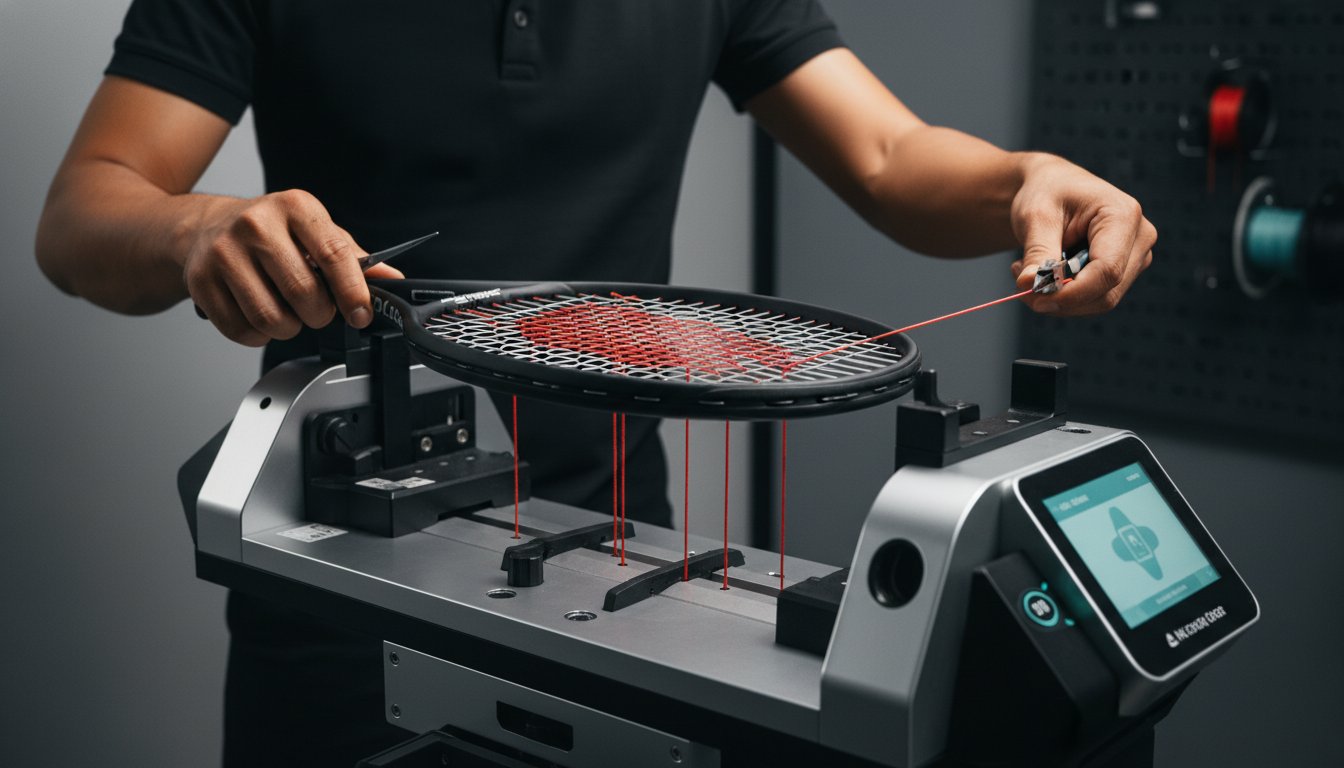
A great stringer does more than just pull tension; they act as a mechanic for your game. By looking at where your strings are fraying or notched, a professional can diagnose if you need more durability or if your tension is too high for your comfort. Consistency is the most important factor here. Using the same technician and a high-end machine ensures that your preferred tension feels exactly the same every single time you step onto the court. This consultative service moves you beyond simply picking a colour and helps you find a genuine solution for your performance goals. Plus, a pro can help with "matching" your racquets. Because manufacturing tolerances allow for slight weight variations, a professional can customise two seemingly identical frames to feel and swing exactly the same way.
The Science of String Selection and Tension Calibration
Understanding the physics behind your strings is just as important as perfecting your technique. While most players focus on the frame, the strings are the only part of the equipment that actually touches the ball. Recent scientific research on string tension highlights how even small adjustments can radically change ball speed and dwell time. This is the core of custom tennis racquet stringing: finding the exact combination of material and tension that complements your swing rather than fighting against it.
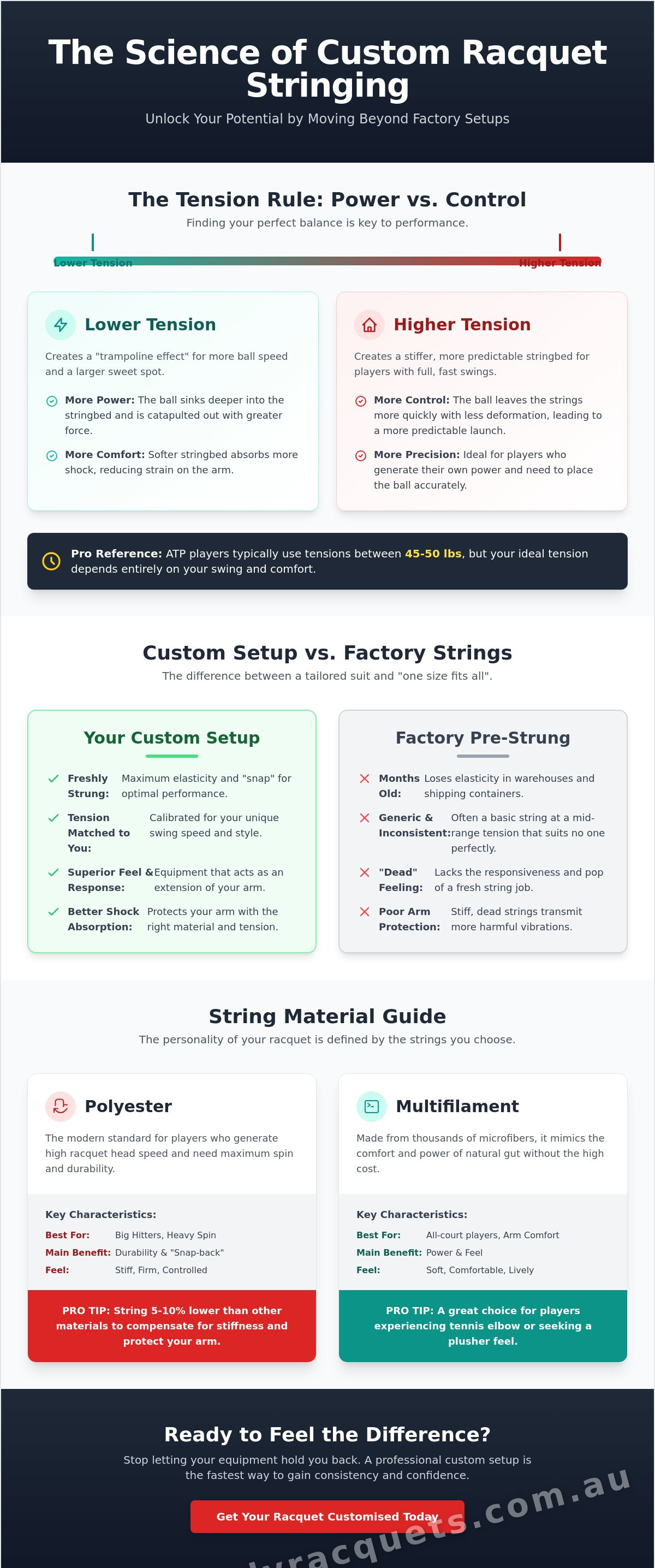
The "Tension Rule" is your primary guide. Lower tension provides more power and comfort due to the "trampoline effect," where the strings stretch more and catapult the ball back. Higher tension offers more control and precision because the string bed is stiffer, allowing for a more predictable launch angle. If you are currently struggling with depth, dropping your tension by just 3 lbs can make a world of difference.
Choosing the Right Material for Your Game
Material choice defines the personality of your racquet. Polyester is the go-to for big hitters who want maximum durability and "snap-back" for heavy spin. However, polyester is stiff. We recommend stringing it at a 5% to 10% lower tension than synthetic gut to protect your arm. Multifilament strings are perfect for those seeking comfort, as they use thousands of microfibers to mimic the feel of natural gut at a lower price point. For the ultimate experience, natural gut remains the gold standard for feel and tension maintenance, even in 2026. Many players now opt for a hybrid setup, using polyester in the mains for spin and natural gut in the crosses for comfort, getting the best of both worlds.
Tension and the Australian Climate
The Australian climate presents unique challenges for your gear. In cities like Melbourne or Brisbane, the intense summer heat causes strings to expand and "bag out" much faster than in cooler regions. This rapid tension loss can make your racquet feel mushy and unpredictable. If you play outdoors in the sun, you might need to increase your tension by 1 to 2 lbs to compensate for the heat. A reliable rule of thumb for maintenance is to restring your racquet as many times a year as you play per week. If you hit the courts three times a week, aim for at least three restrings a year to keep your equipment performing at its peak.
Optimising for Comfort and Power
Finding the sweet spot is essential when transitioning to intermediate tennis racquets. These frames are often stiffer, so using high-quality tennis strings with better vibration dampening is crucial for preventing arm pain. String gauge also plays a role; a thinner 17g string offers more spin and feel but breaks easier, while a thicker 16g string provides better durability for heavy hitters. If you want to dial in your exact specifications, you can speak with our expert team to find the perfect calibration for your next match.
Beyond the Strings: Customising Weight, Balance, and Swingweight
While your choice of strings provides the engine for your game, the racquet's physical specifications act as the chassis. Professional custom tennis racquet stringing works most effectively when the frame itself is calibrated to your physical strength and swing path. Many players struggle with a racquet that feels too "whippy" or one that twists when they face a heavy server. These issues are rarely solved by strings alone. They require a deeper look at weight, balance, and swingweight.
Static weight is the number you see on a scale. Swingweight is far more critical for your performance on the court. It measures the resistance of the racquet as you move it through the air. A racquet with a high swingweight offers more "plow-through" on groundstrokes but can feel sluggish at the net. This is where research on racket customization becomes essential. It details how adding even a few grams of weight to specific areas can shift the balance point and change how much power you can generate without swinging harder. By placing silicone or lead weight in the handle, you can increase stability without making the racquet feel too heavy to swing.
Lead Tape Placement Guide
Using lead or tungsten tape from our range of tennis racquet accessories allows for precise adjustments. Here is how placement affects your game:
- 12 o'clock: Placing weight at the very top of the hoop increases swingweight. This is perfect for baseline players who want more punching power on their shots.
- 3 & 9 o'clock: Adding weight to the sides of the frame enhances torsional stability. This prevents the racquet from twisting in your hand during off-centre hits.
- 6 o'clock: This adds mass to the frame with minimal impact on the overall balance, making the racquet feel more solid overall.
Matching Racquet Pairs
Manufacturing tolerances mean that two performance tennis racquets of the exact same model can vary by up to 10 grams. For a competitive player, this difference is massive. If you break a string during a match and switch to your backup, it needs to feel identical. The customisation process involves measuring the static weight, balance, and swingweight of both frames. We then add internal weights to the lighter frame to ensure your backup racquet matches your primary frame perfectly. This seamless transition allows you to maintain your rhythm and confidence, regardless of which racquet you pull from your bag.
Matching Your Custom Specs to Your Playing Style
Your playing style is the blueprint for your equipment. A setup that works for a powerful baseliner will likely feel clumsy in the hands of a touch-oriented net player. Professional custom tennis racquet stringing bridges the gap between how a racquet is built and how you actually hit the ball. By adjusting the specs, we can enhance your natural strengths and hide your technical flaws.
Baseline grinders often look for maximum depth and spin. To achieve this, we often recommend a slightly head-heavy balance combined with high-spin polyester strings. The extra weight in the hoop provides the momentum needed for heavy groundstrokes. Conversely, all-court players and net attackers need a head-light balance for quick reflex volleys. They typically prefer a crisper, higher tension to ensure the ball doesn't sail long during aggressive plays. While professional players at the Houston ATP 2026 generally sat around 45 to 50 lbs, an all-court player might go slightly higher for added stability at the net.
Defensive specialists who rely on court coverage often benefit from a softer string bed. Lowering the tension helps provide "easy" depth when you're on the run and can't take a full swing. This strategy is a common goal in custom tennis racquet stringing for those who want to turn defense into offense without over-extending their arm. If you're struggling to get the ball past the service line, a 3 lb drop in tension could be the answer.
Tennis Elbow and Customisation
Stiff polyester strings are a primary cause of tennis elbow among club players. While pros have the swing speed to benefit from poly, many recreational players should switch to soft multifilament strings to absorb more shock. Using comfortable racquet overgrips also helps. A fresh, tacky overgrip prevents you from over-squeezing the handle; this reduces the strain on your forearm tendons and allows for a more relaxed, fluid swing.
Customising for Junior to Adult Transitions
Transitioning from junior tennis racquets to adult frames is a critical period for injury prevention. We recommend gradual weight increases rather than a sudden jump to a heavy performance frame. Managing the swingweight carefully ensures that young players don't suffer from shoulder fatigue or wrist issues as they grow. For a deeper dive into finding the right match for your age and level, read our guide on how to choose a tennis racket.
If you're ready to dial in your equipment to match your game, get in touch with our expert stringers for a personalised consultation.
Professional Racquet Customisation at Sturdy Racquets
Our Brooklyn store in Melbourne is more than just a retail space; it's a dedicated hub for performance and a meeting point for the local tennis community. We understand that your racquet is your most important tool on the court. That is why we offer a "Pro Edge" experience that goes far beyond a simple transaction. When you walk through our doors, you aren't just getting a service; you're getting a consultation with experts who are genuinely invested in your progress. We take the time to understand your swing, your injury history, and your goals before we even touch your frame.
While we love seeing our Melbourne locals, we believe every player in Australia deserves access to elite equipment. Whether you are playing in Perth, Adelaide, or Sydney, our nationwide shipping ensures you can access the same custom tennis racquet stringing expertise available in our physical store. We treat every mail-in racquet with the same precision and care as if it belonged to a touring professional. Our team's passion for the sport means we don't just sell gear; we help you build a setup that gives you a competitive advantage.
Our In-Store Stringing Process
Precision is the foundation of our work. We use world-class electronic stringing machines, such as the Yonex Precision 9.0, to ensure that every pull is accurate to the pound. This is the same high-end technology used at major tournaments like the Australian Open. For our local players, we offer a standard 24 to 48 hour turnaround, with "while you wait" options often available by appointment. Every time we string a racquet, we record your specific data in a "Player Profile." This digital tracking allows us to provide perfectly consistent restrings every time you return, so you never have to guess what tension you used last season.
Getting Started with a Custom Setup
Ready to experience the difference that professional calibration makes? Booking a session is easy. Whether you need a full weight customisation or a fresh set of strings, our team is ready to help you find your perfect feel. Once your racquet is dialed in, we recommend pairing your new setup with premium tennis balls to ensure your next practice session provides accurate feedback on your performance. If you want to dive deeper into the technical side of maintenance, read our detailed guide on restringing your tennis racquet. Your journey to better tennis starts with equipment you can trust; come visit us in Brooklyn or reach out online to begin your customisation today.
Step Onto the Court with Total Confidence
Mastering your equipment is the final step in elevating your game. Whether you are fine-tuning your tension for the Melbourne heat or adding lead tape for better stability, every small adjustment brings you closer to your full potential. Professional custom tennis racquet stringing ensures that your gear never holds you back during those high-pressure match points. When your backup racquet feels identical to your primary frame, you can focus entirely on your strategy instead of worrying about your equipment's performance.
Our expert in-store stringers in Brooklyn, Victoria, use world-class technology to provide the precision you need. We are proud to be trusted by competitive players across Australia who rely on our comprehensive range of high-performance strings and accessories to stay at the top of their game. You don't have to be a touring professional to enjoy the benefits of a perfectly calibrated racquet. It's time to stop playing with a generic setup and start playing with one built specifically for your swing.
Ready to transform your gear? Discover professional racquet customisation services today. We can't wait to see you find that perfect feel and dominate your next match.
Frequently Asked Questions
How often should I get custom tennis racquet stringing?
You should aim to restring your racquet as many times per year as you play per week. For example, if you hit the courts three times weekly, you need at least three restrings annually to maintain performance. Regardless of play frequency, strings lose tension over time; we recommend a fresh setup every three months or after 40 hours of play to avoid a "dead" feel.
Can custom stringing really fix my tennis elbow?
Yes, a tailored setup can significantly reduce the vibration and shock that cause chronic arm pain. By switching from stiff polyester to a soft multifilament or natural gut and lowering the tension, you create a more forgiving string bed. This allows the racquet to absorb more impact, which protects your tendons and allows for more comfortable hitting sessions.
What is the best string tension for a beginner?
Beginner players generally perform best with a string tension in the 50 to 53 lbs range. This specific window provides a helpful balance of power and control while you are still developing your swing technique. As your swing speed increases and your game evolves, you can work with a professional to adjust these specs for more specialized custom tennis racquet stringing.
Is it worth adding lead tape to my racquet if I'm not a pro?
Absolutely, because lead tape is a simple and effective way to fix common racquet flaws like twisting or a lack of stability. You don't need a professional swing to notice the benefits of a more stable frame on off-centre hits. It is a cost-effective method to customise your racquet's weight and balance without the expense of buying a completely new frame.
How do I know if my strings have lost their tension?
You will likely notice your shots flying longer than usual or a "mushy" feeling upon impact when your tension drops. Many players now use digital apps to track acoustic frequency, where a drop of 3 to 5 lbs indicates it's time for a restring. Visually, you can also look for deep notches where the strings cross, as this prevents them from snapping back.
What is the difference between a 'dead' string and a broken one?
A broken string is a physical snap of the material, while a "dead" string has simply lost its elasticity and playability. Even if the strings look fine, they eventually lose their ability to snap back and absorb shock. Playing with dead strings feels like hitting with a wooden board; it reduces your control and can lead to increased arm fatigue over time.
Can I send my racquet from interstate for customisation?
Yes, we provide nationwide shipping for players in Perth, Adelaide, Sydney, and beyond who want expert custom tennis racquet stringing. You can book your service online and mail your frame directly to our Brooklyn store. We treat every interstate racquet with the same precision and care as our local Melbourne walk-ins, ensuring your gear is calibrated to your exact needs.
Why does my racquet feel different in summer vs winter?
Temperature changes affect string properties, with heat causing strings to expand and lose tension faster than in cold weather. In the Australian summer, your racquet might feel more powerful but less controlled as the strings "bag out." During winter, the cold makes materials stiffer, which provides more control but requires more physical effort from you to generate ball speed.
Share:
Best Vibration Dampeners for Tennis Elbow: 2026 Comfort & Relief Guide
Best Tennis Shoes for Beginners Australia: What to Wear for Your First Lesson