


Ever stared at a tennis racquet's spec sheet and felt completely lost? Terms like 'balance point' and 'pts HL' can make choosing new gear feel more like a physics exam than a fun shopping trip. This confusion is a major unforced error for many players, as the balance of your racquet is crucial. The debate over a head heavy vs head light tennis racquet isn't just technical jargon-it's the key to unlocking more power, finding pinpoint control, and even preventing nagging injuries like tennis elbow.
Forget the complicated charts and confusing numbers. We?re here to be your knowledgeable friend on the court! In this guide, we'll break down everything you need to know in simple, straightforward terms. You'll learn the pros and cons of each balance type, discover how to match a racquet to your personal playing style, and gain the confidence to demo and select the perfect frame. Let's find the ideal balance to help you play your best tennis yet!
Key Takeaways
- Understand how a racquet's balance point-not just its total weight-is the key to unlocking its true performance on the court.
- Discover if a head-light racquet is your perfect match for lightning-fast swings, quick net play, and superior control.
- Learn how a head-heavy frame can add effortless power and fantastic stability to your game, making your shots feel more solid.
- The head heavy vs head light tennis racquet debate isn't about which is better, but which is better *for you*. Find the right balance for your personal swing style.
What is Tennis Racquet Balance and Why Does It Matter?
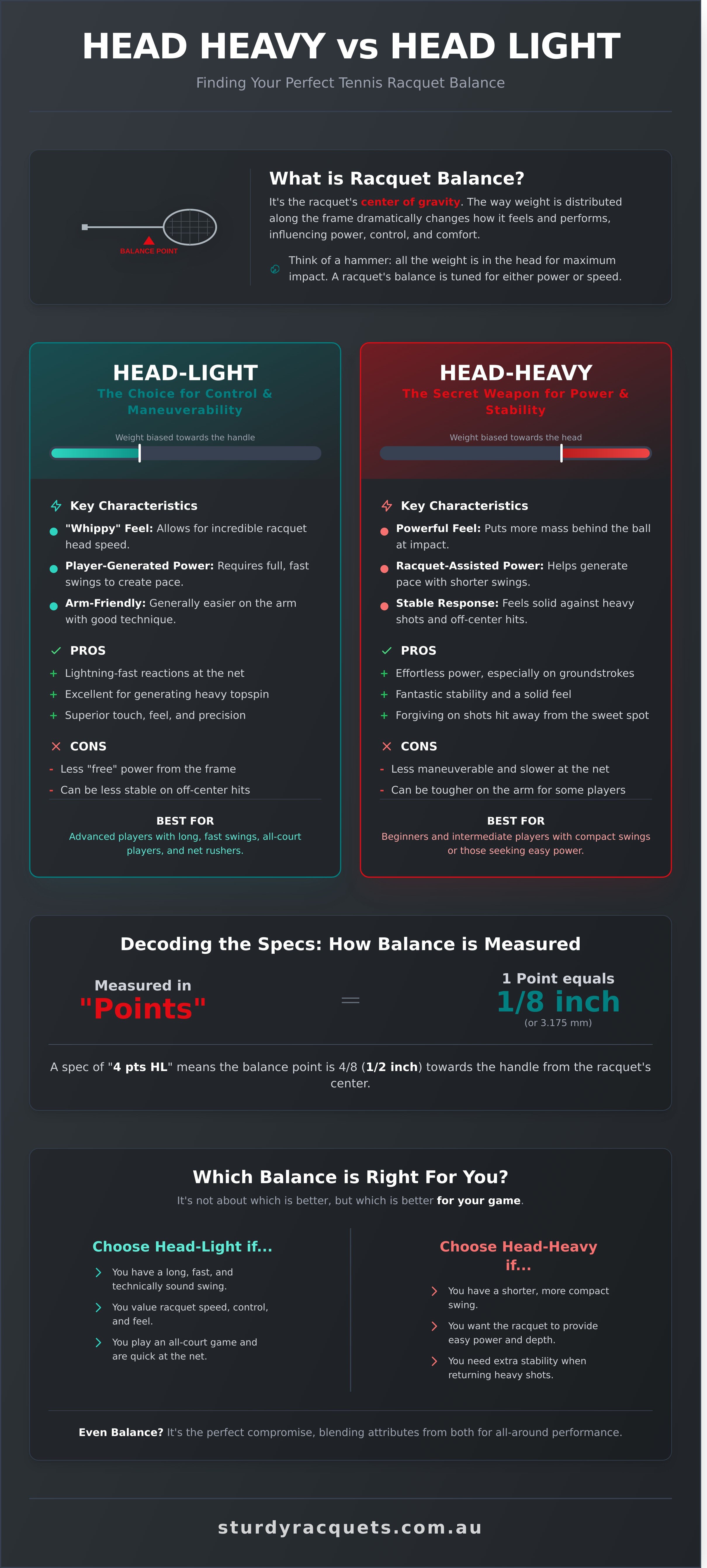
Think about a hammer. All the weight is loaded into the head for one reason: to drive a nail with maximum power. Now, imagine trying to swing that hammer like a tennis racquet-it would feel clumsy and slow. This simple idea is at the heart of racquet balance. The way weight is distributed along the frame, from the butt cap to the tip, dramatically changes how a racquet feels, swings, and performs on the court.
While players often focus on total weight and head size, the balance point is just as crucial. It's the secret ingredient that defines a racquet's personality, influencing everything from power and stability to maneuverability at the net. Getting this right is a game-changer for your performance.
To see how different weight distributions work in practice, check out this fantastic video from the experts at Intuitive Tennis:
Defining the Balance Point: The Racquet's Center of Gravity
The easiest way to understand balance is to find the racquet's center of gravity. If you try to balance a racquet on your finger, the spot where it rests perfectly level is its balance point. Where this point falls determines its category:
- Head-Light (HL): The balance point is closer to the handle. This makes the racquet feel lighter and easier to swing, offering exceptional maneuverability for fast volleys and quick reactions.
- Head-Heavy (HH): The balance point is closer to the head. This puts more mass behind the ball at impact, generating fantastic power and stability, especially on groundstrokes.
- Even Balance (EB): The balance point is right in the middle. These racquets offer a great compromise, blending power with maneuverability for all-around play.
Decoding the Specs: How Balance is Measured
When you're comparing a head heavy vs head light tennis racquet, you'll see the balance listed in the specs. It's usually measured in 'points'. One 'point' simply equals 1/8 of an inch. So, a spec like "4 pts HL" means the balance point is 4/8 (or 1/2) an inch towards the handle from the racquet's physical center. You might also see this measured in millimetres (mm). As modern Tennis racquet technology has evolved, manufacturers have become incredibly precise with these measurements to fine-tune performance. You can find this top-notch information printed on the inside of the racquet's throat or on its product page online.
Head-Light Racquets: The Choice for Control and Manoeuvrability
Step onto any professional court, and you'll find that head-light racquets are the weapon of choice for a huge number of elite players. A head-light (or handle-heavy) frame has more of its mass located towards the handle, making the head feel exceptionally quick and easy to swing. This design, favoured by legends like Roger Federer and Pete Sampras, provides a fantastic 'whippy' feel that allows for rapid adjustments and incredible racquet head speed.
In the classic head heavy vs head light tennis racquet debate, this frame is the artist's brush, offering a level of control and feel that empowers players to craft points with precision and spin.
The Pros: Speed, Spin, and Precision
The number one advantage of a head-light racquet is pure speed. Because the head is lighter, you can accelerate it through the contact zone with explosive pace. This translates into some fantastic on-court benefits:
- Lightning-Fast Reactions: Exceptional manoeuvrability makes it perfect for quick-fire volley exchanges at the net and reacting to powerful serves.
- A Spin Generation Machine: The ability to whip the racquet head up and over the ball allows players to generate heavy, dipping topspin that can trouble any opponent.
- Exceptional Touch and Feel: These frames offer a more connected feel to the ball, giving you the confidence to hit delicate drop shots, sharp angles, and touch volleys with precision.
- Generally Arm-Friendly: While it depends on technique, a head-light racquet with sufficient overall static weight can be easier on the arm as it's less demanding to swing.
The Cons: Less 'Free' Power and Stability
Of course, there are trade-offs. The very features that make a head-light racquet great for control can also be its weakness. Before you commit, it's important to understand the downsides:
- You Bring the Power: These racquets have less mass in the head, meaning they won't generate much power for you. Players need to have full, technically sound swings to create their own pace.
- Stability Under Pressure: When facing a heavy hitter, a head-light frame can feel less stable at impact, sometimes getting 'pushed around' by the force of the opponent's shot.
- Less Forgiving on Off-Centre Hits: Mis-hitting the ball outside the sweet spot can feel more jarring and results in a greater loss of power compared to a head-heavy frame.
Who Should Use a Head-Light Racquet?
Making the right choice in the head heavy vs head light tennis racquet comparison comes down to your personal game style. A head-light frame is a top-notch choice for:
- Intermediate to advanced players who have developed full, fast swing patterns and can generate their own power consistently.
- Aggressive all-court players and serve-and-volley specialists who thrive on quick reactions and moving forward.
- Players who prioritise feel, spin, and racquet manoeuvrability to build points with strategy and variety.
Head-Heavy Racquets: Your Secret Weapon for Power and Stability
Think of a head-heavy racquet as a powerful partner that does most of the heavy lifting for you. Also known as having a "head-heavy balance," these frames have more of their mass concentrated in the hoop. This design creates fantastic momentum, allowing the racquet to "plow through" the ball at impact for exceptional power and stability. To keep them user-friendly, manufacturers often pair this balance with a lighter overall static weight, making them easy to swing. This potent combination is why you'll find head-heavy specs in many of Australia's most popular game-improvement and beginner racquets.
The Pros: Effortless Power and a Forgiving Sweet Spot
The biggest advantage of a head-heavy racquet is its ability to generate easy power. The weight in the head does the work, so you don't have to. Here are the key benefits:
- Effortless Power: Generates impressive pace and depth, even if you have a shorter, more compact swing.
- Rock-Solid Stability: The racquet feels incredibly stable on contact, preventing it from twisting in your hand on off-centre shots.
- Large, Forgiving Sweet Spot: Mishits are less punishing, as the racquet's mass helps maintain pace and direction, keeping you in the point.
- Confidence Booster: It helps you get the ball up and over the net with ease, making the game more fun and rewarding from the start.
The Cons: Slower to Swing and Less Nimble
Of course, there's a trade-off for all that built-in power. The main drawback is manoeuvrability. A head-heavy frame can feel a bit sluggish or difficult to get into position quickly, especially during fast exchanges at the net or on reaction volleys. Players who rely on generating heavy topspin with a rapid, 'whipping' wrist motion may also find it less responsive than a head-light alternative.
Who Should Use a Head-Heavy Racquet?
Deciding in the head heavy vs head light tennis racquet debate often comes down to your swing style and what you need from your equipment. A head-heavy racquet is the perfect match for:
- Beginners who are developing their strokes and need help generating power and depth consistently.
- Players with shorter or slower swings who want the racquet to provide the extra punch they're looking for.
- Solid baseliners who want to hit deep, penetrating groundstrokes and dictate play from the back of the court.
If this sounds like the right fit for your game, our team is always here to provide knowledgeable advice on finding the perfect frame to elevate your performance.
How to Choose: Matching Racquet Balance to Your Game
You've learned the physics, now it's time for the practical part: choosing the right racquet for you. The most important thing to remember in the head heavy vs head light tennis racquet debate is that there is no single "best" answer. The ideal balance depends entirely on your body, your swing, and what you want to achieve on the court. This guide will help you match your playing style to the perfect frame.
Head-Light vs. Head-Heavy Cheat Sheet
For a quick overview, here?s how the two balance types generally stack up. Use this as a starting point to understand the core trade-offs.
| Attribute | Head-Light Racquet | Head-Heavy Racquet |
|---|---|---|
| Power | Low (Player-Generated) | High (Racquet-Generated) |
| Control | High | Medium |
| Stability | Low (can feel 'flimsy' on impact) | High (provides rock-solid stability) |
| Manoeuvrability | High | Low |
| Spin Potential | High (allows faster swing speed) | Medium |
| Comfort | Medium-High (absorbs shock well) | Low-Medium (can cause more vibration) |
Choosing Based on Your Playing Style
Your strategy on the court is a massive clue to the racquet you need. Think about where you win your points and find the description that best fits you:
- The Baseline Grinder: If you love long rallies and dictate play from the back of the court with powerful groundstrokes, you'll benefit from a heavier, head-light frame. This combination provides fantastic stability to handle heavy shots from your opponent and lets you generate your own pace with full, fast swings.
- The All-Court Attacker: Do you like to serve-and-volley or take the ball on the rise? An all-court player needs a racquet that moves fast. A head-light balance is perfect for quick reactions at the net, crisp volleys, and fast preparation on approach shots.
- The Doubles Specialist: In doubles, lightning-fast reflexes at the net are everything. A head-light racquet is the overwhelming favourite for doubles players because its supreme manoeuvrability allows for quick blocks, reaction volleys, and rapid positioning.
Advice for Beginners and Players with Tennis Elbow
For those just starting or managing arm injuries, the choice is even more critical. A lighter-weight, head-heavy racquet is often a great starting point for beginners, as it provides easy power without requiring perfect technique. Conversely, players dealing with tennis elbow often find relief with a heavier, head-light racquet. The extra mass in the frame helps absorb more impact shock, while the head-light balance reduces strain on your arm muscles and tendons.
Ultimately, finding the right feel is a personal journey. Not sure what's right for you? Ask our experts for advice! We love helping players find their perfect match.
Your Perfect Match: Finding the Right Racquet Balance
Choosing your next racquet is a huge decision, and as we've seen, balance is everything. The key takeaway is simple: head-light racquets are your go-to for exceptional control and swift manoeuvrability at the net, while head-heavy racquets are a baseliner's best friend for generating easy power and fantastic stability. The ongoing head heavy vs head light tennis racquet debate has no single winner because the right choice depends entirely on your personal style and on-court goals.
Don't make an unforced error by choosing the wrong gear! If you're still weighing your options, our team of passionate players is here to offer the expert advice you need. We're more than just a shop; we're your partner in the game, offering professional in-store racquet customisation to ensure your frame is a perfect extension of your arm. Plus, with free and fast shipping across Australia, your ideal racquet is closer than you think.
Take the guesswork out of your next purchase. Find the perfectly balanced racquet for your game today! and get ready to play with unmatched confidence.
Frequently Asked Questions
Is a head-heavy or head-light racquet better for beginners?
When deciding on a head heavy vs head light tennis racquet, beginners will almost always find a head-light model to be the perfect starting point. They are much easier to swing and offer fantastic control, which helps you develop proper technique without tiring your arm. While a head-heavy racquet provides more 'free' power, it can be harder to manage and may encourage poor form early on. We recommend focusing on maneuverability first.
Do professional tennis players use head-heavy or head-light racquets?
You'll find that the overwhelming majority of professional players use head-light racquets. Pros generate incredible power with their own technique and fast swing speeds, so they prioritise control and maneuverability for quick reactions at the net and precise shot-making. They often customise their frames with lead tape to achieve a perfect, unique balance, but the foundation is almost always a head-light or evenly balanced frame for ultimate control and feel.
How does racquet balance affect tennis elbow?
Racquet balance plays a huge role in arm comfort. Head-light racquets are generally considered the better choice for preventing or managing tennis elbow. Because the weight is concentrated closer to your hand, the frame is more stable on impact and puts less leverage and strain on your wrist and forearm. A head-heavy racquet can feel jarring on off-centre hits, sending more shock up the arm and potentially aggravating elbow issues.
Can I change the balance of my current tennis racquet?
Absolutely! Customising your racquet's balance is a simple and effective way to fine-tune its performance. Using specialised lead or tungsten tape, you can easily alter the balance point. Adding a few grams of tape to the hoop (at 3 and 9 o'clock, for example) will make it more head-heavy for extra power and stability. Conversely, adding weight under the grip will make it more head-light, boosting maneuverability and feel.
What is swingweight, and how does it relate to balance?
Swingweight is simply a measure of how heavy a racquet feels when you swing it, not just what it weighs on a scale. It?s a crucial factor that combines static weight and balance. For instance, two racquets can have the same weight, but the head-heavy one will have a higher swingweight because the mass is further from your hand. A higher swingweight generally delivers more power but also makes the racquet harder to swing quickly.
Are evenly balanced racquets a good compromise?
Evenly balanced racquets are a fantastic compromise and a top-notch choice for a huge range of players. They offer a great blend of the two extremes: enough mass in the head for solid power and stability, but still maneuverable enough for quick volleys and fast reactions at the net. If you're an all-court player who wants a bit of everything, an evenly balanced frame could be the perfect fit for your game.
Share:
Tennis Racquet for Spin vs. Power: How to Choose the Right Frame
The Best Tennis Racquets to Prevent Tennis Elbow: An Expert Guide