


Staring at a wall of pickleball paddles and feeling completely lost? You're not alone. The jargon can be overwhelming-what's the real difference between swing weight and static weight? And how do you find a paddle that won't strain your elbow or delaminate after a few hot Aussie summers on the court? That?s why our team of passionate experts has created this ultimate 2026 guide on how to choose a pickleball paddle for our unique Australian conditions.
Forget the guesswork and avoid those unforced mistakes. In this guide, we cut through the confusion to help you master the technical specs and local factors that truly matter. Get ready to find a fantastic paddle that feels like a true extension of your arm, helps you nail those tricky dinks with confidence, and gives you top-notch value for your money. Let's find your perfect match on the court!
Key Takeaways
- Understand the critical trade-off between paddle weight for power from the baseline and maneuverability for quick reactions at the net.
- Learn how to choose a pickleball paddle by matching its core and face materials to your play style, whether you prioritise powerful drives or precise, spin-heavy dinks.
- Discover why selecting the correct grip size is essential for maximising comfort, preventing wrist strain, and eliminating unforced errors.
- Get expert tips for Australian players, including why our harsh sun makes UV-resistant paddle faces a must for long-lasting performance.
The Foundation: Why Weight and Shape Define Your Game
Welcome to the most important decision you'll make when buying your next paddle! When learning how to choose a pickleball paddle, weight and shape are the foundational elements that dictate how it will perform on the court. Think of it as the ultimate trade-off: power versus control and manoeuvrability. The right combination for you will complement your playing style and help you feel confident in every shot. The sport's equipment has evolved significantly throughout the history of pickleball, but these core principles remain the same.
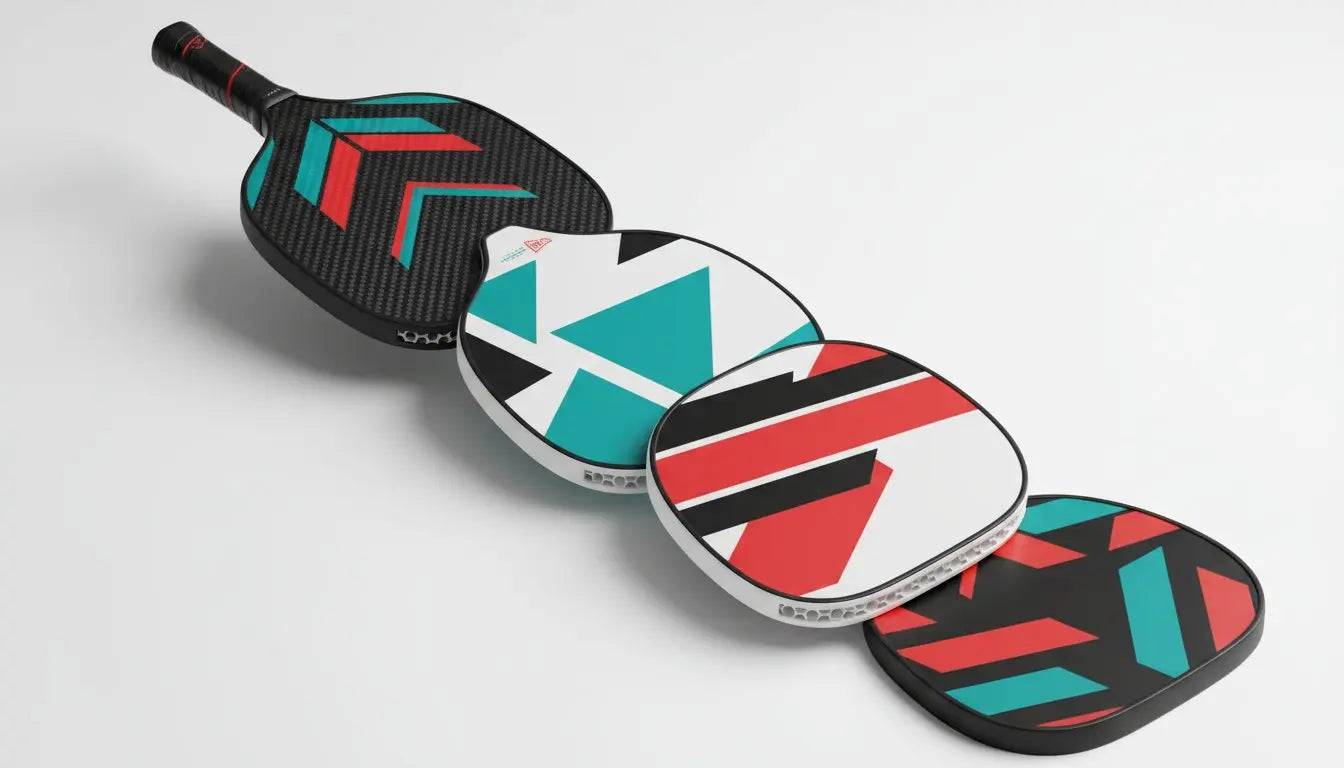
To get a better sense of how different paddle characteristics come together, check out this fantastic overview:
Finding Your Ideal Weight Class
A paddle's static weight (the number on the specs) is your guide, but its swing weight (how heavy it feels in motion) is what you'll notice during play. A head-heavy paddle will have a higher swing weight than a balanced paddle of the same static weight, offering more power but less speed. Here?s a simple breakdown:
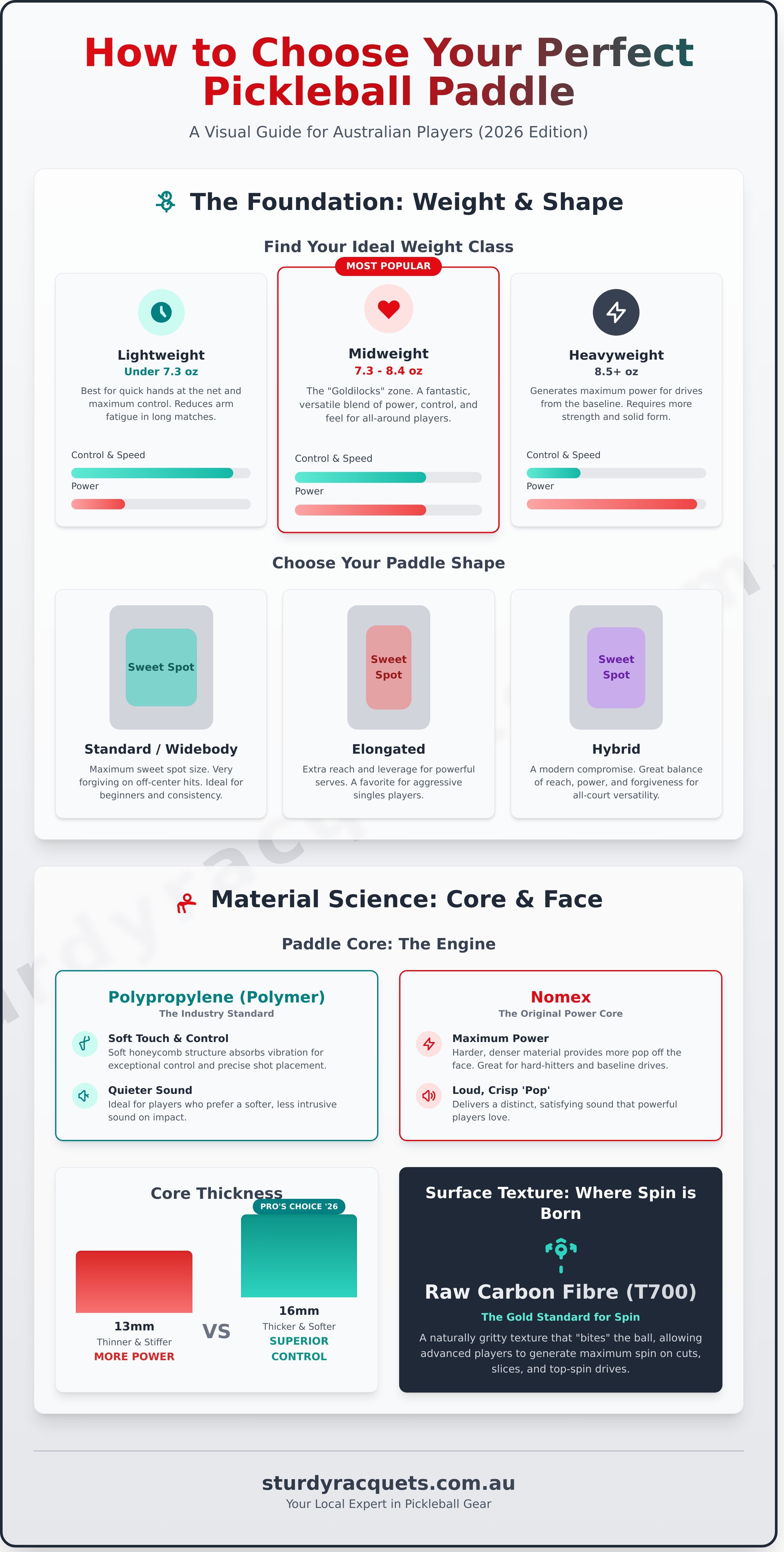
- Lightweight (Under 7.3 oz): Perfect for players who value quick hands at the kitchen line and want maximum control. These paddles are easier to swing, reducing arm fatigue during long matches.
- Midweight (7.3 - 8.4 oz): This is the 'Goldilocks' zone and the most popular choice for Australian social and club players. It offers a fantastic blend of power, control, and feel, making it a versatile option for all-around performance.
- Heavyweight (8.5+ oz): If you want to generate maximum power and drive the ball from the baseline, a heavyweight paddle is your best friend. However, it requires more strength to swing and can increase the risk of 'pickleball elbow' if your form isn't solid.
Paddle Shapes: Standard vs. Elongated
The shape of the paddle face influences two key things: your reach and the size of the 'sweet spot'. Finding the right shape is a crucial step in how to choose a pickleball paddle that suits your game.
- Standard/Widebody: This traditional shape offers the largest possible sweet spot. It's incredibly forgiving on off-centre hits, making it the top recommendation for beginners and players who prioritise consistency.
- Elongated: These paddles trade some width for extra length, giving you more reach for volleys and greater leverage for powerful serves and groundstrokes. They're a favourite among aggressive singles players.
- Hybrid: A modern compromise, the hybrid shape is slightly longer than standard but wider than a fully elongated paddle. It delivers a great balance of reach, power, and forgiveness for all-court versatility.
Material Science: Understanding Cores, Faces, and Grit
When you're learning how to choose a pickleball paddle, understanding its inner workings is a game-changer. The core and face materials are the engine of your paddle, directly influencing the feel, power, and sound of every shot you make. Getting this choice right is fundamental to finding a paddle that complements your unique style of play.
Core Materials: The Engine of Your Paddle
The core is the heart of the paddle, dictating its touch and power. The vast majority of modern paddles use a honeycomb structure, but the material makes all the difference.
- Polypropylene (Polymer): This is the industry standard for a reason. Its softer plastic honeycomb structure absorbs vibration, providing a quieter sound and exceptional control. It?s the top choice for players who value a soft touch for dinking and precise shot placement.
- Nomex: The original paddle core material, Nomex is a harder, denser material. This results in a louder, crisper 'pop' and gives players access to maximum power. It's a fantastic option for hard-hitters who love to drive the ball from the baseline.
Core thickness is just as important. A thinner 13mm core is stiffer and provides more power, while a thicker 16mm core compresses more on impact, absorbing energy for superior control. This focus on touch is why 16mm cores are taking over the competitive Australian scene, with many pros making the switch for the 2026 season.
Surface Textures: Where Spin is Born
The paddle face, or 'skin', is where the magic of spin happens. The texture on the surface grips the ball, and different materials offer distinct advantages.
- Raw Carbon Fibre (T700): Considered the gold standard for generating spin, raw carbon fibre has a naturally gritty texture that 'bites' the ball. This allows advanced players to impart incredible rotation for aggressive serves and cutting dinks.
- Fiberglass (Composite): This surface offers more 'pop' and power. The material flexes slightly more on impact, creating a trampoline effect that's perfect for players with slower swings who want to add extra pace to their shots.
For those playing in tournaments, it's crucial that your paddle's surface texture is legal. To better understand the official grit regulations, it's helpful to consult resources like Pickleball Australia's official paddle guide, which covers the USA Pickleball (USAPA) standards used in most competitions.
Finally, consider the edge. Most paddles have a protective edge guard to enhance durability against ground scrapes, which is ideal for most players. In contrast, edgeless designs offer a slightly larger sweet spot and feel more aerodynamic, but they are more susceptible to chipping. This makes them a better fit for experienced players who prioritise performance over longevity.
Ergonomics and Grip: The Comfort Factor
Beyond the paddle's core and face material, the way it feels in your hand is absolutely critical. The right grip ensures comfort, prevents injury, and gives you the control you need to play your best. A grip that?s too large or too small can lead to unnecessary wrist tension, fatigue, and frustrating unforced errors. Getting this right is a vital step in learning how to choose a pickleball paddle that truly works for you.
Measuring for the Perfect Fit
You can find your approximate grip size at home with the simple 'index finger' rule. Hold a paddle with your natural grip. You should be able to slide the index finger of your other hand into the space between your fingertips and the base of your palm. If there's not enough room, the grip is too small. Too much room, and it's too big.
- Small Grips (4" to 4 1/8"): Often preferred by players with smaller hands or those seeking more wrist snap for extra spin.
- Standard Grips (4 1/4" to 4 3/8"): The most common size, offering a great balance of comfort and stability for the average player.
- Large Grips (4 1/2"+): Ideal for players with larger hands, providing stability and reducing the risk of the paddle twisting on off-centre hits.
Remember, it's much easier to increase the size of a smaller grip with an overgrip than it is to sand down a grip that's too large. When in doubt, go slightly smaller.
Handle Length and Playing Style
The length of the handle directly impacts your playing style. Shorter handles (around 5 inches) maximise the paddle's surface area, which is great for defensive players who value a larger sweet spot. In contrast, longer handles (5.5 inches or more) are essential for players who use a two-handed backhand, a common technique for those coming from a tennis background. This extra length provides more room for both hands and offers increased leverage for powerful shots.
For those long, competitive matches under the Aussie sun, managing sweat is key. An overgrip not only helps you customise your grip size but also provides fantastic moisture absorption and extra tackiness, ensuring the paddle never slips. Check out our range of overgrips to find the perfect feel for your game.
Strategy Alignment: Choosing Based on Your Play Style
Once you understand the core components of a paddle, the next step in learning how to choose a pickleball paddle is matching it to your personal strategy on the court. Are you an aggressive player who loves to drive the ball from the baseline, or a patient strategist who wins points with precision at the net? Your answer will guide you to the perfect equipment. Most players fall into one of two main camps: the power-focused 'Banger' or the control-oriented 'Dinker'.
The Power Hitter (The Banger)
If you love overwhelming opponents with fast serves and powerful drives, you're a Banger. Your game is built on offence, and you need a paddle that delivers maximum pop. Look for paddles that amplify your natural strength and put serious pace on the ball.
- Core & Face: Thinner cores (around 13mm) and responsive fiberglass faces provide exceptional 'pop'.
- Weight: Heavier swing weights generate more momentum for deep, penetrating shots.
- Priority: Power over a soft touch.
The Kitchen Specialist (The Dinker)
If your game is built on patience, placement, and winning battles at the non-volley zone, you're a Dinker. You excel at soft shots, resets, and dinks that force your opponents into making mistakes. Your paddle should feel like an extension of your hand, offering fantastic touch and control.
- Core & Face: Thicker cores (16mm+) and carbon fibre faces absorb impact and increase 'dwell time' for superior feel.
- Weight: Lower swing weights allow for quicker hands and faster resets during intense net exchanges.
- Priority: A soft feel and ultimate control.
Of course, many players are 'all-court' specialists who transition between power and control. If this sounds like you, a balanced paddle with a medium-weight core (14-15mm) is a fantastic choice. A key strategy is also to choose equipment that masks your weaknesses. If you're a power player struggling with your soft game, a control-oriented paddle can help you develop better touch. Conversely, a Dinker looking for more 'put-away' power might benefit from a slightly thinner, more powerful paddle.
Looking ahead, the industry is rapidly evolving. While power and control have been the traditional pillars, 'Spin' is emerging as a dominant third category in the 2026 gear lineups, with new textured surfaces designed to give players a serious competitive edge. Finding the right fit for your game is crucial, and our team at Sturdy Racquets is always here to offer expert advice.
The Sturdy Racquets Advantage: Local Advice for Australian Players
Understanding the technical specifications of a paddle is one thing, but knowing how to choose a pickleball paddle that will perform and last in Australia?s unique environment is another challenge entirely. Online reviews often don't account for our intense sun, varied court surfaces, and local playing conditions. That?s where getting expert, local advice makes all the difference in avoiding a costly purchasing mistake.
Australian Conditions and Gear Longevity
Playing on a 35�C+ day doesn't just test your endurance; it tests your gear. The polymer cores in many paddles can expand in extreme heat, potentially affecting performance and creating dead spots over time. That?s why we prioritise brands with UV-resistant carbon fibre faces that resist fading and delamination under the harsh Aussie sun. We also understand that our dusty, outdoor courts can wear down a paddle?s gritty surface. We stock paddles specifically tested for the Australian market, ensuring your investment is built to last.
Just as protecting your gear from the elements is key, so is managing the sun in other parts of your life. For creating comfortable, shaded outdoor areas at home that are perfect for relaxing after a long match, many Australians also explore Outdoor Blinds.
Visit the Brooklyn Specialist Store
The best way to find your perfect match is to feel it in your hand. At our specialist store in Brooklyn, you can compare the weight, balance, and grip of over 50 different paddles. Our team aren?t just salespeople; we?re passionate players who are active in the Melbourne pickleball scene. We know how a paddle will wear on local hard courts versus synthetic grass, and we provide honest, top-notch advice to help you find the right gear for your game. Nothing beats getting a feel for the paddle before you commit.
Choosing the right paddle is one of the most important decisions you'll make. Buying the wrong one based on incomplete information is an 'unforced mistake' you can easily avoid. By getting hands-on with our fantastic range and speaking to our team, you can make a confident choice that elevates your performance on the court. Ready to find your perfect paddle?
Visit our Brooklyn store for expert advice and let our friendly team help you today!
Step Onto the Court with Confidence
Choosing the right gear is your first step towards winning more games. Mastering how to choose a pickleball paddle comes down to aligning its core characteristics-like weight, material, and grip size-with your personal play style. Whether you favour powerful drives from the baseline or precise dinks at the net, the right paddle will elevate your performance and make every moment on the court more enjoyable.
Feeling ready to find your perfect match? You don't have to navigate the options alone. As Melbourne's trusted racquet specialists, the team at Sturdy Racquets provides fantastic, knowledgeable advice to the Australian pickleball community. Backed by verified 5-star customer service and fast shipping across the country, we make finding the right gear simple and stress-free.
Put our expert advice into action today. Shop the 2026 Pickleball Paddle Range at Sturdy Racquets and find the paddle that?s perfect for you. Your best game is just a click away!
Frequently Asked Questions About Choosing a Pickleball Paddle
How often should I replace my pickleball paddle?
For the average club player, a pickleball paddle will perform at its best for about 1-2 years. If you play multiple times a week, you might notice a decline after one year. Key signs it's time for a new paddle include a loss of 'pop', a change in sound on impact, or visible damage like cracks or soft spots on the face. A worn-out grip can be replaced, but a dead core means it's time for an upgrade to keep your game sharp.
What is the best pickleball paddle for beginners in 2026?
That's a fantastic question! While there's no single "best" paddle, we find beginners have the most success with a mid-weight paddle (around 7.8-8.4 ounces) that has a large sweet spot. Look for paddles with a graphite or composite face, as they offer a great blend of control and power. The key is to choose a paddle that feels comfortable and gives you the confidence to develop your shots and learn the game.
Does a more expensive paddle really make you a better player?
A premium paddle won't magically fix technique, but it can enhance your skills. More expensive paddles (A$200+) often use advanced materials like raw carbon fibre for incredible spin or thermoformed cores for extra power and consistency. While practice is always the most important factor, a high-performance paddle can provide the specific touch, power, or control that helps elevate a player's game from good to great. It complements your skill, it doesn't create it.
What is the difference between a 13mm and 16mm core?
The core thickness is all about feel and performance. A thicker 16mm core paddle provides more control and a softer feel, absorbing more of the ball's energy. This is fantastic for your touch game, like dinks and resets. A thinner 13mm core paddle offers more power and 'pop', providing more direct feedback to your hand. Players who love powerful drives often lean towards a thinner core, while control-oriented players prefer the thicker 16mm option.
Can I use a tennis racquet overgrip on my pickleball paddle?
Absolutely! Using a tennis overgrip is a very common and effective way to customise your pickleball paddle's handle. Both sports use similar grip technology, so a quality tennis overgrip will provide the extra tackiness, sweat absorption, or thickness you're looking for. It's an easy and affordable way to make sure the paddle feels perfect in your hand, giving you better control and comfort on the court.
What does 'USAPA Approved' mean and do I need it?
The 'USA Pickleball Approved' (formerly USAPA) mark means a paddle has been tested and certified to meet the official equipment standards for sanctioned tournament play. For social and casual games in Australia, you don't strictly need it. However, if you plan to play in any official leagues or tournaments, an approved paddle is mandatory. We always recommend choosing an approved paddle to ensure you're playing with regulation gear.
Why is my pickleball paddle losing its 'pop'?
This is a common experience for regular players. Over thousands of impacts, the honeycomb core inside your paddle begins to soften and lose its rebound ability, which is what players call 'losing its pop'. The paddle face can also lose its texture, reducing its ability to grip the ball for spin. This is a natural wear-and-tear process. When your shots don't feel as crisp or powerful as they used to, it's likely a sign the paddle's core has reached the end of its life.
Is there a difference between indoor and outdoor paddles?
This is a great question that comes up often! The simple answer is no; paddles are designed to be used in both indoor and outdoor environments. The real difference is in the pickleballs themselves, which are made differently for indoor and outdoor courts. When learning how to choose a pickleball paddle, you should focus on personal preference factors like weight, core thickness, and grip size rather than where you'll be playing.
Share:
Same-Day Racquet Stringing in Melbourne: Get Back on Court Today
Pickleball Paddle Weight Guide: How to Choose Your Perfect Match in 2026