




What if the most expensive racquet on the shelf is actually the reason your forehand keeps landing in the net? It's a common trap for the 1.5 million Australians who hit the courts annually, often getting caught up in flashy marketing rather than looking at the actual specs. You've likely felt that specific frustration of swinging a frame that feels like a heavy wooden plank, or perhaps you're tired of the nagging ache of tennis elbow after a long afternoon at the local club. Learning how to choose a tennis racquet for my game style shouldn't require a physics degree or a deep dive into confusing technical jargon like swingweight and stiffness.
We're here to cut through the noise for the 2026 season. You deserve to feel confident every time you step onto the court, knowing your equipment is working with you, not against you. This guide provides a clear roadmap to identify your unique playing signature and matches it with the right technical requirements. We'll explore the high performance tennis frames for spin and provide a shortlist of specs that will help you find the most comfortable tennis racquets for arm safety without wasting your hard-earned A$. By the end, you'll have the expert knowledge needed to pick a frame that elevates your performance on any Australian surface.
Key Takeaways
- Identify your unique tactical identity to ensure your equipment supports your strengths rather than creating unforced mistakes on the court.
- Discover how to choose a tennis racquet for my game style by decoding how head size and swingweight impact your ability to control every point.
- Learn why versatile "tweener" frames offer the perfect blend of power and feel for intermediate players looking to level up their performance.
- Master the "index finger" rule for grip sizing and select the best tennis racquet strings to handle the fast-paced Australian court conditions.
- Unlock the secrets of professional customisation to fine-tune your racquet’s tension and feel for a more confident and personalised swing.
Identifying Your Tennis Game Style and Why It Matters
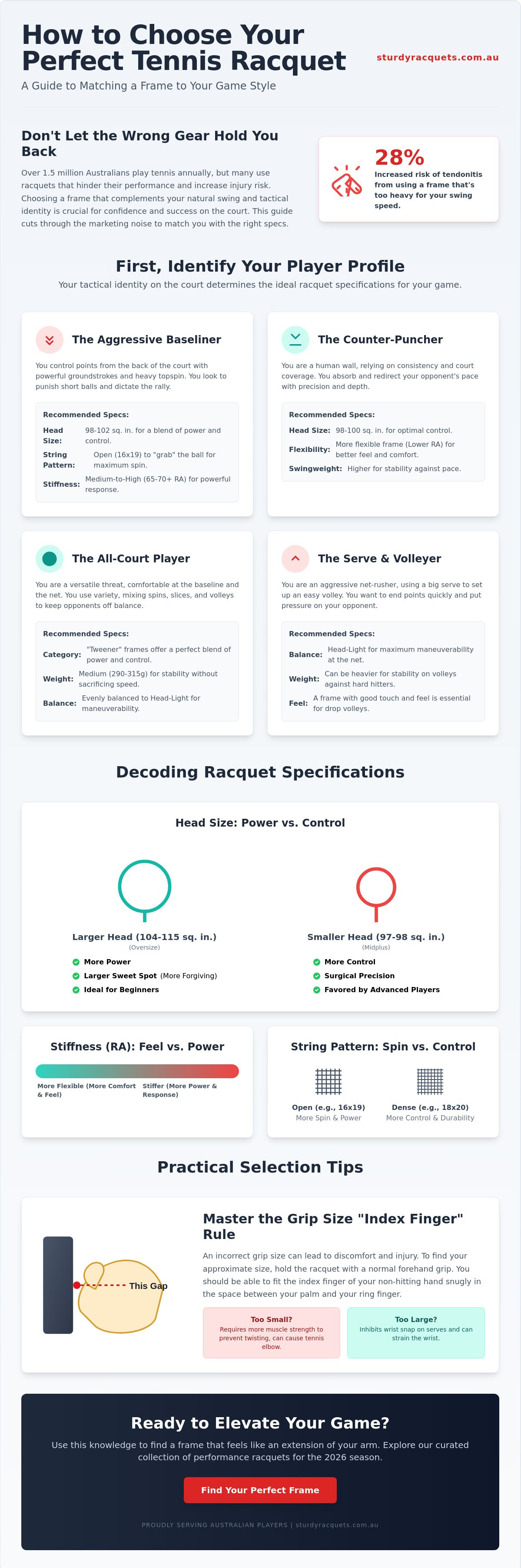
Picking the right gear starts with self-awareness. When you're researching how to choose a tennis racquet for my game style, you've got to look beyond the paint job and the famous names. Your racquet shouldn't just be a piece of graphite; it's an extension of your arm designed to amplify your natural strengths. Whether you're grinding out wins at your local club in Melbourne or competing in Sydney's weekend pennant leagues, the wrong equipment can lead to frustration. In fact, sports medicine data suggests that playing with a frame too heavy for your swing speed can increase the risk of tendonitis by up to 28% for recreational players.
To better understand this concept, watch this helpful video:
Many club players fall into the trap of buying what the pros use. While it's tempting to swing the same frame as a Grand Slam champion, those racquets are often customized with lead tape and high stiffness ratings that require elite-level strength to maneuver. For most of us, a racquet that's too demanding becomes a liability by the third set. Your physical strength and natural swing path dictate your style. Understanding the evolution of racquet technology helps you see how modern materials now allow for lighter frames that still pack a punch, catering to specific tactical identities. This shift means you don't have to sacrifice power for comfort anymore.
The Aggressive Baseliner vs. The Counterpuncher
The aggressive baseliner lives to dictate points. You likely have a fast swing and look for short balls to punish with heavy topspin. You'll want a frame with an open string pattern to "grab" the ball and generate dip. Conversely, the counterpuncher is a human wall who relies on consistency. You thrive on redirecting your opponent's pace. For this, you need a stable, slightly more flexible frame that offers exceptional control. Choosing between these requires a look at high-performance frames for competitive players that match these specific stiffness requirements to ensure your gear doesn't let you down during a long rally.
The All-Court Player and The Serve-and-Volleyer
If you're comfortable at the net and the baseline, you're an all-court player. You need a versatile racquet: not too heavy, not too light, with a balanced head weight. This balance is key for players who use variety to win. The net specialist or serve-and-volleyer, however, prioritizes maneuverability and stability. You need a racquet that won't twist when a 180 km/h passing shot hits the strings. Modern tech in 2026 has introduced hybrid frames that offer the feel of traditional materials with the power of carbon fiber, making it easier than ever to find quality gear for every style of play. Playing with equipment that fits your tactical DNA provides a massive psychological boost, giving you the confidence to go for your shots when the score is 30-40. This is the core of how to choose a tennis racquet for my game style effectively.
Decoding Racquet Specifications: Power, Control, and Feel
Understanding technical specifications is the first step when learning how to choose a tennis racquet for my game style. Head size plays a massive role in your success on the court. A larger head, typically between 104 and 115 square inches, creates a generous sweet spot. This helps beginners make solid contact even on off-center hits. Advanced players often prefer a smaller head of 97 or 98 square inches. These compact frames offer the surgical precision needed to hit lines with confidence during competitive matches.
Weight and swingweight are two different beasts. Static weight is what you feel when picking up the frame at your local club or shop. Swingweight measures how heavy the racquet feels during your stroke. A racquet with a high swingweight provides more stability against fast serves, but it requires more strength to maneuver. For the 2026 season, many manufacturers are utilizing expert advice on choosing a tennis racket to help players balance these two metrics for better arm health and performance.
Frame stiffness, or the RA rating, determines how much energy returns to the ball versus being absorbed by the frame. A stiff frame with an RA of 67 or higher offers easy power but can be tough on the elbow. Flexible frames with an RA of 63 or lower provide better feel and comfort. You'll also need to consider string patterns. An open 16x19 pattern allows strings to move and snap back for more spin. A dense 18x20 pattern offers a predictable, controlled response for players who hit flat, driving shots. You can find the right setup by exploring our durable tennis strings designed for various patterns.
Understanding Weight Distribution and Balance
Balance significantly changes how a racquet handles at the baseline versus the net. Head-light (HL) racquets have more weight in the handle. This makes them essential for fast net play and quick volleys during doubles. Head-heavy (HH) frames put the mass in the hoop to provide plow-through for baseline rallies, helping you hit deeper with less effort. If you're a developing intermediate player, an even-balance racquet provides a reliable middle ground for all-court versatility.
The Impact of Frame Geometry and Beam Width
Beam width refers to the thickness of the racquet's side profile. Thick beams of 24mm or more act like a springboard, offering effortless power for shorter swings. Thin beams of 20-22mm flex more, giving you maximum feedback and dwell time on the strings. A wider beam profile increases aerodynamic drag but creates a more stable hitting surface for defensive shots. In 2026, new vibration-dampening polymers are being integrated into the frame layup. These materials reduce harsh shocks by up to 15% without sacrificing the crisp ball feel that competitive players crave. If you want to upgrade your gear, browse our high-performance tennis frames to find your perfect match.
Matching Frame Characteristics to Your Player Profile
Understanding how to choose a tennis racquet for my game style requires a tactical map of your own swing. You can't just pick the frame used by your favourite pro and expect results. Instead, look at the length of your swing. Players with short, compact strokes usually struggle to generate depth, so they benefit from power-oriented frames. These racquets do the heavy lifting for you. If you have a long, fast, and loopy swing, you already create plenty of pace. You need a control-oriented frame to keep the ball inside the lines.
Intermediate players often find their "Goldilocks" zone in "tweener" racquets. These frames sit between 285 and 305 grams, offering a blend of stability and manoeuvrability. Choosing intermediate tennis racquets for club players allows for technical growth without the racquet becoming a hindrance as your swing speed increases. It's a smart way to ensure your gear evolves with your ranking at the local club.
One common misconception in Australian pro shops is that heavier racquets are always harder to use. This isn't true. While a 315-gram frame takes more effort to get moving, it offers much better stability against fast incoming balls. A racquet that's too light will often twist in your hand when you're facing a heavy hitter. The key is finding the heaviest weight you can comfortably swing for a full three-set match without losing your technique.
The Power Seeker: Low Effort, High Reward
If you prefer to stay at the baseline and want the ball to fly off the strings with minimal effort, you're a power seeker. Look for oversized head shapes, typically 104 to 115 square inches. These frames have a wider "sweet spot" and thicker beams that don't flex much upon impact. This setup is also perfect for younger players moving into junior tennis racquets that feature adult technology in a slightly shorter or lighter package. It helps maintain depth even when your footwork isn't perfect.
The Control Specialist: Precision and Placement
Advanced players who can generate their own power often feel like the ball "sails" on them. To fix this, look at performance tennis racquets with thinner beams and smaller head sizes, usually 97 to 98 square inches. A head-light balance is essential here. It makes the racquet feel nimble at the net and allows for the high-speed swing paths needed for heavy topspin. When you're learning how to choose a tennis racquet for my game style, remember that control frames reward clean hitting and fast hands.
Practical Selection: Grip Size, Swing Speed, and Australian Conditions
Selecting the right frame is only half the battle. You need to ensure the physical specifications match your hand and your local environment to perform your best. Understanding how to choose a tennis racquet for my game style involves looking past the paint job and focusing on the ergonomics that prevent injury and improve consistency.
Getting the Grip Size Right
A common mistake many players make is choosing a grip that is too small. This often leads to "death gripping" the handle to keep it from twisting, which is a primary cause of tennis elbow and wrist fatigue. You can check your size using the index finger rule. Hold your racquet in a normal Eastern forehand grip; you should be able to fit the index finger of your non-hitting hand comfortably in the space between your ring finger and your palm. If the gap is too narrow, the grip is too small.
If you're between sizes, it's always better to go smaller and build it up. You can use essential tennis accessories like overgrips to add about 1.5mm to the circumference. This allows you to customize the feel and absorb sweat during those humid summer sessions. Many local club players find that a fresh overgrip every three to four matches keeps their connection to the ball much more secure.
Adapting to the Australian Climate
Australian hard courts are notoriously unforgiving on gear. The abrasive surface generates significant heat, which transfers to your racquet and strings. In cities like Melbourne or Adelaide, 40-degree days can cause your string tension to drop by 2 or 3 pounds in a single afternoon. If you play in these conditions, you might want a slightly stiffer frame that maintains its shape and power even when the strings go soft.
Coastal players in Sydney or Perth also have to contend with heavy winds. A racquet with a slightly higher "swing weight" provides the stability needed to punch through a gusty breeze without the frame fluttering at contact. To protect your investment from these temperature swings, you need a high-quality tennis bag for Australian conditions that features thermal lining. This simple addition can extend the life of your strings by 25% by preventing extreme expansion and contraction.
Your racquet choice shouldn't exist in a vacuum. Because hard courts are so taxing on the body, you should pair your new frame with high-performance tennis shoes for hard courts. The right footwear provides the lateral stability required to handle the extra power and spin your new racquet will generate. When you align your grip, your frame stiffness, and your footwear, you create a cohesive setup that works with your body instead of against it.
Ready to find the perfect match for your technique? Shop our full range of performance tennis racquets today.
Professional Customisation and Finalising Your Choice
You've narrowed down the technical specs. Now, it's time to turn a generic frame into a precision tool. Understanding how to choose a tennis racquet for my game style involves more than just picking a weight or head size. The final 10% of performance comes from customisation. Most racquets arrive from the factory with basic strings that don't do justice to the frame's potential. These "factory strings" are often generic synthetic gut designed for durability on a shop shelf rather than performance on the court. They lack the specific snapback and tension stability required for a competitive edge.
String tension is the most effective way to "fix" a racquet that feels slightly off. If you find your shots are consistently landing just past the baseline, increasing your tension by 2 or 3 pounds can provide the extra control you need. If you're struggling to reach the baseline, dropping the tension will give you more "trampoline effect" and effortless depth. It's a fine-tuning process that evolves as your game improves.
The Secret Weapon: Professional Stringing
The strings are the only part of the equipment that actually touches the ball. Tension directly affects the size of your sweet spot and your overall power level. High tension shrinks the sweet spot but offers surgical precision. Low tension expands it, making the racquet more forgiving. You should invest in professional racquet stringing and maintenance at least as many times per year as you play per week. If you play three times a week, restring three times a year to avoid "dead" strings that cause arm strain.
Matching the material to your style is vital. Polyester strings are the gold standard for players who generate their own power and want maximum spin. Multi-filament strings are better for club players seeking comfort and a feel similar to natural gut. Choosing the wrong material can make even the most expensive racquet feel like a wooden board.
Demoing and Expert Advice at Sturdy Racquets
Nothing beats a hands-on experience. When you visit our specialist store in Brooklyn, Victoria, you get to feel the swing weight in person. It’s the best way to ensure a frame won't cause arm fatigue after a long second set. Speaking to a knowledgeable friend at our store helps you cut through the marketing jargon. We've seen thousands of players find their match by simply holding three different frames side by side. Selecting the right racquet reduces unforced errors by ensuring the frame complements your natural swing speed instead of fighting against it.
Before you make your final decision on tennis racquets for all playing levels, run through this quick checklist:
- Grip Size: Can you fit one index finger in the gap between your ring finger and palm?
- Swing Weight: Does the racquet feel manoeuvrable at the net during quick volleys?
- Balance Point: Do you prefer the stability of a head-light frame or the "plow-through" of a head-heavy one?
- String Choice: Have you picked a string that matches your specific need for power, comfort, or spin?
Taking these final steps ensures your new gear feels like an extension of your arm. Don't settle for a "good" racquet when the right customisation can make it a great one.
Take Control of Your Game Today
Finding the right frame isn't just about picking a popular model; it's about aligning technical specs like swing weight and balance with your unique physical profile. Whether you're a baseline grinder or an aggressive net-rusher, understanding how to choose a tennis racquet for my game style is the fastest way to reduce unforced errors. You've learned how head size affects power and why Australian court temperatures impact your string tension. Now, it's time to put that knowledge into practice with gear that supports your performance goals.
We're here to help you get it right. Our team offers expert in-store stringing services in Brooklyn, VIC, ensuring your setup is tuned to perfection for local conditions. We provide fast free shipping across Australia so you can get on the court sooner. It's why we're highly recommended by local Victorian club players who value precision and expert advice. Don't leave your performance to chance when you can play with total confidence.
Find your perfect match in our 2026 range of tennis racquets and start playing your best tennis yet. See you on the court!
Frequently Asked Questions
How do I know if I need a power or control racquet?
You need a power racquet if you have a short, compact swing and want the frame to generate depth, whereas a control racquet suits players with long, fast swings who provide their own pace. Power frames usually have larger heads over 100 square inches and stiffer beams. Control models feature thinner beams and smaller head sizes to help you aim accurately. Knowing how to choose a tennis racquet for my game style depends on whether you want the racquet to do the work or if you prefer to swing out with confidence.
What is the best tennis racquet for a beginner in 2026?
The best beginner racquet in 2026 is a lightweight frame weighing between 270g and 285g with an oversized head of 102 to 105 square inches. These specs provide a forgiving sweet spot that helps you keep the ball in play while you learn basic technique. Most entry-level players in Australia find that lightweight tennis racquets for adults offer the perfect balance of maneuverability and stability as they start their tennis journey.
Does a heavier tennis racquet cause more injuries like tennis elbow?
Actually, a racquet that's too light often causes more injuries because it lacks the mass to absorb ball impact, sending vibrations directly into your arm. While a 300g plus racquet requires more strength to swing, it provides better stability and shock dampening. Research from sports clinics suggests that 70 percent of tennis elbow cases stem from poor technique or using tennis equipment for arm health that doesn't match the player's physical strength.
How often should I change my tennis racquet if I play twice a week?
You should look at replacing your tennis racquet every 2 to 3 years if you play twice a week, as the graphite fibers eventually lose their snap and feel dead. However, your strings are more important; the rule of thumb is to restring as many times per year as you play per week. For a twice-weekly player, refreshing your durable tennis strings every 3 months ensures you maintain consistent performance and don't lose tension.
What is the most common grip size for adult tennis players in Australia?
The most common grip size for adult players in Australia is Size 3 (4 3/8 inches) for men and Size 2 (4 1/4 inches) for women. Choosing the correct size prevents the handle from twisting in your hand, which reduces the risk of wrist strain. If you're between sizes, it's smarter to pick the smaller handle and add absorbent tennis overgrips to achieve the perfect fit.
Can I use a pro player’s racquet even if I am an intermediate player?
You can use a pro player's racquet, but it's usually not recommended for intermediate players because these frames are often heavy and have very small sweet spots. Pro-spec racquets frequently weigh over 315g and require perfect timing to use effectively. Most club players perform 15 to 20 percent better when using versatile intermediate tennis racquets that offer a blend of power and forgiveness rather than a demanding tour-level model.
How does string tension affect the way my racquet feels?
String tension acts like a trampoline; lower tension provides more power and comfort, while higher tension offers more control. In the Australian summer, heat can cause strings to lose tension faster, so many local players increase their tension by 2 lbs in January to compensate. Finding the right feel is a key part of understanding how to choose a tennis racquet for my game style and maximizing your on-court potential.
What is the difference between a head-heavy and head-light racquet?
A head-heavy racquet has more weight distributed toward the top of the hoop to provide extra power on groundstrokes, whereas a head-light racquet has more weight in the handle for faster net play. Head-light frames are the choice for 90 percent of advanced players because they allow for quicker racquet head speed and easier volleying. If you enjoy a mix of styles, look for balanced tennis racquets that sit right in the middle for all-court performance.
Share:
Signs You Bought the Wrong Tennis Racquet: How to Spot a Spec Mismatch
Babolat Pure Aero vs Pure Drive: The Ultimate 2026 Comparison Guide