



Let's face it: the sheer variety of tennis shoes shoes on the market can be overwhelming. Are special hard-court shoes really necessary for your local Aussie court? And how do you know if you need more stability for your baseline game or a lighter shoe for charging the net? Picking the wrong pair isn't just a waste of money; it can hold back your performance and even lead to frustrating injuries.
But don't stress! That's exactly why we've created this ultimate buyer's guide for Australian players. We're here to give you the friendly, expert advice you need to make a confident choice. We'll break down everything from court surfaces and playing styles to the must-have features that provide top-notch comfort and durability. By the end of this guide, you?ll know exactly how to find the perfect tennis shoes to protect your feet, boost your game, and feel fantastic on the court.
Key Takeaways
- Understand why your running shoes aren't built for the sharp, side-to-side movements of tennis and how the right footwear prevents injury.
- Learn how to match your shoe's outsole to the specific courts you play on in Australia, from hard court to clay and grass.
- Your playing style directly impacts your footwear needs; discover how to choose the right tennis shoes for maximum support and agility.
- Get practical tips for measuring your feet at home to find a perfect, comfortable fit, even when buying your shoes online.
Why Your Running Shoes Are Holding You Back on the Court
It's one of the most common mistakes we see on courts all over Australia: players lacing up their everyday running shoes for a game of tennis. While it might seem harmless, using the wrong footwear is a classic unforced error that can impact your performance and, more importantly, increase your risk of injury. Tennis isn't a straight-line sport; it's a battle of explosive starts, sudden stops, and constant, sharp lateral movements.
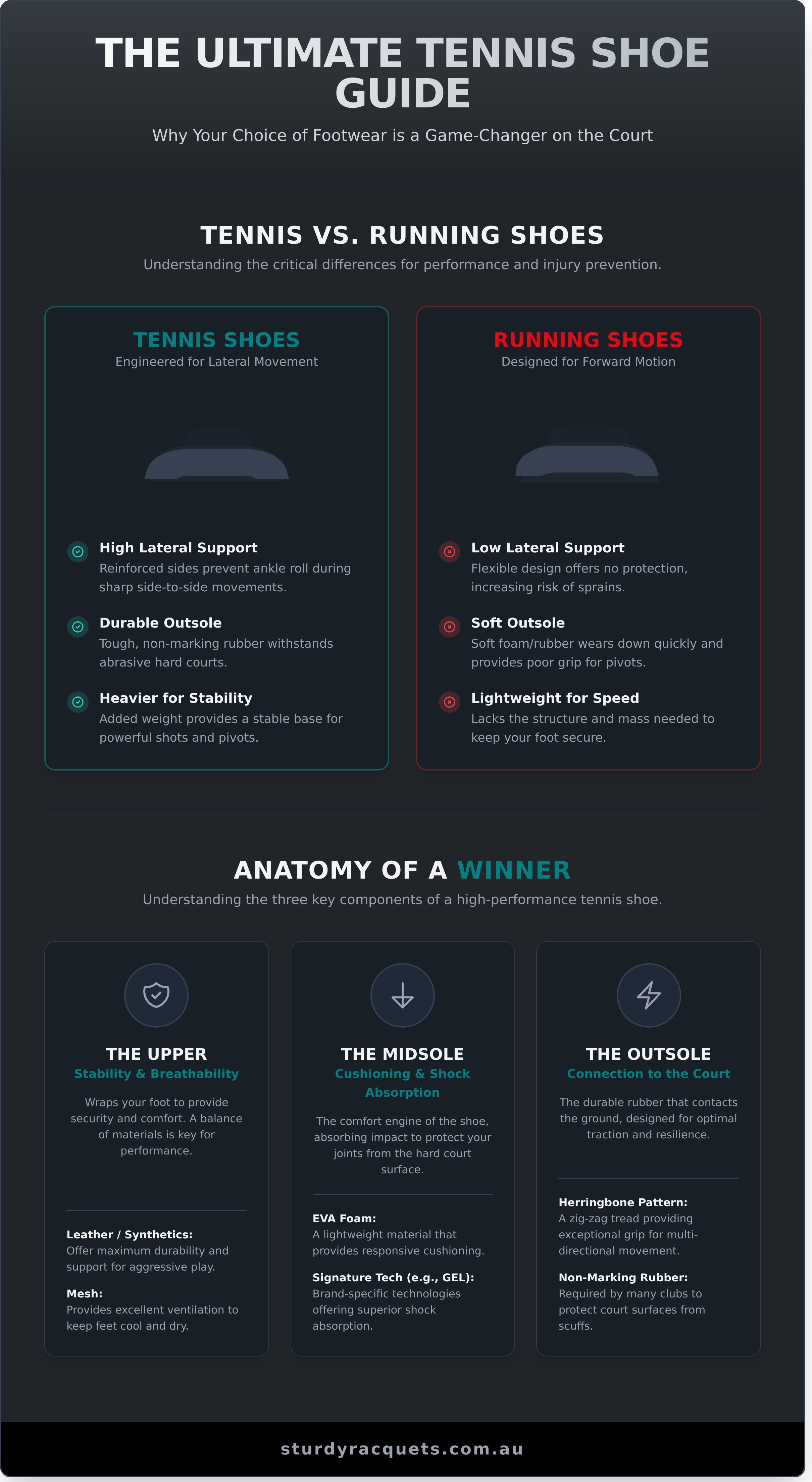
Running shoes are engineered for one thing: consistent forward motion. They are lightweight, flexible, and designed to cushion your stride as you move ahead. Tennis, however, demands a completely different kind of support ? one specifically engineered for the unique stresses of the game. Understanding these fundamental differences is crucial for both performance and injury prevention.
The Critical Difference: Lateral Support
The single most important feature that sets tennis shoes apart is lateral support. This refers to the reinforcement built into the sides of the shoe, designed to keep your foot secure during quick side-to-side sprints and pivots. It prevents your foot from rolling over the edge of the shoe bed, a common cause of ankle sprains. Running shoes lack this structure, prioritising flexibility over stability, which leaves you vulnerable on the court.
Built for Battle: Outsole Durability
Australian hard courts are notoriously abrasive. The gritty surface provides excellent grip but can shred the soft outsoles of running shoes in just a few sessions. That's why the outsoles on proper tennis shoes shoes are engineered with dense, durable rubber compounds. The History of tennis shoes shows a constant evolution in design, leading to modern shoes with extra reinforcement in high-wear areas like the toe cap and the ball of the foot, ensuring they can withstand the grind of a long match.
Tennis Shoes vs. Runners: A Quick Comparison
| Feature | Tennis Shoes | Running Shoes |
|---|---|---|
| Lateral Support | High & Reinforced | Low & Flexible |
| Weight | Slightly Heavier for Stability | Lightweight for Speed |
| Outsole Durability | Tough, non-marking rubber | Soft, flexible foam/rubber |
| Cushioning Focus | Under the ball of the foot | Primarily in the heel |
Decoding the Tennis Shoe: Anatomy of a Winner
Ever felt overwhelmed by the technical specs on a shoe box? You're not alone! Understanding the basic anatomy of your gear is the first step to making a fantastic choice. Choosing the right pair of tennis shoes shoes is much simpler when you know what each part does for your game. Let's break it down into three key areas so you can shop with confidence.
The Outsole: Your Connection to the Court
Think of the outsole as the tyres on your car-it?s the durable rubber part that makes direct contact with the court. Most tennis shoes feature a herringbone (zig-zag) tread pattern, a top-notch design providing exceptional grip for the quick stops, starts, and lateral movements in tennis. Many Australian clubs require a ?non-marking? outsole to protect their court surfaces, so always check for this feature before you buy!
The Midsole: Cushioning and Shock Absorption
The midsole is the powerhouse of comfort and protection, sandwiched between the outsole and your foot. This is where the magic happens! It?s typically made from materials like lightweight EVA foam, which absorbs the impact of every sprint and jump. Brands often have their own signature technologies, like ASICS' famous GEL cushioning, to provide superior shock absorption. Getting this part right is crucial for reducing stress on your knees and ankles. In fact, a deep understanding of the biomechanics of athletic footwear shows just how vital proper midsole design is for preventing common court injuries.
The Upper: Stability and Breathability
The upper is everything that wraps around the top and sides of your foot. Its main job is to keep your foot secure, stable, and comfortable during play. Uppers are made from various materials, and there's usually a trade-off between durability and breathability:
- Leather & Synthetic Leather: Offer maximum durability and support, perfect for aggressive players who put their shoes through a lot of stress.
- Mesh: Provides fantastic breathability and a lightweight feel, ideal for keeping your feet cooler during those long, hot matches on Aussie summer days.
Many modern shoes use a clever combination of both to give you the best of both worlds-support where you need it and ventilation everywhere else.
Match Your Shoe to the Surface: Hard, Clay, and Grass Courts
Ever felt like you were slipping on court, or noticed your shoes wearing out way too fast? The court surface is likely the culprit! Just like you wouldn't use a golf club to play cricket, you need the right gear for the ground you're playing on. Choosing tennis shoes designed for a specific surface gives you a huge advantage in performance, safety, and durability. Let's break down the main types you'll find in Australia.
Hard Court Shoes: Durability is King
From local clubs to the Rod Laver Arena, hard courts are the most common surface in Australia. This unforgiving surface demands a lot from your footwear. Hard court shoes are built tough with:
- Extra-durable outsoles: Made from robust rubber compounds to handle the high-friction surface without wearing down quickly.
- Exceptional cushioning: To absorb the impact that travels through your joints with every step, sprint, and jump.
- Strong upper support: A sturdy frame keeps your foot locked in place during aggressive lateral movements, preventing ankle rolls.
If you primarily play on concrete or synthetic hard courts, these are your go-to.
Clay Court Shoes: Grip and Slide
Playing on a clay court is a completely different experience. The loose top surface requires a shoe that can grip when you need it and slide when you want it. The secret is the outsole, which features a full, deep herringbone tread pattern. This design grips the clay for explosive starts but also allows for controlled slides into your shots. The uppers are also designed with a tighter weave to stop that pesky red dust from getting inside your socks!
All-Court Shoes: The Versatile Choice
For most Aussie recreational players who might play at a local club with multiple surface types, the All-Court shoe is the perfect solution. These fantastic tennis shoes shoes are the ultimate all-rounders, blending the key features of other models. They offer solid durability for hard courts while having a modified herringbone pattern that still provides reliable grip on clay or synthetic grass. If you're just starting out or play on a variety of surfaces, an All-Court shoe is a smart, versatile investment.
Ready to find your perfect pair? Shop our huge range of All-Court tennis shoes and get the best of all worlds!
How Your Playing Style Dictates Your Shoe Choice
Choosing the right tennis shoes shoes isn't just about finding a great fit; it's about matching your gear to your game. How you move on the court-your unique rhythm of sprints, slides, and pivots-directly impacts what you need from your footwear. Understanding your playing style is the secret to unlocking better performance and preventing injury, and it?s the kind of expert advice we love to share.
Most players in Australia fall into one of two main categories. By identifying which one sounds like you, you can make a smarter, faster buying decision. Let?s break it down.
For the Baseline Grinder: Stability and Support
Do you love to dominate from the back of the court, grinding out long rallies with powerful groundstrokes? If so, you're a baseliner. Your game involves intense, repetitive side-to-side movements. This means you need a shoe built for maximum lateral support to protect your ankles during sharp changes of direction. These shoes often feature highly durable outsoles to withstand the abrasion from sliding on hard courts and are typically a bit heavier, but that extra weight provides rock-solid stability you can trust.
For the All-Court Player: Flexibility and Speed
If you're an aggressive player who charges the net, follows up a big serve with a volley, and covers every corner of the court, you fit the all-court profile. Your dynamic game demands a different kind of shoe. You need something lighter and more flexible to support quick forward sprints and agile footwork. The outsoles on these shoes are often designed with a modified tread pattern that provides excellent grip for acceleration while still allowing for smooth pivots when you get to the net.
Ultimately, identifying your style is the key to avoiding an "unforced error" when selecting your gear. The right pair of tennis shoes will feel like a natural extension of your body, supporting your strengths and giving you the confidence to play your best. If you're ready to find your perfect match, explore our fantastic range of tennis shoes or chat with our friendly team for some top-notch advice!
Finding the Perfect Fit (Even When Buying Online)
We get it-buying shoes online can feel like a bit of a gamble. But finding the perfect fit for your tennis shoes is non-negotiable. It?s the secret to on-court comfort, powerful performance, and preventing pesky injuries. With a few simple tricks, you can order your next pair of tennis shoes shoes with complete confidence from our online store.
And remember, at Sturdy Racquets, we?ve got your back. Our easy returns policy means you can shop with total peace of mind, knowing we?ll help you get it right.
How to Measure Your Foot at Home
Getting an accurate measurement is your first step to a perfect fit. For best results, measure your feet at the end of the day when they are slightly swollen from activity. Just follow these simple steps:
- Step 1: Place a piece of paper on a hard, flat floor.
- Step 2: Stand on the paper with your full weight on that foot.
- Step 3: Carefully trace the outline of your foot with a pen held upright.
- Step 4: Use a ruler to measure the length from the back of your heel to the tip of your longest toe. Measure the width at the widest part of your foot.
- Step 5: Repeat for your other foot and use the larger of the two measurements.
The ?Rule of Thumb? for Tennis Shoes
Once you have your measurement, look for the right amount of space. The ideal fit for tennis shoes leaves about a thumb's width (approximately 1-1.5cm) between your longest toe and the end of the shoe. This crucial gap gives your foot room to move forward during sudden stops and sprints, preventing your toes from painfully jamming into the front. When trying them on, also check for heel slippage. Your heel should feel secure with minimal movement as you walk.
Tips for Buying from Sturdy Racquets
We?re here to make your online shopping experience exceptional. To ensure you nail the sizing for your new tennis shoes:
- Check Brand-Specific Size Guides: Every brand fits differently. You'll find a detailed size chart on each product page to compare your measurements.
- Read Customer Reviews: Our fantastic community often leaves helpful feedback on sizing. Look for comments like "runs small" or "great for wide feet" to guide your choice.
- Ask Our Team: Still unsure? That's what we're here for! Contact our friendly experts for personalised advice! We love talking gear and can help you find the perfect match for your game.
Step Onto the Court in Your Perfect Pair
You now know that the right footwear is a game-changer. Understanding how court surface, your playing style, and a secure fit all come together is the secret to unlocking better performance and preventing injury. Choosing the right pair of tennis shoes shoes is one of the smartest investments you can make, giving you the stability and traction you need for every sprint, slide, and pivot on the court.
Feeling ready to find your perfect match? At Sturdy Racquets, we're passionate players dedicated to helping you with expert advice. We make it easy with fast, free shipping across Australia on all orders over $150 and a simple returns policy so you can shop with complete confidence. Don't let the wrong footwear hold you back any longer.
Find Your Perfect Pair of Tennis Shoes Now! Get ready to play your best game yet.
Frequently Asked Questions
How often should I replace my tennis shoes?
For avid players hitting the court 2-3 times a week, a good rule of thumb is to replace your shoes every 6-9 months. The critical factor is the breakdown of the midsole cushioning, which absorbs impact but isn't always visibly worn. If you start feeling new aches in your feet or knees, or if the outsole tread is smooth, it's definitely time for a fresh pair. Investing in new shoes is an investment in protecting your joints!
Can I use my tennis shoes for walking or going to the gym?
While you can, we don't recommend it. Tennis shoes are specifically engineered for lateral stability to support sharp side-to-side movements, making them heavier and stiffer than running shoes. This can feel clunky and uncomfortable for long walks. For the gym, their rigid soles lack the flexibility needed for many exercises. It's best to reserve your tennis shoes exclusively for the court to preserve their unique support features and extend their lifespan.
What is the difference between men's and women's tennis shoes?
The key differences are all about fit and anatomy. Women's tennis shoes are generally built on a different last, featuring a narrower heel and a wider forefoot area to match the common female foot shape. They also often incorporate different midsole densities to account for a generally lower body mass and a wider Q-angle (hip angle). Choosing a gender-specific shoe ensures you get the proper support and stability where you need it most, helping prevent injury.
How do I clean and care for my tennis shoes to make them last longer?
Proper care makes a huge difference! After playing, knock any loose dirt or clay off the soles. To clean them, use a soft brush with a mixture of mild soap and cold water-never put them in a washing machine or dryer, as the heat can destroy the adhesives. Remove the insoles and let them air dry separately. Stuffing your shoes with newspaper will help them dry faster and maintain their shape. This keeps them in top-notch condition for your next match.
Are more expensive tennis shoes always better than cheaper ones?
Not always, but a higher price tag often reflects superior technology, durability, and cushioning. Premium models over $A200 typically use more advanced materials for better support and have outsoles that last longer. However, the best tennis shoes shoes for you are the ones that perfectly fit your foot shape, playing style, and court surface. A fantastic mid-range shoe that fits you well is always a smarter choice than a top-tier model that doesn't.
Do I need to 'break in' my new tennis shoes before playing a match?
Yes, we highly recommend it! While modern shoes are incredibly comfortable straight out of the box, it's wise to wear them around the house for a few hours first. Follow that with a light practice session or a warm-up. This allows the materials to mould to your specific foot shape and helps you identify any potential rubbing spots before a competitive match. This simple step is your best defence against painful blisters and ensures you feel confident on game day.
Share:
A Beginner's Guide to Choosing Tennis Strings
How to Choose the Best Tennis Racquet for Beginners in Australia (2026 Guide)