



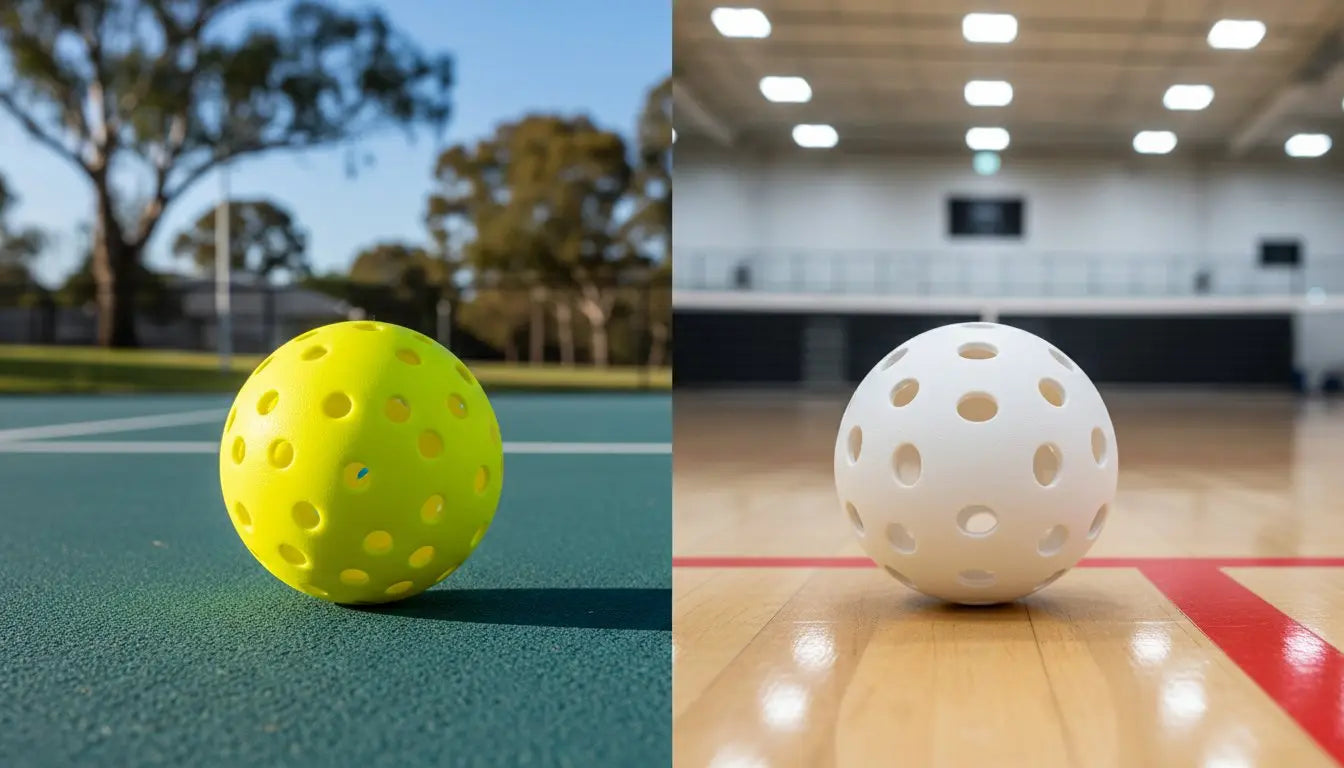
Your choice of pickleball is more important than your paddle. It's a bold claim, we know. You've likely spent weeks finding the perfect paddle with the right weight and sweet spot, but what about the ball itself? Think about the last time a rogue gust of wind sent your shot sailing wide, or a ball cracked mid-dink on a chilly court in Perth. Those aren't paddle problems; they're ball problems.
We're here to help you solve them. This guide delivers the ultimate breakdown of indoor vs outdoor pickleball balls, giving you the specialist knowledge to choose the perfect gear for any condition. You'll master the technical differences that make one ball fantastic for a gym floor and another tough enough for the Aussie elements, ensuring longer-lasting equipment and more consistent gameplay.
Get ready to explore everything from hole patterns and plastic hardness to bounce height and wind resistance. It's time to make a smarter, faster buying decision for your next match.
Key Takeaways
- Understand the core design differences, like hole count and plastic density, that determine a ball's flight and bounce on different surfaces.
- Discover how your choice between indoor vs outdoor pickleball balls directly impacts game speed, spin potential, and overall strategy.
- Learn how to select the perfect ball for unpredictable Australian weather, ensuring top performance in both summer heat and winter chill.
- Get our expert recommendations for 2026, helping you find the most durable and consistent balls available on the market today.
The Anatomy of a Pickleball: Why Court Choice Dictates Design
At its heart, a pickleball is a simple tool: a perforated, hollow plastic ball engineered for a low-flight bounce. It's this unique design that gives the sport its characteristic rhythm and feel. But if you've ever grabbed a ball from your bag and found it playing completely differently from your last game, you've discovered the core conflict in the indoor vs outdoor pickleball balls debate. You simply can't use the same ball for every environment and expect top-notch performance. The court surface, temperature, and even the presence of wind dramatically alter how a ball behaves.
To see these differences in action, this fantastic review from PickleballCentral breaks down the key characteristics:
While the question of What is a Pickleball? seems straightforward, the answer is more complex than it appears. To ensure fair play, USA Pickleball (USAPA) sets strict standards for all tournament-approved balls. These regulations create a baseline for manufacturers, but also provide a window for innovation. Every approved ball must meet these key specs:
- Weight: Between 22.1 and 26.5 grams.
- Diameter: Between 7.29 cm and 7.54 cm.
- Bounce Height: Between 76 cm and 86 cm when dropped from a height of 198 cm onto a granite surface.
These precise ranges allow manufacturers to design balls that are either softer and lighter (for indoors) or harder and heavier (for outdoors) while still being legal for play. This engineering directly impacts the 'speed of play' in modern 2026 pickleball, where a harder outdoor ball can lead to faster, more aggressive rallies, while a softer indoor ball encourages longer, more strategic dink rallies.
Hole Counts and Aerodynamics
The most obvious difference between indoor and outdoor pickleballs is the hole pattern. An indoor ball typically has 26 larger holes, while an outdoor ball has 40 smaller holes. This isn't an arbitrary choice; it?s all about aerodynamics. The larger holes on an indoor ball create more drag, helping to slow it down in a controlled, wind-free environment. Conversely, the smaller, more numerous holes on an outdoor ball help it maintain a more stable, predictable flight path despite wind and gusts, cutting through the air with less resistance.
Material Composition: PE vs. Advanced Polymers
The plastic used to make a pickleball is just as crucial as its hole pattern. Outdoor balls are made from a harder, more brittle plastic blend (often polyethylene or PE) to make them more durable on rough surfaces like asphalt or concrete. This results in a faster, harder-feeling ball. Indoor balls use a softer, more flexible polymer that provides a better feel and more control on smooth gym floors. The manufacturing process also plays a part, with single-piece rotationally molded balls generally offering superior durability and a more consistent bounce compared to two-piece injection-molded alternatives. Shore D Hardness is the industry standard for measuring pickleball density, with higher numbers indicating a harder ball.
5 Critical Differences Between Indoor and Outdoor Pickleball Balls
Grab any two pickleballs, and they might look similar at first glance. But the subtle design choices create a world of difference on the court. Understanding the critical distinctions in the indoor vs outdoor pickleball balls debate is your first step to playing a smarter, more consistent game. These aren't just minor variations; they fundamentally change how the ball flies, bounces, and feels off your paddle.
Let's break down the five key factors that separate these two types of balls.
- Hole Quantity: The most visible difference is the hole pattern. An indoor ball features around 26 larger, uniformly spaced holes. This design minimises air resistance, allowing for a truer, more stable flight path inside a wind-free gym. In contrast, an outdoor ball is drilled with approximately 40 smaller holes. This pattern is engineered to catch the air slightly, creating drag that helps it resist gusts and fly more predictably in open-air conditions.
- Hardness and Noise: Outdoor balls are made from a harder, smoother plastic polymer. According to one top pickleball equipment expert, this construction is specifically engineered for resilience on abrasive surfaces. This results in that crisp, loud 'pop' you hear on outdoor courts. Indoor balls are crafted from a slightly softer plastic, which gives them more grip on slick wooden or polyurethane floors and produces a much quieter sound.
- Bounce Height: This is a game-changer for timing. Thanks to their harder construction, outdoor balls have a higher and faster rebound on gritty asphalt or concrete courts, typically bouncing to about 81 cm from a 190 cm drop. Indoor balls, designed for smooth gym floors, have a slightly lower and more predictable bounce, usually around 76 cm from the same drop height. This 5 cm difference directly impacts your reaction time at the net.
Weight and Wind Resistance
That tiny 2.8-gram weight difference feels massive at the end of your paddle. Outdoor balls weigh around 26 grams, making them heavier and denser to slice through the air. This extra heft is crucial for preventing your baseline drive from 'drifting' sideways in a classic Melbourne breeze. The trade-off? A heavier ball requires more paddle 'punch' to generate pace, especially on dinks and reset shots inside the kitchen.
The Durability Gap
The plastic in an outdoor ball becomes extremely brittle in the cold. During those chilly Victorian winter mornings (below 10�C), they are notorious for developing cracks mid-rally. Conversely, an indoor ball used outside on a 30�C+ day can 'soften' and become mushy, losing its bounce and shape. Always check your gear before a match. Look for hairline fractures on outdoor balls and press indoor balls to feel for 'flat spots' that can ruin a rally. If you're finding your current balls aren't lasting, it might be time for an upgrade. Check out our specialist collection of indoor and outdoor pickleballs to find a set built to last.
Performance Comparison: How Your Game Changes with the Ball
Choosing between indoor vs outdoor pickleball balls isn't just about the court; it's about fundamentally changing the way you play. The ball you use directly impacts the speed, strategy, and feel of every single rally. From the moment it leaves your paddle, its design dictates how much spin you can generate, how it bounces on the court, and the overall pace of the game. Get this choice right, and you'll have a fantastic advantage.
The most immediate difference you'll feel is the speed. An indoor ball, with its 26 larger holes, catches more air. This creates significant drag, slowing its flight speed by an estimated 15-20% compared to its outdoor counterpart. This slower pace naturally leads to longer, more strategic dinking rallies. In contrast, an outdoor ball's 40 smaller holes and harder plastic (often with a Durometer D hardness rating of 80 or higher) allow it to slice through the air with much less resistance, favouring a faster, more aggressive style of play.
Spin and bounce are also dramatically different. The slightly textured surface of an outdoor ball grips the gritty face of modern paddles exceptionally well, allowing advanced players to generate high levels of topspin or backspin. Indoor balls, being smoother, offer less of this "grab." The ball's interaction with the court surface is critical too. On a polished indoor gym floor, a soft indoor ball provides a true, consistent bounce. Take that same ball outside onto a gritty court, and it will play poorly. An outdoor ball, however, is built for abrasive surfaces but can "skid" low and fast on smooth concrete, demanding quicker reactions.
So, how do you adapt? Let's say you've spent the summer playing at Melbourne's popular outdoor courts at Royal Park and are now moving to an indoor centre for winter. Here?s how to adjust your game:
- Moving from Outdoor to Indoor: You need to generate more of your own power. Shorten your backswing on drives and focus on a "lifting" motion for your third shot drops. The ball won't fly as far, so you can be more aggressive with your placement without fear of hitting it long.
- Moving from Indoor to Outdoor: Prepare for speed. Your reaction time at the net needs to be faster. You can use a more compact swing, as the ball will jump off your paddle with more velocity. Be ready for the ball to bounce higher and less predictably.
The Indoor 'Soft' Game
The forgiving nature of an indoor ball is perfect for developing a controlled "soft game." Its slower speed gives you a split-second longer to set up for shots, making intricate dinking battles easier to manage. This is especially true for the crucial third shot drop, where the ball's tendency to float allows for higher, softer arcs that land perfectly in the kitchen. It?s no wonder beginners often find indoor balls much more user-friendly.
The Outdoor 'Power' Game
If you're a "banger" who loves to hit hard drives, the outdoor ball is your best friend. Its harder, heavier construction (around 26 grams) rewards powerful shots and aggressive play. While you need to manage the occasional unpredictable bounce from a weathered court surface, the ball's weight and aerodynamics are ideal for powerful overhead slams. You can hit through the ball with confidence, knowing it will travel fast and true through the air.
Choosing the Right Ball for Australian Conditions
Picking the right pickleball isn't just about following the manufacturer's label. Here in Australia, our unique climate and court surfaces demand a smarter approach. A ball that plays perfectly on a purpose-built court in Queensland might crack on a cold Melbourne morning. Let's break down how to choose the perfect ball for your game, right here in Victoria.
The weather is your biggest opponent. On a scorching 40-degree summer afternoon, a standard outdoor ball becomes softer and spongier. The plastic expands, slowing the ball down and creating a higher, less predictable bounce. Conversely, during a frosty 5-degree winter morning session, that same ball turns hard and brittle. It will fly faster off the paddle but is far more likely to crack, especially after a powerful smash. This temperature sensitivity is a crucial factor in the indoor vs outdoor pickleball balls discussion for players with a single set of gear.
Then there?s the reality of our court surfaces. While some clubs have beautiful, cushioned acrylic courts, many indoor games happen in converted warehouses with rough, unforgiving concrete floors. In these venues, a traditional soft indoor ball would get shredded in just a few games. This is a classic case where an 'outdoor' ball, like the durable Franklin X-40, is the superior choice for an indoor setting simply because its harder plastic can withstand the high-friction surface.
The Rise of the Hybrid Ball
Enter the hybrid ball, designed with 32 to 38 holes to offer a middle ground. It's a fantastic option for the casual player who wants one ball that works reasonably well everywhere. Its main advantage is versatility. The downside? It's a master of none. It won't have the true, wind-resistant flight of a dedicated outdoor ball or the controlled feel of a proper indoor one. If you play socially across multiple venues, it's a perfect, simple solution.
Local Spotting: Brooklyn and Victoria Courts
We've noticed a key trend at local Melbourne clubs from Brooklyn to Hawthorn: visibility is king. The standard Optic Yellow ball is great on blue courts, but under the harsh glare of older stadium lighting or against a pale concrete floor, it can vanish. Many competitive players are switching to Neon Orange or even pink balls for better tracking. Your choice of ball colour can genuinely give you a split-second advantage in reacting to a shot. Check our Pickleball Equipment for the latest 2026 arrivals in high-visibility colours.
Ultimately, the best advice comes from your local community. Ask what the regulars are using at your court. The ongoing debate over indoor vs outdoor pickleball balls often gets solved by local experience. Don't be afraid to carry a few different types in your bag to match the day's conditions. Still feeling lost? Get personalised advice from our gear experts today and we?ll match you with the perfect ball for your game.
Expert Recommendations: The Best Pickleballs for 2026
You've learned the technical differences, now let's get down to the fun part: choosing the perfect ball for your game. Making the right choice in the indoor vs outdoor pickleball balls debate comes down to where you play and what you value most. Our team has tested dozens of options to bring you the top performers for Australian conditions in 2026.
For outdoor courts, the Franklin X-40 remains the undisputed champion in Australia. It's the official ball for the Australian Pickleball Championships for a reason. Its 40 precisely drilled holes provide a stable, predictable flight, even in a gusty Melbourne southerly. The single-piece rotational moulding means it resists cracking on abrasive hard courts, giving you a consistent bounce game after game. It?s the reliable workhorse you?ll see at 9 out of 10 social clubs and tournaments nationwide.
Indoors, the choice is more nuanced, often coming down to the Onix Fuse vs. the Selkirk SLK Hybrid. The Onix Fuse Indoor ball is fantastic for its true flight and exceptionally consistent bounce on wooden gym floors. Its slightly softer composition offers a bit more control for those intense dink rallies. In contrast, the Selkirk SLK Hybrid plays a little faster and harder, appealing to players who want more pop off the paddle. If your indoor venue has slower courts, the SLK can help speed up the game.
Looking for the best value? Don't overlook buying in bulk. For clubs and social groups, purchasing a 100-pack of balls can slash the per-ball cost from around A$5.50 down to A$3.80 or less. That?s a saving of over 30% that can be reinvested into court hire or new nets!
Before you finalise your purchase, run through this quick checklist:
- Where will I play 90% of the time? Be honest. If you?re almost always on an outdoor court, an outdoor ball is a non-negotiable.
- What?s my priority: pro-level performance or long-term durability? Tournament players need USAPA-approved balls, while social players might prefer a ball that lasts for months.
- What?s my budget per ball? Are you happy paying a premium for the latest tech, or does a value pack make more sense for your practice sessions?
Sturdy Racquets' Top 3 Picks
The 'Pro' Choice: Dura Fast 40. It?s fast, hard, and unforgiving, but its consistent play at a high level makes it the pick for serious tournament competitors.
The 'Durability' Choice: CORE Outdoor Pickleballs. These balls are built like a tank. Their seamless construction is designed to withstand hours of aggressive play on rough surfaces without cracking.
The 'Beginner' Choice: Onix Pure 2 Indoor. With its softer feel and slower, more forgiving flight, this ball helps new players build confidence and master the crucial dinking game.
How to Store Your Balls for Maximum Life
Your investment doesn't stop at the purchase. Proper care extends a ball's life significantly. Temperature control is critical. Leaving your pickleballs in a hot car on a 35�C day in Geelong will permanently soften the plastic and kill its bounce. Always store them in a cool, dry place at room temperature.
You should also clean your balls regularly. A quick wipe with a damp cloth after play removes court grit and grime. This not only keeps the ball playing true but also protects your paddle face. A gritty ball can scratch the surface of a A$250 paddle, reducing its spin and effectiveness. Want to see the difference for yourself? Visit our Brooklyn store for a hands-on feel of the 2026 range.
Master Your Court: Choosing the Right Pickleball for 2026
Choosing the right ball isn't a small detail; it's fundamental to your performance. Remember, indoor balls with their 26 larger holes are built for control on smooth surfaces, while the heavier, 40-hole outdoor balls are designed to cut through wind and withstand rough Aussie courts. The debate over indoor vs outdoor pickleball balls truly comes down to matching the ball's specific construction to your playing environment. Using the correct ball ensures a consistent bounce, predictable flight, and a much better game every time you step out to play.
Ready to find the perfect match for your game? Shop the 2026 Pickleball Range at Sturdy Racquets and get expert advice from Australia's leading racquet specialists. We offer fast shipping right across Australia, so you can get playing sooner. If you're local, feel free to visit our physical store in Brooklyn, VIC, for a chat and convenient local pickups.
Don't let the wrong ball hold you back. Let's get you geared up for your best season yet!
Frequently Asked Questions About Indoor vs Outdoor Pickleballs
Can I use indoor pickleballs outdoors?
No, you shouldn't use indoor pickleballs for outdoor play. They are made from a softer plastic that can't handle abrasive outdoor court surfaces like concrete or asphalt. The lighter construction and larger holes also make them highly susceptible to wind, leading to an unpredictable flight path. An indoor ball used outside will likely wear out or break within 1-2 games, so it's best to stick with the correct ball for the court.
Why do outdoor pickleballs have more holes?
Outdoor pickleballs have more holes to ensure a stable flight in windy conditions. A standard outdoor ball features 40 smaller, strategically drilled holes, which allow air to pass through with minimal resistance. In contrast, an indoor ball has only 26 larger holes. This aerodynamic design is crucial for outdoor play in Australia, giving you a truer, more predictable bounce and trajectory, even when a breeze picks up during your match.
How long does a typical pickleball last before it needs replacing?
An outdoor pickleball's lifespan is typically between 3 and 10 games. This depends heavily on court surface, weather, and your playing style. A hard-hitting player on a rough concrete court might crack a ball in just a couple of games, especially in temperatures below 15�C. Indoor balls last significantly longer, often for 20+ games, due to the controlled climate and smooth gym floors which cause much less wear and tear.
What is the best pickleball color for outdoor play in Australia?
Bright yellow is the most popular and effective pickleball colour for outdoor play in Australia. It provides excellent contrast against the common blue and green court surfaces found nationwide, making it easy to track under bright sunlight. For games played at dusk or under lights, vibrant orange can also be a fantastic choice as its high visibility stands out in lower-light conditions. Always choose a colour that is distinct from the court itself.
Is there a difference in noise between indoor and outdoor balls?
Yes, there's a significant difference in the sound they make. Outdoor balls are made from harder plastic and produce a loud, high-pitched "pop" upon contact, which is the classic sound many people associate with pickleball. Indoor balls are softer and create a much quieter, lower-pitched "thud." This noise difference is a key consideration for clubs near residential areas, where the quieter indoor balls are sometimes preferred to minimise disturbances.
Do pickleballs have an expiration date if left unused?
No, pickleballs don't have a printed expiration date. However, the plastic can become brittle over time, especially if stored improperly. Leaving balls in a hot car, where temperatures can easily exceed 50�C, can degrade the plastic and make them crack easily. To maximise their life, store your pickleballs in a bag at room temperature, away from direct sunlight. Properly stored balls should remain in top condition for over 2 years.
Why do some balls crack while others go soft?
Cracking is a common issue for outdoor balls, while going soft is typical for indoor balls. Outdoor balls are made from a hard, rigid plastic to withstand rough surfaces, but this makes them brittle, especially in cool weather (below 10�C). A hard shot can cause them to crack. Indoor balls use a more flexible plastic. Instead of cracking, they gradually lose their shape and bounce after many games, eventually becoming "soft" or unplayable.
Are all pickleballs the same size?
No, while they are very close in size, there are slight variations allowed within official rules. According to USA Pickleball guidelines, a sanctioned ball must have a diameter between 7.3 cm and 7.5 cm. Most brands aim for the middle of that specification. The major difference when comparing indoor vs outdoor pickleball balls isn't the size, but rather their weight, material hardness, and hole pattern, which are tailored for specific playing conditions.
Share:
Pickleball Paddle Weight Guide: How to Choose Your Perfect Match in 2026
How Wilson Became One of the Most Trusted Tennis Brands in the World