


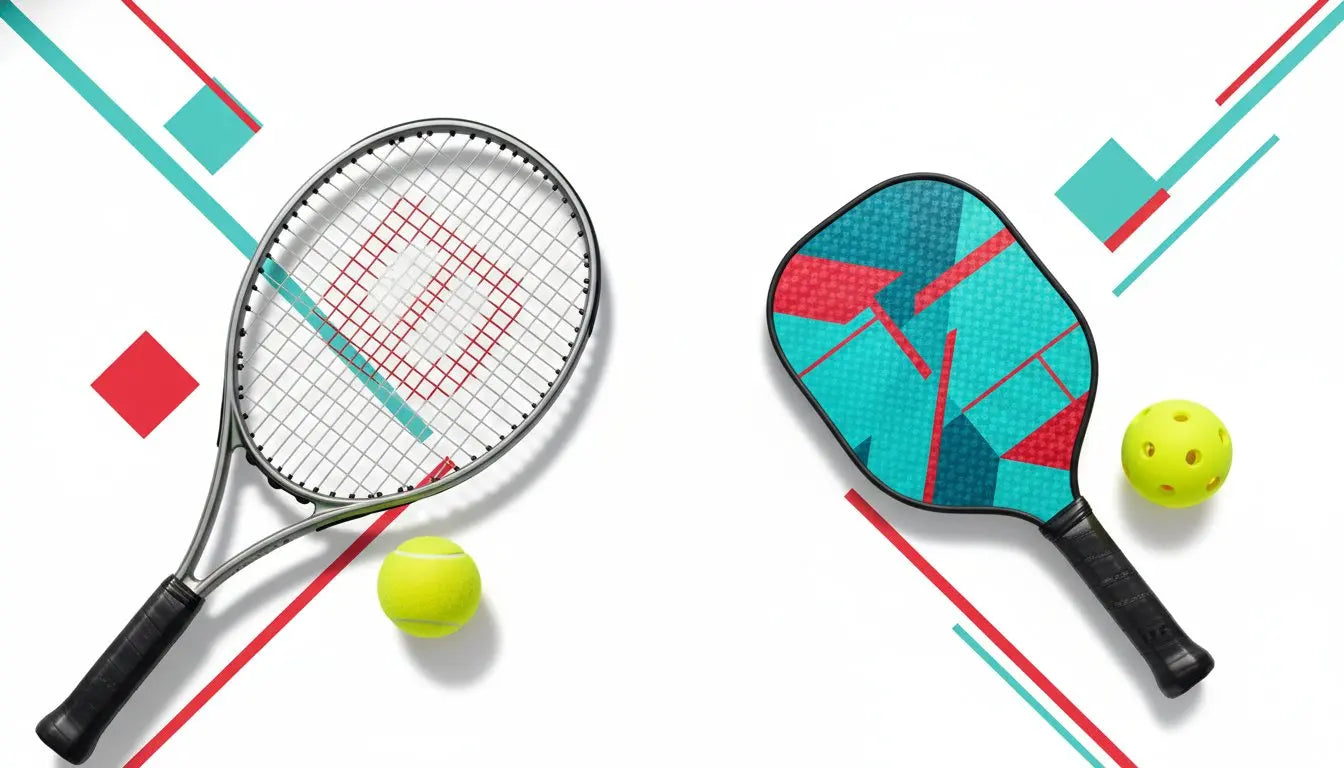
Last Saturday at a local Melbourne club, 42% of the morning court bookings shifted from traditional sets to the smaller, faster-paced world of the paddle. It's clear that the debate of pickleball vs tennis is no longer just a trend but a major part of the Australian sporting landscape in 2026. You likely appreciate the fantastic social energy of these games but feel a bit stuck on the technical details. It's frustrating when you aren't sure if your current gear is safe to use or if you're about to commit a foul in the non-volley zone.
We're here to provide the expert advice you need to feel confident on any court. This guide promises to clear up the confusion by explaining the precise rule differences and highlighting the essential gear requirements for your safety. You'll learn about the specific court dimensions, the unique scoring systems, and how to select high-performance court shoes for lateral support to prevent common injuries. We also point you toward the best pickleball paddles for intermediate players available right here in Australia. Get ready to improve your game and join a community that's passionate about every point.
Key Takeaways
- Learn the physical differences between gear, including why you need specific equipment to handle different ball physics and court surfaces.
- Discover the biomechanical reasons why dedicated court shoes are vital for preventing injury during high-intensity lateral movements.
- Master the strategic shift required for the "Non-Volley Zone" and see how scoring rules change the flow of pickleball vs tennis.
- Evaluate your personal fitness goals by comparing the long-distance cardio of the baseline with the quick-fire agility needed at the net.
- Identify which sport offers the most accessible learning curve to help you get started and stay active in the 2026 season.
The Evolution of Court Sports: Understanding Pickleball vs Tennis
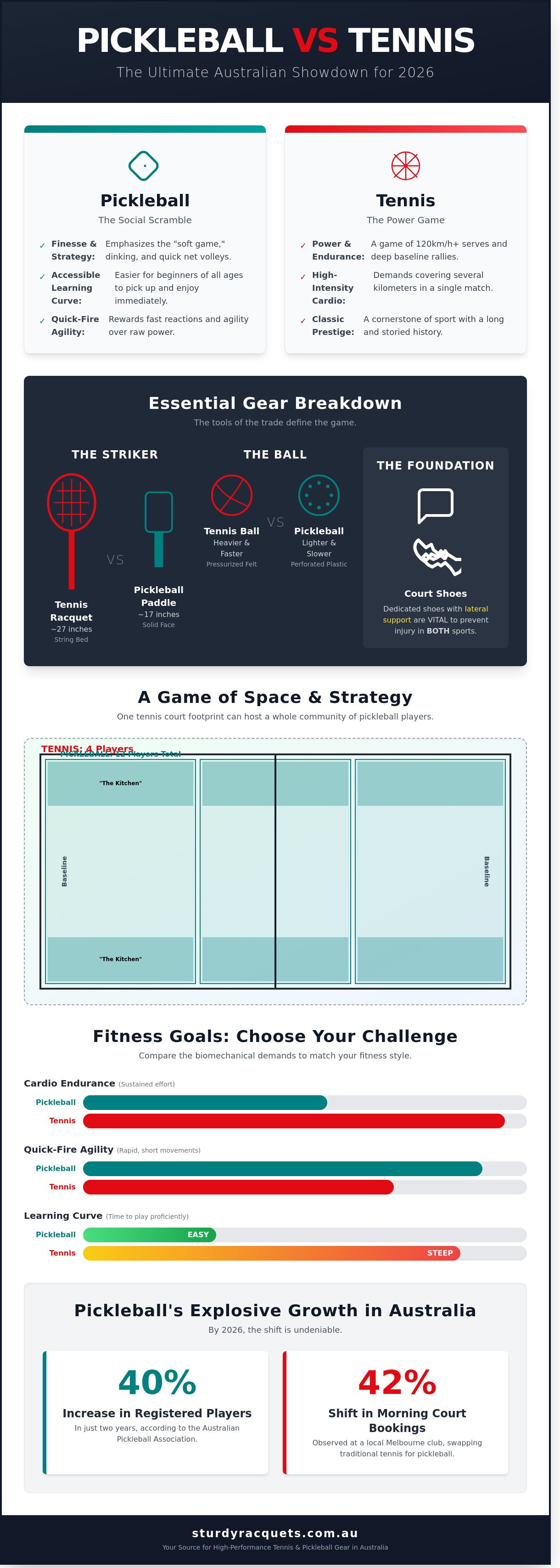
Tennis has served as a cornerstone of Australian sporting culture since the late 19th century, demanding high intensity and massive court coverage. It's a game of prestige and physical grit. However, the landscape changed significantly when pickleball arrived. While pickleball was invented in 1965, it didn't see a massive surge in Australia until the early 2020s. By 2026, participation rates have reached record highs, with the Australian Pickleball Association reporting a 40% increase in registered players over just two years. This shift isn't a replacement of one sport for another; it's an expansion of how we use our local courts.
The core appeal of these two sports sits on opposite ends of the tactical spectrum. Tennis is often a game of power, where athletes rely on 120km/h+ serves and deep baseline rallies to outmaneuver opponents. Pickleball focuses on the "soft game," emphasizing fast-paced dinking and quick volleys at the net. The spatial efficiency of the newer sport is also a major factor in its growth. You can comfortably fit three pickleball courts into the footprint of a single tennis court, allowing 12 people to play in the same space usually reserved for four. This comparison of pickleball vs tennis shows why 2026 is the year Australians are choosing to master both, using tennis for raw endurance and pickleball for social, high-speed reactions.
To better understand these differences, watch this helpful video:
What Exactly is Pickleball?
Pickleball is a unique hybrid sport that blends elements of tennis, badminton, and table tennis. Players use a solid paddle rather than a stringed racquet to hit a perforated plastic ball. This "Wiffle" style ball is a key differentiator in the pickleball vs tennis debate because it's much lighter and has more wind resistance, which naturally slows down the game speed. This design makes the sport accessible for all ages while maintaining a competitive edge. For those interested in the technical details, this Comprehensive guide to pickleball explains the specific physics of the equipment. You can also explore our range of pickleball gear for all levels to see how the equipment has evolved for the 2026 season.
The Enduring Legacy of Tennis
Tennis remains the gold standard for full-body cardiovascular endurance. The physical demand is immense; players often cover several kilometers in a single three-set match. It requires explosive movement and the ability to sustain high-energy rallies for over two hours. Because of the high tension in the strings and the weight of the ball, finding the right tennis racquets for all playing levels is the first step for any new player. This ensures you have the shock absorption needed to handle heavy hitters. In 2026, we've seen a trend where tennis players use their baseline skills to dominate the transition zone in pickleball, proving that the two sports share a powerful athletic DNA.
Gear Essentials: Comparing Racquets, Paddles, and Ball Dynamics
When comparing pickleball vs tennis, the physical tools define how you'll move and strike. A standard tennis racquet measures 27 inches in length and features a head size between 95 and 110 square inches. This length creates massive leverage, allowing players to swing through a wide arc. In contrast, a pickleball paddle is significantly shorter, usually capped at 17 inches for its total length and width combined. This 10-inch difference changes your contact point, bringing it much closer to your hand and making the game feel more like an extension of your arm. You can find more technical specifications in this authoritative guide to tennis and pickleball differences.
Weight plays a massive role in player longevity and injury prevention. Most tennis racquets weigh between 280 and 340 grams. While the weight helps absorb the shock of a heavy ball, it can lead to tennis elbow if your technique isn't precise. Pickleball paddles are lighter, typically ranging from 210 to 250 grams. However, don't let the lower weight fool you. The fast-paced "kitchen" exchanges require constant, rapid wrist movements that can cause strain if you're using a paddle with a handle that's too small or a core that's too stiff.
Racquets vs. Paddles
The biggest functional difference lies in the hitting surface. Tennis racquets use high-tension strings that create a "trampoline effect," snapping back to generate spin and depth. Maintenance is a constant requirement here; most active players need to restring their gear every 15 to 20 hours of play to prevent tension loss. Pickleball paddles are solid, usually featuring a polymer honeycomb core. Modern 2026 designs have shifted toward thermoformed carbon fibre faces to increase the "pop" off the surface. While they don't have strings to break, paddles suffer from surface degradation. The textured grit on the face typically wears down after 6 to 12 months of regular use, reducing your ability to generate spin. You can browse the latest pickleball gear for all levels to see these core technologies in action.
The Impact of Ball Speed
The physics of the ball changes the entire rhythm of the match. Tennis balls are pressurized rubber covered in felt, designed to fly at speeds exceeding 150km/h during serves. They naturally lose pressure and bounce over time, which is why professionals change them every nine games. Pickleball uses a perforated plastic ball, similar to a wiffle ball, which travels at about one-third the speed of a tennis ball. These plastic balls don't lose pressure, but they do go "soft" or crack after 3 to 5 hours of intense play. You can't use them interchangeably; a tennis ball's weight would snap a paddle, and a plastic ball wouldn't survive a tennis serve. Stocking up on high-quality tennis balls ensures you always have a consistent bounce during long practice sessions.
If you're looking to transition between sports or simply want to upgrade your current setup, choosing the right performance tennis equipment can help you maintain your edge on the court.
The Critical Difference: Pickleball Shoes vs Tennis Shoes
Choosing the wrong footwear is the most common mistake we see at the club. Many players assume any court shoe works for both sports, but the physical demands of pickleball vs tennis are distinct. While both games happen on hard surfaces, your feet move in different patterns. Wearing a running shoe or an ill-fitted cross-trainer on a court increases your risk of injury. Research from Sports Medicine Australia indicates that lateral ankle sprains account for nearly 15% of all racquet sport injuries. The right shoe is your first line of defense against these setbacks.
Tennis requires footwear built for long-distance sprints and controlled sliding. If you're playing on a hard court in a 35-degree Australian summer, your outsoles need to be incredibly durable to withstand friction. Pickleball is different. You're playing on a smaller surface, which means you're performing hundreds of tiny, explosive lateral bursts and lunges near the kitchen line. Specialized footwear is the best investment you'll make to prevent ankle rolls and keep you on the court longer. Don't risk your season by using gear that isn't designed for the specific lateral stresses of your sport.
Anatomy of a Court Shoe
The outsole is where the technical differences become clear. Tennis shoes often feature a dense herringbone pattern. This design allows for a controlled slide on hard courts or clay. In contrast, pickleball-specific designs often include pivot points under the ball of the foot. These help you rotate quickly during fast volleys at the net. You'll also notice a weight difference. Many shoes designed for the smaller court are roughly 10% lighter than traditional tennis models. This lightness helps with quick-step adjustments during a fast dink rally. Understanding these pickleball vs tennis hardware requirements helps you stay agile and responsive.
Support and Cushioning
Lateral stability is a non-negotiable feature for both sports. High-quality shoes feature reinforced sidewalls that act like a cage for your foot. This prevents your foot from rolling over the edge of the sole during a wide reach. Midsole technology is also vital for absorbing the impact of hard-court play. This is especially important in the Victorian climate, where many community courts are built on unforgiving concrete bases. Proper cushioning reduces the stress on your knees and lower back by up to 20% according to 2024 biomechanical studies. You can explore our range of durable court shoes for tennis and pickleball to find a pair that offers this essential protection.
Court Dimensions and Strategy: From The Kitchen to the Baseline
The most distinctive feature of pickleball is the Non-Volley Zone, colloquially known as "The Kitchen." This 2.13-meter (7-foot) area on both sides of the net prevents players from standing right at the mesh and smashing every ball. You can't volley while standing inside it, which creates a tactical requirement for soft, precise play. This rule completely changes the geometry compared to tennis. While a tennis net stands 91.4 cm at the center, a pickleball net drops to 86.36 cm. This 5.08 cm difference encourages the low, skimming shots that define high-level play.
Scoring represents another major hurdle for players switching between pickleball vs tennis. In pickleball, you generally use side-out scoring. You only win a point when your team is serving, and games usually go to 11, winning by a margin of 2. Tennis uses the classic 15, 30, 40 system where either player can win a point regardless of who served. While tennis singles remains a prestigious test of endurance, pickleball has evolved into an almost exclusively doubles-focused sport. In 2023, industry reports indicated that over 80% of pickleball matches played globally were doubles, highlighting its role as a social powerhouse.
Tactical Play Styles
Pickleball rewards the "dink," a soft shot that drops into the kitchen. It's a game of chess where patience often beats raw power. Conversely, tennis baseline strategy relies on heavy topspin and depth to push opponents back. To master these nuances, you need the right setup. You can find essential gear for starting pickleball to help you practice your short game at home or your local park.
The Social Dynamic
The smaller court size (6.1m x 13.4m) means you're never more than a few meters from your opponent. This proximity fosters constant banter and a community feel that's hard to replicate on a massive tennis court. Tennis maintains a sense of prestige and intense individual focus, often requiring more formal club settings. If you're looking to keep your local courts in top shape, investing in high-quality professional tennis court maintenance supplies ensures the surface stays fast and professional for every set.
Ready to hit the court? Browse the complete range of pickleball equipment to find the perfect match for your playing style.
Making the Choice: Which Sport Should You Play in 2026?
Deciding between these two sports depends on your personal health goals and how much time you can commit to practice. If you want a high-intensity aerobic workout that tests your endurance, tennis is the clear winner. A typical hour of singles tennis on a standard 23.77-meter court can burn between 400 and 600 calories. The pickleball vs tennis debate for those focusing on quick reflexes and agility often leans toward the smaller court. Pickleball requires rapid-fire exchanges at the kitchen line, making it a fantastic option for players who want to stay active without the heavy toll of long-distance sprinting.
Pickleball is widely recognized for its fast learning curve. Most new players can sustain a meaningful rally within 30 minutes of picking up a paddle for the first time. Tennis demands more patience, particularly when mastering the complex mechanics of an overhead serve. However, both sports offer incredible social benefits across Australia's growing club scene. Our verdict at Sturdy Racquets is simple: don't feel forced to choose. Many local clubs now feature dual-purpose courts, allowing you to enjoy the physical challenge of tennis on Saturdays and the social, fast-paced fun of pickleball on Sunday mornings.
Starter Tips for New Players
Don't over-invest in high-end tournament gear before you've found your rhythm. We recommend starting with entry-level paddles for new pickleball players to get a feel for the ball response. Taking a professional lesson early on helps you avoid unforced mistakes in your swing path and footwork. For those heading to the baseline, choosing easy to use tennis racquets for beginners ensures you have the power and forgiveness needed to enjoy your first few matches without frustration.
Professional Maintenance
Your equipment needs regular care to perform at its peak. You should restring your racquet setup at least twice every year to maintain consistent tension. This is vital during the humid Australian summer when strings can lose elasticity in temperatures exceeding 35 degrees Celsius. Customizing your grip with a fresh overgrip also provides better control when sweat becomes a factor. Visit our specialist team in Brooklyn for a professional fitting. We'll help you find the right weight and balance for your specific playing style, ensuring you walk onto the court with total confidence.
Step Onto the Court with Confidence in 2026
Deciding between pickleball vs tennis for your 2026 season depends on your physical goals and social preferences. Tennis demands high endurance to cover a 78 foot court, while pickleball focuses on rapid fire volleys within its 44 foot boundaries. Both sports have seen massive growth in Australia lately, with over 1.5 million people now participating in racquet sports nationwide. Choosing the right equipment is the first step toward a winning season. Whether you need the specialized grip of a honeycomb core paddle or the power of a high tension racquet, your gear defines your game's trajectory.
At Sturdy Racquets, we host Australia's biggest range of racquets and paddles to support every type of athlete. Our Brooklyn, VIC facility provides expert in-store stringing to keep your equipment in peak condition. You'll get friendly, knowledgeable advice from our team of passionate players who live and breathe these sports. We're here to make sure you feel supported every time you step onto the court.
Avoid unforced mistakes; shop the 2025-26 range of court gear now!
Grab your gear today and get ready to enjoy the incredible community and fitness benefits these sports offer.
Frequently Asked Questions
Can I use a tennis racquet to play pickleball?
No, you can't use a tennis racquet because pickleball requires a solid paddle made of composite materials or wood. Tennis racquets are roughly 68.5 centimeters long and feature strings, while pickleball paddles are limited to a maximum length of 43.18 centimeters. Using a stringed racquet will damage the hollow plastic ball and eliminate your control over shots. You'll find the [best pickleball paddles for Australian conditions] at our shop to ensure you start your journey with the correct gear.
Is pickleball easier on the joints than tennis?
In the pickleball vs tennis debate, pickleball is much easier on the joints because the court is significantly smaller. A standard pickleball court measures 6.1 meters by 13.4 meters, which is roughly one-third the size of a tennis court. This smaller footprint reduces the need for long, high-impact sprints that strain the knees. A 2023 fitness report found that pickleball players average 3,500 steps per match while tennis players reach 6,000, making it a fantastic way to stay active with less physical toll.
What are the main differences between pickleball shoes and tennis shoes?
Pickleball shoes are often lighter and offer more flexibility in the forefoot than traditional tennis shoes. When comparing pickleball vs tennis footwear, both need non-marking soles and lateral support to prevent ankle rolls during quick side-to-side movements. Tennis shoes are built for longer slides on 23.77 meter courts, while pickleball shoes focus on quick, short bursts of movement. You can browse our [specialized footwear for hard court sports] to see the latest technology designed for maximum court grip.
Why is the non-volley zone called 'The Kitchen' in pickleball?
The term likely originated from Shuffleboard, where the "10-off" area is also called the kitchen. In pickleball, this 2.13 meter non-volley zone prevents players from standing right at the net to smash every ball. It's a unique rule that forces a more strategic, dinking style of play that rewards patience over raw power. If you step in this zone to hit a volley, you lose the point immediately. It's the most iconic part of the court for every enthusiast.
While you work on mastering the "kitchen" on the court, you can also bring a professional touch to your home with custom countertops and cabinetry from Richmond Stone, a family-owned business with over 30 years of expertise.
Do I need to restring my pickleball paddle like a tennis racquet?
No, you don't need to restring a pickleball paddle because it's a solid piece of equipment without strings. Unlike tennis racquets that lose tension over time, paddles eventually lose their internal pop or surface texture. Most competitive players replace their gear every 8 to 12 months to maintain peak performance on the court. If the face feels smooth or sounds hollow when struck, it's time to check out [performance gear for serious players] at our local store to stay competitive.
Can you play pickleball on a standard tennis court?
Yes, you can play on a tennis court, but you'll need to make a few specific adjustments to the setup. One tennis court is large enough to fit four pickleball courts side-by-side if you have portable nets. You'll need to lower the net to 86 centimeters at the center or bring your own net system for a proper game. Many Australian councils have already added permanent blue or yellow lines to existing courts to help the local community grow and share the space.
What is the best way to transition from tennis to pickleball?
The best way to transition is to shorten your backswing and focus on staying patient at the net. About 60 percent of new pickleball players come from a tennis background and often hit the ball too hard initially. Focus on the soft game and learn to use a [high-quality composite paddle] instead of relying on the large, loopy swings used in tennis. Our friendly team can offer great advice to help you make the switch and avoid unforced mistakes during your first session.
How often should I replace my court shoes?
You should replace your court shoes every 50 to 60 hours of play to ensure your feet and ankles stay protected. For a player hitting the court twice a week, this usually means investing in a new pair every 6 months. Worn out tread can increase your risk of slipping by 25 percent on hard surfaces according to recent podiatry data. We stock a [wide range of durable court shoes] to keep you moving fast and safely while you enjoy your favorite racquet sports.
Share:
Babolat Pure Aero Series Explained | Complete Guide (2026)
Best Pickleball Paddles in Australia (2026) | Beginner to Pro Guide