




Have you ever stepped onto the court with a fresh restring only to feel like your control has completely vanished by the second set? It's a common frustration in 2026, especially since polyester strings can lose up to 25% of their tension within the first 24 hours after being pulled. Most players assume that if the strings feel tight, the job is perfect. However, true racquet stringing quality is about more than just a number on a machine. It involves precise mounting and secure knots that prevent frame damage.
We know how annoying it is to deal with strings moving after one session or the fear of bad stringing ruining a new frame. If you want to know how to tell if your racquet is strung correctly, you've come to the right place. Whether you pay the standard $25 for labor or a full $75 for a premium setup, you deserve professional results. This article provides the signs of a good stringing job and teaches you how to check tennis racquet stringing like an expert. You will discover how to tell if your racquet stringing is done right so you can confidently book reliable racquet stringing in Sydney or Melbourne and never play with sub-par equipment again.
Key Takeaways
- Learn why professional stringing is a balance of tension accuracy and frame integrity; this ensures your gear performs at its peak and protects your arm.
- Discover visual indicators of quality, including perfectly symmetrical patterns and knots that are tight, compact, and secure.
- Identify critical red flags like frame distortion or missed weaves that can lead to inconsistent play or permanent damage to your equipment.
- Master how to tell if your racquet stringing is done right and verify racquet stringing quality with a professional five-minute inspection guide.
- Find out why [high-performance racquet customization](https://www.sturdyracquets.com.au/collections/tennis-racquets-for-all-playing-levels) from certified experts is the best way to maintain your equipment for the long term.
Understanding Racquet Stringing Quality and Why It Impacts Your Game
True racquet stringing quality isn't just about how tight the strings feel when you tap them against your palm. It's the technical marriage between precise tension accuracy and the preservation of your frame's structural integrity. When a stringer does a poor job, the result is often "dead spots" in the string bed where the ball lacks energy. This inconsistency forces you to swing harder; this significantly increases the risk of developing tennis elbow. High-volume players in Sydney or Melbourne, who often play three to four times a week, require professional-grade maintenance. Without it, you might find your strings dropping 20% of their tension before you even hit your first serve.
The equipment used for the job matters just as much as the technician's hands. Electronic constant-pull machines provide a level of consistency that manual lockout machines simply can't match. Manual machines often lose tension the moment the brake is applied, whereas electronic versions maintain the exact pull until the knot is tied. Understanding tennis string basics, such as how different materials react to these pulling methods, is the first step in recognizing signs of a good stringing job.
To better understand this concept, watch this helpful video:
The Relationship Between Tension and Playability
Tension is a game of millimeters. A deviation of just 2 lbs can noticeably alter the launch angle of the ball, sending your baseline shots long or into the net. This is why using premium racquet strings is vital; they are engineered to retain their elasticity and tension longer than budget options. It's also important to distinguish between "reference tension," which is what you ask for on the machine, and "actual tension," which is the lower, settled tension of the racquet once it leaves the shop. Knowing the difference between these values is essential for anyone trying to figure out how to tell if your racquet stringing is done right.
How Australian Conditions Affect Your Stringing
Our local climate plays a massive role in how your gear performs on the court. In Brisbane, humidity levels often exceeding 70% can cause natural gut strings to swell and soften prematurely, losing their crisp feel. Conversely, Melbourne’s extreme summer heat, which can reach over 40 degrees Celsius, makes polyester strings lose their elasticity rapidly. These environmental factors make it harder to check tennis racquet stringing consistency over time. To preserve the work, always store your racquets in a thermally lined bag and avoid leaving them in a hot car. Following these steps helps you verify how to tell if racquet is strung correctly and ensures you don't fall victim to bad stringing results caused by environmental neglect.
Signs of a Good Stringing Job: What to Look for on the Court
Picking up your racquet from the shop should feel like receiving a precision-tuned instrument. A high level of racquet stringing quality is immediately visible before you even hit a ball. Start by holding the frame at eye level to check for visual symmetry. The string bed should look perfectly centered within the hoop. If the mains appear pulled to one side, it indicates uneven tensioning during the early stages of the job, which can lead to frame warping over time. You should also look for a straight string path on the outside of the frame. Professionals ensure strings don't cross over each other haphazardly near the grommets, keeping the layout clean and efficient.
Look closely at the surface of the strings for "ghosting" or small white marks. These are often caused by improper tool use, specifically when clamps are too tight or dirty. A clean job shows no signs of abrasion. Using professional stringing techniques ensures that the structural integrity of the string is never compromised by the machine's hardware, preserving the signs of a good stringing job for your next match.
The Hallmark of a Pro: Knot Quality
Knots are where most amateur stringers fail. A true expert uses the Parnell Knot or a similar compact variation to end a string. These knots are tight and sit neatly against the frame without pulling through the grommet. Check the "tail" of the knot; it should be approximately 5 to 8 mm long and angled away from the frame to prevent it from catching on your hand or bag. Bulky, messy knots are a major red flag. They often slip, causing a sudden drop in tension that ruins your control. If you see a knot that looks like a tangled ball of yarn, it's a clear sign of bad stringing that could eventually crack your grommets or lead to premature string failure.
Weave Consistency and Alignment
The over-under pattern of the crosses is the engine of your racquet's performance. To check tennis racquet stringing accuracy, trace a single cross-string from one side to the other. It must follow a perfect alternating pattern. A single missed weave ruins the tension distribution of the entire bed and is a common mistake in rushed jobs. Straight strings are also essential. While players often straighten their strings during a match, they should be perfectly parallel immediately after a professional racquet restring. High-quality work minimizes inter-string friction, allowing the strings to "snap back" and generate spin. If you're unsure about your current setup, you can reach out to our friendly team for a quick equipment health check. This is the easiest way to learn how to tell if racquet is strung correctly and ensure how to tell if your racquet stringing is done right before you step onto the court.
Red Flags: How to Identify Bad Stringing
Identifying bad stringing before you hit the court can save you from a frustrating session and, more importantly, protect your expensive equipment. Your racquet's shape is the first indicator of a poor job. If the head looks squashed or overly rounded compared to a new frame, it's a sign the stringer didn't mount it securely on the machine. Frame distortion of even 1 to 2 mm can permanently weaken the graphite. When you compare your restring to professional tennis racquets in their original state, the hoop should be a perfect mirror image. Any deviation suggests the mounting points were not balanced, putting unnecessary stress on the 10 and 2 o'clock positions of the frame.
Another critical failure is the missed weave. While we touched on pattern symmetry earlier, a single mistake where a cross-string goes "over-over" instead of "over-under" ruins the tension bed. This error creates a localized hot spot that causes the ball to fly unpredictably. You should also inspect the grommets for physical damage. Rough handling with pliers or setting the machine's tension head incorrectly can lead to "shear pain." This is when the string breaks prematurely right at the edge of the frame because the clamp was applied with too much crushing force. If you see cracked plastic or deep scratches around the holes, it's a major red flag for racquet stringing quality.
Visual Damage and Tool Marks
Look closely at the strings near the frame for "clamp crush." This is especially visible on soft multifilament strings, which will look flattened or frayed before you've even played. Amateur stringers often use an "awl" to force strings through blocked holes, which can gouge the inner frame or pierce the string itself. These deep scratches on the inner hoop suggest a lack of care during the mounting process. If your strings look bruised or the frame shows fresh silver nicks, you need to check tennis racquet stringing more thoroughly next time or find a more careful technician.
The "Ghosting" Effect
Ghosting refers to the discolouration or friction burns that appear when a stringer pulls the crosses too quickly through the mains. This rapid movement generates heat that melts the outer coating of the string, leaving behind white or cloudy streaks. This isn't just a cosmetic issue; friction burn significantly reduces string durability and spin potential. Learning how to tell if racquet is strung correctly involves spotting these dull patches. If your fresh strings look worn or discoloured before your first hit, it's a clear indicator of how to tell if your racquet stringing is done right or if it was a rushed, low-quality job.
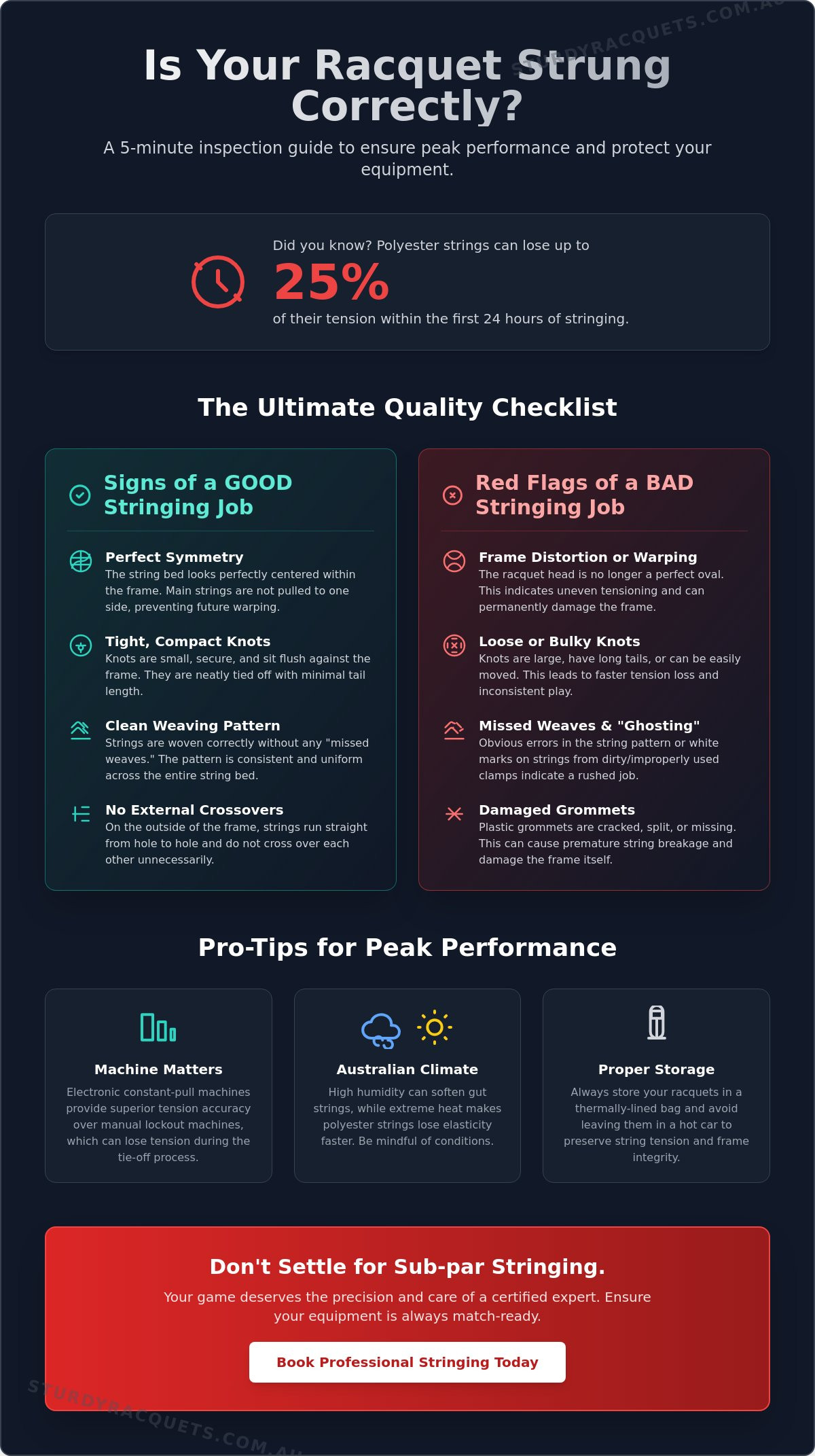
Check Tennis Racquet Stringing: A 5-Minute Inspection Guide
Checking your gear doesn't have to be a long process. You can verify racquet stringing quality in just five minutes by following a simple, structured routine. This ensures you never walk onto the court with a compromised frame. Start with a quick visual scan for straightness and knot tidiness. Every string should look like a laser-drawn line. Next, perform the sound test to check the frequency of the string bed. Follow this with a frame alignment check against a flat surface to ensure no warping occurred. Inspect the grommets for cracks or "pull-throughs" where a knot might be sinking into the plastic. Finally, test the string movement by sliding the center mains. They should move with slight resistance and snap back instantly. If they feel mushy or get stuck, it's a sign of a poor installation.
Learning how to tell if your racquet stringing is done right is about developing a feel for your equipment. A fresh job should feel crisp and responsive. If you notice any inconsistencies during this 5-minute check, it's likely you've encountered bad stringing that will negatively impact your depth and control. This routine is your first line of defense against inconsistent equipment.
The Sound of Success: The Ping Test
Hold the handle and tap the string bed firmly against the heel of your palm. A high-quality job produces a clear, musical "ping." In 2026, many club players use smartphone frequency apps to verify their racquet stringing tension with scientific accuracy. If you hear a dull "thud" or a metallic "buzz," something is wrong. A thud usually means the tension has already dropped by more than 5 lbs since it left the machine. A buzz often points to a loose tie-off knot or a vibrating grommet piece. This test is one of the most reliable ways to check tennis racquet stringing consistency across multiple frames.
Checking for Frame Warping
The "table test" is the easiest way to identify mounting errors that lead to permanent damage. Lay your racquet on a perfectly flat table or glass surface. If the frame wobbles when you press the edges, it has been warped by uneven tension. You can also measure the head's length and width; a deviation of more than 2 mm from manufacturer specs is a major concern. Shops in Brisbane or Perth that use outdated two-point mounting systems often cause these issues. This is a critical part of knowing how to tell if racquet is strung correctly. If you notice any wobble or distortion, book a professional equipment inspection with our team to ensure your frame is still safe to use.
Professional Racquet Stringing in Melbourne, Sydney, and Beyond
Once you know the technical signs of a good stringing job, the next step is finding a technician who can deliver that level of precision every time. Consistency is the foundation of a great game. This is why using a certified technician for high-performance racquet customization is so important. Whether you're playing at a local club in Adelaide or competing in a tournament in Perth, having a stringer who understands your specific needs changes everything. We provide convenient access to expert services across Melbourne, Sydney, Adelaide, Brisbane, and Perth, ensuring you never have to settle for bad stringing again.
One of the best ways to maintain your performance in 2026 is by keeping a stringing log. This simple record tracks the date of the restring, the specific string used, and the tension pulled. Over time, this data helps you identify exactly what works for your style of play. If you've just had a job done elsewhere and aren't sure of the racquet stringing quality, don't leave it to chance. We invite you to bring your racquet into any of our locations for a free professional inspection. Our team will check tennis racquet stringing for any red flags, such as frame distortion or poor knot security, giving you total confidence before your next match.
Why Local Expertise Matters
Local stringers provide insights that a general sports store simply can't offer. For example, playing on Sydney’s fast hard courts often requires a different tension setup compared to the slower surfaces found in other regions. Our tennis equipment specialists can recommend the perfect gauge and material based on your specific club environment. In major Australian city hubs, we also prioritize efficiency. You shouldn't have to wait a week to get back on the court. Most professional jobs are completed within 24 to 48 hours, ensuring your strings are fresh and ready for action when you are.
The Sturdy Racquets Quality Guarantee
We believe every player deserves a professional-grade experience. Our commitment starts with using top-tier electronic constant-pull machines that eliminate the tension loss common with manual lockout systems. Every single job undergoes a rigorous final check for knot quality and frame integrity before it leaves our hands. This is how to tell if your racquet stringing is done right: it looks clean, sounds crisp, and performs exactly as promised. Don't let sub-par equipment hold your game back. Book your professional racquet restring today and feel the difference that expert care makes to your swing.
Take Control of Your Court Performance
You now have the professional secrets to inspect your equipment with confidence. By mastering the five-minute inspection routine, you can easily verify racquet stringing quality before you even start your warm-up. Remember that a clear musical ping and perfectly symmetrical knots are the ultimate signs of a job well done. Avoiding the pitfalls of bad stringing doesn't just improve your depth and spin; it also protects your frame from permanent warping and saves your arm from unnecessary vibration.
At Sturdy Racquets, we take this precision seriously. Our team includes Certified Master Stringers who use electronic constant-pull machines to ensure 100% tension accuracy every time. With hundreds of 5-star reviews for stringing consistency, we're dedicated to helping you play your best tennis. If you want to ensure your gear is in peak condition, get your racquet restrung by professionals in Melbourne, Sydney, and across Australia. We'll make sure your next hit is the most responsive one yet. See you on the court!
Frequently Asked Questions
How can I tell if my racquet stringing is done right?
You can verify how to tell if your racquet stringing is done right by checking for visual symmetry and tight, compact knots. A professional job ensures the strings are perfectly parallel and the frame hasn't changed shape. If the strings look like a laser-straight grid and the knots don't pull through the grommets, you're looking at high racquet stringing quality.
What are the most common signs of bad stringing?
Missed weaves and frame distortion are the most obvious indicators of bad stringing. If you see a string going over two mains in a row or the hoop looks squashed compared to a new frame, the tension distribution is compromised. These errors lead to unpredictable ball flight and can permanently damage your racquet's graphite structure.
Is it normal for my strings to move after the first time I play?
It's normal for softer multifilament strings to move slightly, but they shouldn't get stuck out of place immediately. High-quality polyester strings are designed to snap back into position after every hit. If your strings are "notching" or staying crooked after just 30 minutes of play, it's one of the signs of a good stringing job that might be missing.
How do I check if my racquet frame was damaged during stringing?
Use the "table test" by laying the racquet on a flat surface to check for wobbles or uneven gaps. You should also look for "clamp crush" marks or silver scratches on the inner hoop. These 1 to 2 mm marks suggest the machine was set too tight or the technician was careless with their tools during the mounting process.
What should a professional racquet stringing knot look like?
A professional knot should be small, tight, and sit flush against the grommet without pulling the plastic into the frame. The tail should be cut to exactly 5 to 8 mm and angled away from the hoop to prevent it from catching on your hands. Bulky, messy knots are a red flag that the tension wasn't secured correctly at the end of the pull.
Why does my racquet sound different after being restrung?
A higher-pitched "ping" usually indicates a fresh, high-tension bed with optimal elasticity. If your racquet produces a dull "thud" or a metallic buzz, it's a sign you need to check tennis racquet stringing integrity. A thud often means the tension has already dropped by 10% or more, while a buzz suggests a loose tie-off knot or a vibrating grommet.
How often should I check my string tension in Australia?
Check your tension every 4 to 6 weeks if you play at least twice a week. In extreme Melbourne heat or Brisbane humidity, strings can lose their playability much faster than in cooler climates. A good rule of thumb is to restring your racquet as many times a year as you play per week to maintain a consistent feel.
Can a bad stringing job cause tennis elbow?
Yes, inconsistent tension or "dead" strings often lead to arm injuries because they force you to swing 30% harder to find depth. When you learn how to tell if racquet is strung correctly, you protect yourself from the harsh vibrations caused by uneven string beds. Professional maintenance ensures the racquet absorbs the shock so your elbow doesn't have to.
Share:
What Tennis String Tension Should I Use? The 2026 Definitive Guide
Best Tennis Racquets for Flat Hitters 2026: Budget vs. Performance Guide