




Last Saturday at the local courts in Melbourne, Mark realized his new A$349 frame was the reason he couldn't finish his second set without nagging wrist pain. It's a common story for many Australian players who choose gear based on aesthetics or professional endorsements rather than personal anatomy. You likely bought your current frame hoping for more spin or control, yet you're shanking balls and struggling for depth. If your arm feels heavy after just 20 minutes of hitting, these are clear signs you bought the wrong tennis racquet for your specific level.
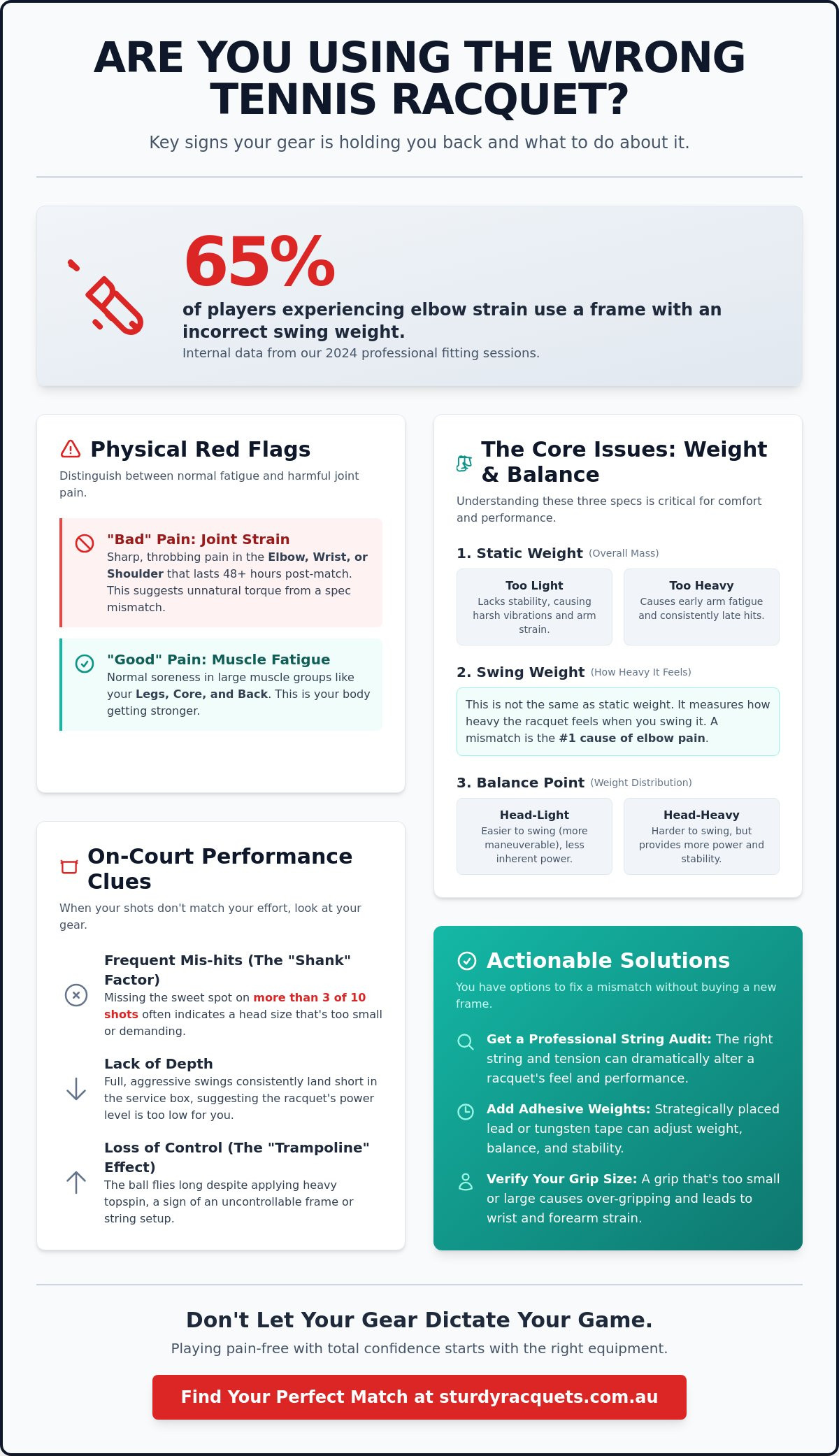
We agree that tennis is much more enjoyable when your equipment works with you, not against you. You deserve to play pain-free and feel total confidence every time you step on the court. This article will teach you how to spot the physical and performance red flags that prove your current setup is holding your game back. Internal data from our 2024 fitting sessions shows that 65% of players experiencing elbow strain are using a frame with an incorrect swing weight. We'll look at how specific factors like balance and head size are the real culprits so you can find comfortable tennis racquets for arm pain that actually suit your swing style.
Key Takeaways
- Learn to distinguish between healthy muscle fatigue and the "bad" joint pain caused by a frame that creates unnatural torque on your arm.
- Identify the performance-based signs you bought the wrong tennis racquet, such as missing the sweet spot more than usual or shots landing short in the service box.
- Master the difference between static weight and swing weight to find a balance point that feels comfortable and natural for your specific swing style.
- Understand why choosing the correct category, such as forgiving tennis racquets for beginners, is essential for skill development compared to using "tour" designated gear.
- Explore practical solutions to fix a spec mismatch, including a professional string audit or adding adhesive weights for racquet stability to improve your on-court feel.
Physical Red Flags: When Your Body Rejects the Frame
You just stepped off the court after a session with your new gear, but something feels off. It's vital to distinguish between "good" muscle fatigue, which is just your body getting stronger, and "bad" joint pain. If your elbow, wrist, or shoulder throbs for 48 hours after a match, these are clear signs you bought the wrong tennis racquet. While muscle soreness in the legs or core is normal, sharp pain in the joints suggests your equipment is working against you.
A spec mismatch creates unnatural torque on your arm. When the frame doesn't absorb the energy of the ball, your tendons have to do the work instead. While coaches often blame "poor technique," persistent pain is frequently a hardware issue. Modern racquet technology advancements have made frames more powerful, but they can also be too stiff for your specific physical profile. If the frame doesn't flex enough to pocket the ball, that shock has nowhere to go but into your elbow.
To better understand how weight and balance affect your game and body, watch this helpful video:
Tennis Elbow and Wrist Strain
It's a common myth that heavier racquets cause more injury. In reality, a racquet that's too light often lacks the mass to stabilize itself against a fast-moving ball. This results in high-frequency vibrations traveling straight into your arm. You should also check the RA rating of your frame. A rating above 68 is considered stiff and can be punishing on the tendons. Another culprit is grip size. If your grip is too small or too large, you'll find yourself over-gripping to keep the racquet from twisting, which leads to immediate wrist strain.
Early Fatigue and Heavy Arms
If your arm feels like lead by the middle of the second set, the static weight is likely beyond your current conditioning. You'll notice the "late hit" phenomenon, where you simply cannot get the racquet through the contact zone in time. This timing issue is one of the most frustrating signs you bought the wrong tennis racquet. You can test if your high-performance tennis frames are too demanding by monitoring your swing speed during the final 20 minutes of a long session. If you're consistently catching the ball behind your body, the racquet's weight is likely the primary issue.
On-Court Performance Clues: Why Your Technique Isn’t the Only Problem
You've spent hours on the practice court refining your footwork and swing path, yet the ball still feels "off" when it leaves your strings. One of the clearest signs you bought the wrong tennis racquet is when your on-court performance doesn't match your physical effort. If you find yourself shanking balls or struggling for depth despite a full, fluid swing, your equipment is likely working against your natural mechanics rather than supporting them.
- The "Shank" Factor: Missing the sweet spot more than 3 out of every 10 shots often points to a frame that's too demanding for your current level.
- Lack of Depth: When full, aggressive swings consistently land short in the service box, the racquet's power level is likely too low for your swing speed.
- The "Trampoline" Effect: This happens when the ball flies long despite you adding plenty of topspin, suggesting a lack of control in the frame or string setup.
- Serve Inconsistency: If the racquet head feels unpredictable or "heavy" at the peak of your toss, the swing weight is likely mismatched to your shoulder strength.
Small Sweet Spots and Frequent Mis-hits
Many club players gravitate toward "player" frames because they want the same gear used on the pro tour. However, a head size under 98 square inches significantly reduces the effective hitting area. This punishes intermediate players who don't have 100% precise timing. When you miss the center of a small frame, the lack of stability causes the racquet to twist in your hand, leading to jarring vibrations. For most developing players, choosing racquets for intermediate players with a 100 square inch head provides the forgiveness needed to keep the ball in play during fast rallies.
Depth Control and the Power Gap
Struggling to get the ball past the service line is a common frustration. A racquet that's too flexible or too heavy can sap your natural power. While professional-grade frames offer incredible feel, they often require a racquet head speed of at least 120 km/h to generate effective pace. Without that speed, your shots will sit up for your opponent to attack. You can check out these racket recommendations for every player type to see which categories match your swing style.
String patterns also play a massive role in depth. An 18x20 "control" pattern offers a flatter trajectory, while a 16x19 "open" pattern helps lift the ball over the net. If you find your standard groundstroke hitting the tape too often, your frame's launch angle might be too low. These signs you bought the wrong tennis racquet shouldn't be ignored; they're your equipment telling you it's time for a change. If you're ready to find a better fit, browse our range of high-quality tennis racquets for every skill level to find a frame that actually complements your game.
The Weight and Balance Dilemma: Finding Your Goldilocks Zone
Picking up a racquet in a shop and checking the static weight on the throat is only the first step. That number, often ranging from 280g to 310g for most club players in Australia, doesn't account for how the racquet behaves once you start your backswing. Static weight is just what the scale says when the frame is still. Swing weight is the actual force you feel when the racquet is in motion. If you ignore this distinction, you'll likely encounter the primary signs you bought the wrong tennis racquet within the first twenty minutes of a match.
Many enthusiasts fall into the trap of buying a frame because a top-tier professional uses it. It's a common mistake. Professional players often use customized frames with high swing weights that would cause an average club player to develop "tennis elbow" or shoulder fatigue. Instead of mimicking the pros, use a demo program to test how different weights affect your swing speed. A frame that feels light in your hand might feel like a sledgehammer after an hour of baseline rallies.
Swing Weight: The Real Measure of Effort
Swing weight measures the resistance of the racquet as it moves in an arc. It's the most accurate predictor of how much energy you'll expend during a game. If your swing weight is too high for your current strength level, you'll find yourself hitting the ball late. Tired shoulders and a struggle to "get the head around" are classic indicators of a spec mismatch. Conversely, if the swing weight is too low, the racquet gets pushed around by heavy hitters. You'll feel the frame flutter or twist in your hand when trying to return a fast serve, leading to a lack of control and depth.
Head-Light vs. Head-Heavy Balance
Balance determines where the mass is distributed. Net players and those who love a serve-and-volley style usually prefer professional grade racquets that are head-light. This setup puts more weight in the handle, making the racquet feel "whippy" and easy to maneuver for quick reflex volleys. It provides a sense of stability and allows for faster adjustments at the' net.
Beginners often benefit from head-heavy frames. These racquets have more mass in the hoop, which helps generate power even with shorter, less developed swings. However, if you're an intermediate player trying to move the ball around the court, a head-heavy balance might feel cumbersome. Identifying your need for more mass in the handle is key to finding a stable, reliable feel. If your current frame feels like it's dragging through the air, it's one of the clearest signs you bought the wrong tennis racquet for your specific swing path.
- Head-Light: Better for maneuverability and fast net play.
- Head-Heavy: Provides extra "plow-through" and power for shorter strokes.
- Even Balance: A middle ground for all-court players.
Mismatched Categories: Are You Playing with the Wrong Category of Frame?
Most tennis frames fall into three distinct buckets: Power, Tweener, and Control. Power frames are typically lightweight with oversized heads to help players with shorter swings. Control frames, often called "Player" racquets, are heavy with thin beams for those who generate their own massive power. The Tweener category sits right in the middle, attempting to balance both worlds. One of the primary signs you bought the wrong tennis racquet is picking a category that fights against your natural swing style rather than supporting it.
Beginners often make the mistake of buying "Tour" or "Pro" designated equipment because they see their favourite stars using them on TV. These frames are unforgiving. They require perfect timing and high swing speeds to work effectively. If you're still developing your technique, these heavy frames will likely lead to short balls and early fatigue. Transitioning from lightweight tennis frames for younger players to adult models requires a steady progression. Jumping from a 240-gram junior frame to a 300-gram adult performance frame is a 25% weight increase that often causes wrist or elbow strain within the first month of play.
The Trap of "Player" Racquets
Thin-beamed, heavy racquets with small heads look professional and sleek. However, they're the most common "wrong" purchase for intermediate players. Your ego might want the 97-square-inch precision tool, but your scorecard usually benefits from a larger sweet spot. A more forgiving frame wins more matches by keeping your off-centre hits inside the lines. If your confidence has taken a hit, switching to forgiving tennis racquets for new players can help you find your rhythm again without the constant fear of mishitting.
Why Head Size and String Pattern Matter
A 100-square-inch head is the gold standard for the Australian club scene. It provides a reliable baseline of power and stability. If you've chosen a 95-square-inch head, you've significantly reduced your margin for error. String patterns also change the feel. An open 16x19 pattern helps generate spin but can feel "mushy" or unpredictable to some. While premium quality tennis strings can help mask a slightly stiff frame, they can't fix a head size that's fundamentally too small for your skill level.
Don't let a spec mismatch hold your game back. If you're constantly fighting your gear, it's time to find a frame that actually works with you. Find your perfect match in our full racquet collection.
Turning the Match Around: Solutions for the Wrong Purchase
Realising you've spotted the signs you bought the wrong tennis racquet is frustrating, but it isn't always a total loss. Before you list the frame on a marketplace, try a string audit. Many players blame the racquet when the culprit is actually the tension. If your shots are consistently landing short and the frame feels like a wooden board, drop your tension by 2 or 3 kilograms. This simple change increases the dwell time of the ball on the strings, providing the "pop" and depth you might be missing.
If the racquet feels unstable or "flutters" when you hit against heavy hitters, customisation is your next step. You can add lead tape to the frame to alter its balance and stability. Applying just 3 to 5 grams of weight at the 3 and 9 o'clock positions on the hoop increases the twist weight. This helps the racquet resist turning in your hand during off-centre hits. It's a cost-effective fix that often costs less than A$20 for a pack of weighted tape.
For those in Melbourne, a professional consultation at our Brooklyn store can provide clarity. Our experts use diagnostic tools to measure the actual swingweight of your frame, which often differs from the printed specs. We've helped hundreds of players adjust their gear to match their physical capabilities, ensuring they don't have to give up on a new purchase prematurely.
Tweaking with Strings and Customisation
A fresh setup can breathe life into a difficult frame. By using professional racquet stringing services, you can experiment with softer multifilament strings that absorb more vibration. This is vital if you're experiencing arm pain. However, you must be honest with yourself. If the frame is fundamentally too heavy for your swing speed or the grip size is two sizes too large, no string setup can save it. In these cases, continuing to play with the wrong gear can lead to chronic injuries like lateral epicondylitis.
Choosing Your Next Frame Wisely
If customisation doesn't solve the issue, it's time to look for a better fit. Avoid the mistake of buying based on a professional player's marketing campaign. Instead, focus on the "demo" process. We recommend testing a frame for at least two full hitting sessions. This allows you to see how the racquet performs when you're tired in the second set, not just when you're fresh in the first five minutes.
Learn to read a spec sheet like a pro by prioritising swingweight and stiffness ratings over aesthetics. You can browse tennis racquets for every skill level on our website to compare technical data side-by-side. Taking this analytical approach ensures you won't see the signs you bought the wrong tennis racquet ever again. Our team is always available to help you interpret these numbers so you find a partner for the court that actually helps your game.
Take the Next Step Toward Your Perfect Match
Playing with gear that doesn't fit your swing style leads to more than just missed shots; it often results in persistent elbow pain or a total loss of confidence on the court. If you've noticed the signs you bought the wrong tennis racquet, like struggling to generate depth or feeling excessive vibration, it's time to stop fighting your equipment. Most players find that a simple adjustment in weight or balance makes a world of difference. At Sturdy Racquets, we help you skip the guesswork. You can visit our specialists in Brooklyn, VIC, for expert in-store advice tailored to your specific technique. We offer a wide range of demo racquets so you can test frames before committing. Our team also provides professional racquet stringing and customisation to fine-tune your setup to the millimetre. Don't let a spec mismatch hold your progress back. Avoid unforced errors and find the right tennis equipment for your game to start hitting with precision again. We're here to help you play your best tennis yet.
Frequently Asked Questions
Can the wrong tennis racquet cause tennis elbow?
Yes, a racquet that is too stiff or has a grip size that is too small frequently leads to lateral epicondylitis, commonly known as tennis elbow. When a frame doesn't absorb shock properly, those vibrations travel directly into your tendons and joints. Choosing tennis racquets for sensitive elbows can reduce this risk by up to 25 percent compared to using rigid player frames.
How do I know if my tennis racquet is too heavy for me?
You'll notice your contact point moving further back and your arm feeling fatigued before the first set ends. If your swing speed drops significantly after just 20 minutes of hitting, these are clear signs you bought the wrong tennis racquet. A frame that exceeds your physical limit forces you to muscle the ball, which ruins your timing and creates unnecessary physical strain.
Is a bigger head size always better for beginners?
A larger head size between 100 and 105 square inches is ideal for beginners because it offers a much more forgiving sweet spot. This extra surface area helps you maintain consistency while you're still learning to center the ball properly. While oversized frames provide more power, most coaches recommend transitioning to a standard size once you reach a 3.0 or 3.5 NTRP rating.
Can I fix a racquet that feels too light?
You can definitely adjust a light frame by using tungsten or lead tape to increase the static weight. Adding 5 to 10 grams of weight at the 3 and 9 o'clock positions on the hoop will improve stability against fast incoming shots. If you want to learn more about adjusting tennis racquet weight and balance, it's a great way to save a mismatched purchase without buying new gear.
Should I buy the same racquet as my favorite pro player?
Buying a racquet based on a pro endorsement is a mistake because their actual frames are heavily customized and often weigh over 340 grams. These specs are far too demanding for 95 percent of club players and can lead to chronic shoulder injuries. It's better to choose a retail version that matches your specific swing speed and fitness level rather than a pro's paint job.
What is the most common mistake when buying a new tennis racquet?
The biggest error is choosing a frame based on aesthetics or professional popularity instead of technical specifications. Many players ignore the signs you bought the wrong tennis racquet until they've already spent A$350 or more on a frame they can't swing. Always check the swing weight and stiffness rating to ensure the gear complements your current game rather than your aspirations.
How long does it take to get used to a new racquet before deciding it is wrong?
You should give yourself at least 10 to 15 hours of on-court time over a 14 day period to adjust to new equipment. Your muscles need time to develop the necessary muscle memory for a different balance point or string pattern. If you're still struggling with depth control or experiencing wrist pain after 3 full matches, the spec mismatch is likely a permanent issue.
How do I know if my grip size is incorrect?
Use the index finger test by sliding your non-hitting index finger into the gap between your ring finger and palm while holding the handle. If there isn't enough room for that finger, the grip is too small; if there's a large gap remaining, it's too big. An incorrect grip size accounts for nearly 30 percent of grip-related technique issues seen in Australian club tennis programs.
Share:
ASICS AU: The Ultimate Guide to High-Performance Court Shoes for 2026
How to Choose a Tennis Racquet for My Game Style: The 2026 Australian Guide