



That nagging pain in your elbow isn't just a sign of a hard training session; it's often the direct result of a racquet handle that doesn't fit your hand. We know it's frustrating to stare at markings like 4 3/8 or Size 3 online without being able to test the feel. Most players spend weeks researching frame tech but only seconds picking a grip. This tennis racquet grip size guide australia is designed to remove that uncertainty. Whether you're browsing performance tennis racquets for competitive play or seeking professional racquet stringing services, the right fit is a health decision, not just a preference.
We agree that you shouldn't have to guess when buying gear. You'll master the two easiest ways to measure your hand at home to avoid tennis elbow and play your best game. This guide covers the 2026 trend toward smaller grips for better topspin and includes an AU conversion chart for easy ordering. We'll preview the finger and ruler tests so you can find a definitive size number and feel confident hitting the court with your new equipment.
Key Takeaways
- Prevent chronic injuries like tennis elbow by understanding how handle dimensions directly impact muscle tension and racquet stability.
- Master the index finger and ruler methods to determine your exact measurements accurately before you buy gear online.
- Navigate our 2026 tennis racquet grip size guide australia to easily convert between European and US sizing for a perfect fit.
- Follow the "Golden Rule" of choosing the smaller size when in doubt, then customize the feel with absorbent tennis overgrips.
- Gain the confidence to order equipment online by learning how to fine-tune your racquet's handle for maximum comfort and control.
Why Grip Size is the Most Critical Spec for Your Tennis Racquet
Choosing a new frame is an exciting process, but getting the handle dimensions wrong can sideline you for months. Many players obsess over string tension or frame stiffness while completely overlooking the most vital connection point: the grip. In this tennis racquet grip size guide australia, we emphasize that handle size isn't just about comfort. It's a fundamental health and performance requirement. If your grip doesn't fit your hand, your technique will suffer, and your risk of chronic injury skyrockets.
Incorrect sizing is the primary culprit behind lateral epicondylitis, or tennis elbow. When a handle is too small, the racquet tends to twist in your hand upon impact. To prevent this, your muscles instinctively squeeze harder, creating a "death grip" that sends vibrations straight up your forearm. Over time, this repetitive strain causes micro-tears in the tendons. Modern tennis racquet technology has produced incredibly powerful frames, but that power is useless if your hand can't stable the racquet without excessive tension.
To better understand how the right handle affects your swing biomechanics, watch this helpful video:
A handle that's too large presents different challenges. It restricts your wrist's natural range of motion, which is devastating for serves and overheads. You'll find it difficult to get that final "snap" at the top of your swing, leading to flatter, less effective shots. For those browsing beginner tennis racquets, prioritizing grip size is actually more important than weight or balance. A perfectly weighted racquet will still feel "wrong" if you can't wrap your hand around it properly.
Performance Benefits of a Correct Fit
When your racquet fits like a glove, you gain immediate control during high-intensity rallies at your local Australian club. You'll notice that changing grips between an Eastern forehand and a Continental backhand becomes fluid and intuitive. This seamless transition is essential for modern play, especially when you're defending on fast hard courts and need to react in milliseconds. Confidence comes from knowing the racquet won't shift when you swing through the ball with full speed.
Avoiding Long-Term Arm Strain
Protecting your body is the ultimate goal of any tennis racquet grip size guide australia. Forearm fatigue often sets in halfway through a match if your grip is too small, as your muscles work overtime to absorb shock. This is a particular concern for younger players using junior tennis racquets who are transitioning to adult sizes. Their developing joints are at the highest risk for strain. A correctly sized grip acts as the first line of defense, allowing the racquet's internal dampening systems to work effectively on off-centre hits rather than forcing your arm to take the brunt of the impact.
How to Measure Your Grip Size: Two Simple Methods
Finding your exact handle measurement shouldn't be a guessing game. Whether you're testing a frame at a local club or browsing for your next racquet at home, these two methods are the industry gold standard. It's vital to measure your dominant hitting hand. If you're right-handed, use your right hand; if you're left-handed, use your left. Your dominant hand is often slightly larger due to muscle development, so measuring the wrong side can lead to a fit that feels restrictive during play.
Getting this right is the first step in our tennis racquet grip size guide australia. Accuracy here ensures you don't end up with a handle that twists or causes strain. If you're still feeling unsure after measuring, you can always chat with our friendly experts for a second opinion before you finalize your order.
The Index Finger (Handshake) Method
This method is the quickest way to check a racquet's fit if you have one in front of you. Pick up the racquet and hold it with a standard Eastern Forehand grip. This is often called the "handshake grip" because the racquet should feel like a natural extension of your arm. Once you have a firm hold, try to slide the index finger of your non-hitting hand into the gap between your ring finger and your palm.
In a perfect fit, your finger should slide into that space snugly with very little room to spare. If there's a massive gap, the handle is likely too big, which will limit your wrist snap. If you can't fit your finger at all, the handle is too small, which forces that "death grip" we want to avoid. Detailed steps for this technique are outlined in this comprehensive grip size measurement guide, which remains a reliable field test for players of all levels.
The Ruler or Measuring Tape Method
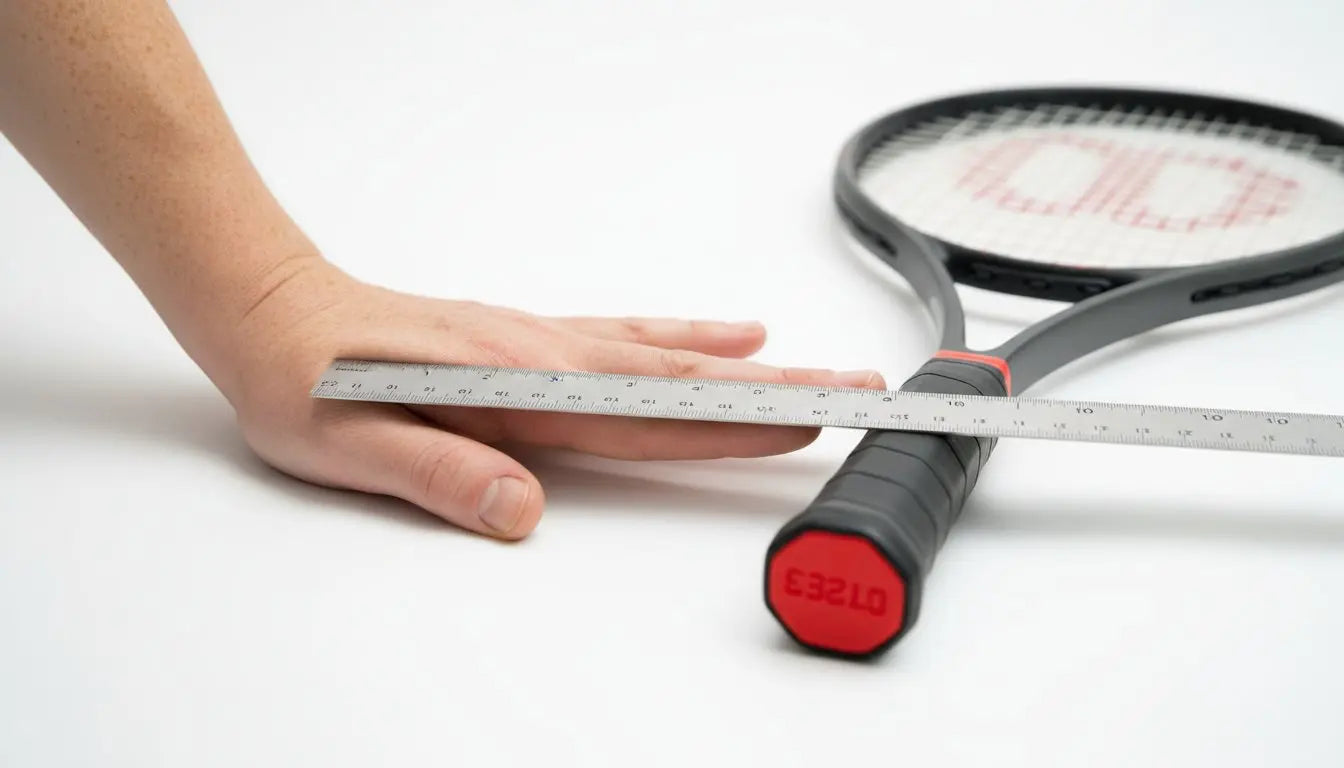
If you're shopping online and don't have a racquet handy, the ruler test is your best friend. It provides a concrete number that maps directly to Australian and international sizing charts. Follow these steps for an accurate reading:
- Open your hitting hand and extend your fingers, keeping them close together.
- Keep your palm flat and avoid curling your fingers toward your palm.
- Align the start of your ruler with the bottom lateral crease. This is the middle crease that runs across the center of your palm.
- Measure straight up to the very tip of your ring finger.
This measurement in inches is your grip size. For most adults, this will fall between 4 1/8 and 4 5/8 inches. Using this tennis racquet grip size guide australia ensures you have a data-driven number for your next purchase. Common mistakes include measuring to the middle finger or starting the ruler at the very base of the palm. Stick to the lateral crease and the ring finger for the most consistent results.
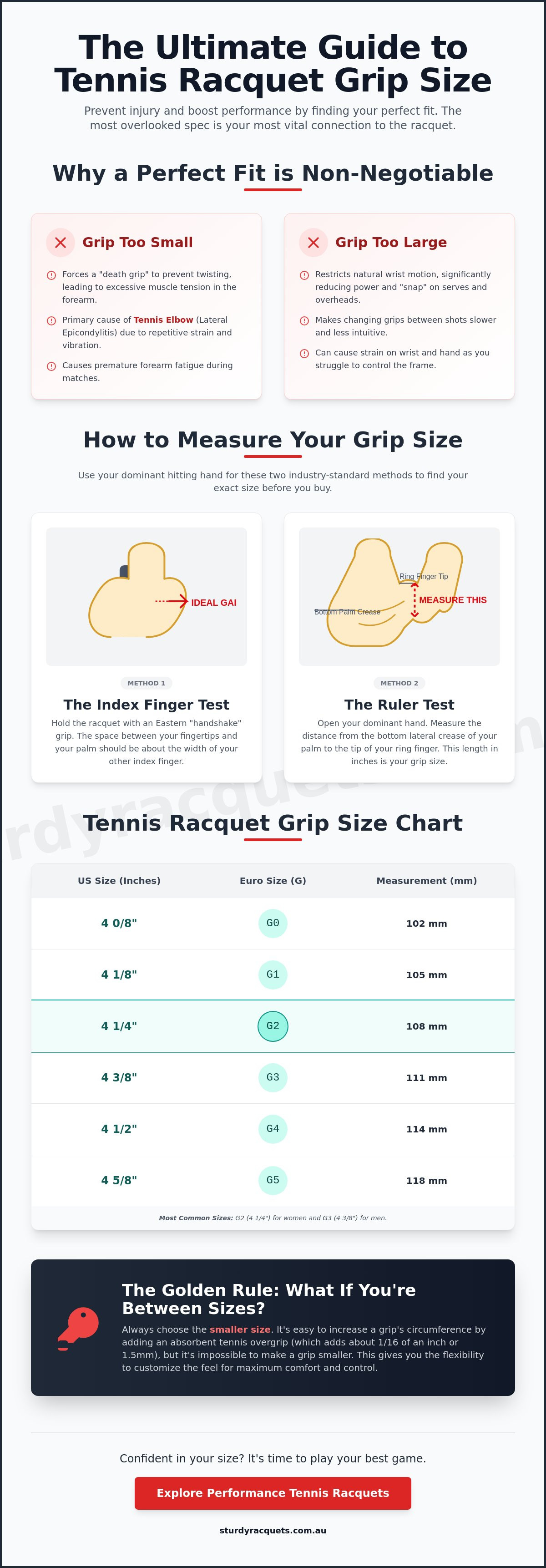
Tennis Racquet Grip Size Chart (AU, US, and EU Conversions)
Australian players often encounter a confusing mix of US and European stock when shopping online or in local pro shops. While some brands label their handles with inches, others use a simple numbering system from 0 to 5. This tennis racquet grip size guide australia is here to clear up that confusion so you don't end up with a frame that feels like a literal log in your hand. You can usually find your current size by looking at the butt cap of your racquet; it's typically embossed with a single digit or a fraction.
In 2026, we're seeing a clear trend toward smaller grip sizes across all levels of play. Modern tennis relies heavily on topspin and quick wrist acceleration. A slightly smaller handle allows for a more active wrist, helping you brush up the back of the ball more effectively. While Size 4 3/4 was once common, it's rarely seen today as players prioritize maneuverability over the bulky stability of the past. If you're browsing performance tennis racquets, keep this shift in mind.
Grip Size Conversion Table
- Size 0 (4 inches): Primarily for junior tennis racquets or adults with very small hands.
- Size 1 (4 1/8 inches): A standard choice for older juniors and many female club players.
- Size 2 (4 1/4 inches): The most popular size for women in Australia and a great fit for men with smaller hands.
- Size 3 (4 3/8 inches): The traditional starting point for most Australian men and women with larger hands.
- Size 4 (4 1/2 inches): Suitable for players with very large hands, though its popularity is declining in the modern game.
Choosing by Hand Size and Gender
While hand measurements are the most accurate tool, general averages offer a helpful baseline for Australian club players. Most women find their "sweet spot" at Size 2, while most men settle on Size 3. Juniors should be cautious about moving up too quickly; staying with a Size 1 or 2 helps them develop proper stroke mechanics without straining their developing joints.
Charts are excellent, but nothing beats a physical test. If you're located near Melbourne, visiting a specialist shop in Brooklyn VIC allows you to hold different handle sizes side-by-side. Feeling the bevels of the handle in person provides a level of certainty that online guides can't fully replicate. This hands-on approach is especially useful if you're transitioning between different brands, as handle shapes can vary slightly even if the numerical size is the same.
Troubleshooting: What if You Are Between Sizes?
Finding yourself caught between two measurements is a common dilemma for many players. If the ruler test puts you right in the middle of a Size 2 and a Size 3, you might feel stuck. The "Golden Rule" in this situation is simple: always choose the smaller grip size. It's far easier to increase a handle's thickness than it is to decrease it. This tennis racquet grip size guide australia focuses on helping you customize that fit so it feels exactly right for your hand and playing style.
Choosing smaller gives you the flexibility to use different types of wraps to reach your ideal circumference. A handle that's too large from the start leaves you with very few options other than potentially replacing the entire racquet. If you're struggling to decide, reach out to our friendly team for a quick consultation on which size will best suit your needs.
The Power of the Overgrip
An overgrip is the most effective tool for fine-tuning your handle. These thin, replaceable wraps are designed to go over your racquet's original base grip. Adding a single overgrip typically increases the handle size by about 1.5mm, which is exactly 1/16 of an inch. This is the perfect amount to bridge the gap between two standard sizes without making the handle feel cumbersome.
Beyond just sizing, overgrips are essential for maintaining a secure hold on your racquet. We recommend checking out our range of essential tennis accessories to find grips that offer the specific texture you prefer, whether that's "tacky" for extra stickiness or "dry" for maximum sweat management. Regularly changing your overgrip ensures that your handle dimensions remain consistent and your racquet doesn't slip during a crucial point.
Customising for Australian Conditions
The Australian climate has a surprising impact on how your equipment performs. In the sweltering humidity of a Sydney or Brisbane summer, your hands will naturally sweat more. This moisture can make a handle feel thinner and less stable. Using an extra-absorbent overgrip is a must in these regions to maintain your tennis racquet grip size guide australia standards and prevent the racquet from twisting.
In contrast, players in Melbourne or Hobart might notice their hands feel slightly different during the colder winter months. Cold weather can make the materials in your base grip feel firmer and less forgiving. If you need a more permanent change than an overgrip provides, you can use a heat-shrink sleeve. These sleeves slide over the handle and, when heated, provide a consistent increase of 1/8 of an inch, which equals one full grip size. Pairing a customized grip with professional racquet stringing ensures your entire setup is optimized for the demanding Australian courts.
Expert Advice for Australian Shoppers at Sturdy Racquets
While global guides offer a decent starting point, they often lack the local context that makes a difference for players down under. This tennis racquet grip size guide australia is built specifically for our local conditions. We understand that a player facing a humid afternoon match in Darwin has different needs than someone playing a brisk morning session in Hobart. Our team brings years of on-court experience to help you choose gear that actually performs when the pressure is on.
If you're located in Melbourne, we highly recommend visiting our Brooklyn store for a hands-on grip assessment. There's no substitute for actually holding a frame in your hand. You can feel the subtle differences between handle shapes and bevels that a screen just can't show. If you're elsewhere in the country, don't worry. We provide fast shipping across Australia, reaching enthusiasts from Adelaide to Perth and everywhere in between. You can browse our curated selection of tennis racquets for all playing levels and have your new equipment delivered directly to your door with total peace of mind.
Personalised Sizing Support
Our staff members act as your personal gear consultants. We've seen many enthusiastic beginners make the common mistake of buying "too much" racquet. This usually means a frame that is too heavy or a grip that is too large for their current technique. We help you avoid these pitfalls by matching your hand measurements to the right frame specifications. A complete court setup involves more than just your hands, though. We also help you coordinate your equipment with the right tennis shoes to ensure your footwork is as stable and reliable as your swing.
Ordering with Confidence Online
We know that buying a racquet online can feel like a gamble if you aren't sure about the fit. That's why we take a "no-stress" approach to every order. We provide detailed product descriptions for all our beginner tennis racquets, highlighting the specific handle dimensions and weight balances. If you're still unsure after using our measurement tips, our team is always available for a quick chat to verify your choice before you commit.
Once you've found your perfect fit, we invite you to join our growing community of sports enthusiasts. We're more than just a retail outlet; we're a hub for players who want to improve their game. By joining us, you'll get access to ongoing gear advice, local tips, and professional insights that keep you performing at your peak. Whether you're hitting the local club for a social hit or preparing for a tournament, we're here to support every step of your journey.
Step Onto the Court with Total Confidence
You now have the essential tools to ensure your equipment supports both your health and your performance. By mastering the index finger and ruler tests, you've removed the guesswork that often leads to painful injuries like tennis elbow. Remember the 2026 trend toward smaller handle sizes for better topspin, and don't forget the golden rule: always choose the smaller size if you're stuck between two options. This tennis racquet grip size guide australia is your roadmap to a more comfortable and powerful game.
Our team in Brooklyn, Victoria, is ready to provide expert advice tailored to your specific hand size and playing style. We offer fast shipping to Melbourne, Sydney, Adelaide, Brisbane, and Perth, ensuring your gear arrives exactly when you need it. From professional customization to high-quality stringing, we're here to support every aspect of your journey on the court. If you're still unsure about your measurements, contact our racquet experts for personalized sizing advice. We're excited to see you playing your best tennis yet!
Frequently Asked Questions
Is it better to have a tennis grip that is too big or too small?
It's generally better to choose a grip that's slightly too small because you can easily build it up. You can use overgrips or heat-shrink sleeves to add thickness until the handle feels perfect. Reducing a handle that's too large is nearly impossible without damaging the racquet's internal structure. Selecting a smaller base size gives you the flexibility to customize the feel based on the weather or your current comfort level.
What is the most common tennis racquet grip size for men in Australia?
The most frequent grip size for men across Australia is 4 3/8 inches, which is labeled as Size 3. While this is the traditional standard, many modern players are moving toward Size 2 to gain better control over topspin. Following a tennis racquet grip size guide australia ensures you don't just follow the crowd but find the measurement that actually fits your hand's unique geometry.
Can I change the grip size of my racquet after I buy it?
You can certainly increase the size of your racquet handle, but making it smaller is much more difficult. Most players use overgrips to add about 1.5mm of thickness or heat-shrink sleeves for a more permanent full-size increase. If your racquet is already too large, your only real option is to replace the thick base grip with a thinner version or a couple of overgrips to try and shave off a few millimeters.
How do I know if my tennis grip is worn out and needs replacing?
You'll know your grip is worn out when it feels slippery, looks discolored, or begins to flake off in your hand. A fresh grip should feel tacky or absorbent, providing a secure connection without requiring a tight squeeze. If you find yourself adjusting your hand constantly between points because the racquet is shifting, it's time to visit a pro shop for a replacement wrap to maintain your control.
Does an overgrip change the balance of my tennis racquet?
Yes, an overgrip will slightly change your racquet's balance by adding weight to the handle. A typical overgrip weighs between 5 and 7 grams, which shifts the balance point toward the handle. This makes the frame feel slightly more headlight. While professional players might notice this change, most club enthusiasts find the added comfort and sweat absorption far outweigh the minor shift in weight distribution during a match.
What grip size should a 10-year-old child use?
Most 10-year-old players will find a Size 0 or Size 1 to be the best fit for their hands. It's important to use a tennis racquet grip size guide australia even for juniors to avoid handles that are too bulky. A handle that's too large for a child's hand prevents them from learning proper grip changes and can lead to early wrist fatigue during their coaching sessions or weekend matches.
How often should I change my overgrip in the Australian summer?
You should consider changing your overgrip every 2 to 5 hours of play during the peak Australian summer. Heat and humidity cause sweat to build up quickly, which destroys the tackiness of the material. If you play in high-humidity areas, keeping a few spare overgrips in your bag is essential. This ensures you always have a dry, secure surface to hold when the match gets intense and the temperature rises.
Is there a difference between European and US grip sizing?
The only difference between European and US sizing is the label on the butt cap. US sizes are measured in inches, such as 4 1/2, while European sizes use a single digit from 0 to 5. They refer to the exact same handle circumference. A Size 3 in Europe is the same as 4 3/8 in the US. Knowing this conversion makes it much easier to shop international brands without getting confused by the labels.
Share:
The Benefits of 17 Gauge Tennis String: Why Thinner is Better in 2026
DIY Tennis Racquet Grip Replacement: The Complete 2026 Pro Guide