



You rip a heavy topspin shot, feeling the ball bite into the strings... only to see it fly a foot long. Sound familiar? For so many passionate players, finding the best tennis strings for spin and control feels like a constant battle. The wrong setup can leave you feeling disconnected from the ball or, worse, worried about a stiff string causing arm pain. It?s frustrating when you know your equipment isn't helping your game, and the huge range of options available in Australia can feel overwhelming.
But it doesn't have to be! This player's guide is here to give you the confidence to choose the right gear. We'll break down the key differences between string types and show you how to create the perfect setup for your style. You'll discover our top-notch recommendations that deliver exceptional spin without sacrificing precision, allowing you to swing freely and keep the ball in. Get ready to find the perfect string and unlock your best tennis.
Key Takeaways
- Understand the "snap-back" effect-the key mechanism that allows modern strings to grip the ball and generate massive topspin.
- Find our top 5 expert picks for the best tennis strings for spin and control, each chosen for its exceptional blend of bite and precision.
- Learn how to create a personalised setup by using a hybrid string combination, the secret used by pros to fine-tune their feel.
- Discover why your string tension is just as important as the string itself for dialling in the perfect level of power and control.
How Strings Actually Create Spin and Control: The Basics
Ever wondered how a thin set of strings can generate vicious, dipping topspin while also letting you paint the lines with precision? It's a fantastic question! The search for the best tennis strings for spin and control is all about balancing two key physical concepts. Understanding these basics is the first step to finding the perfect string setup for your game.
To see these principles in action, the team at TopSportGear have put together this brilliant video:
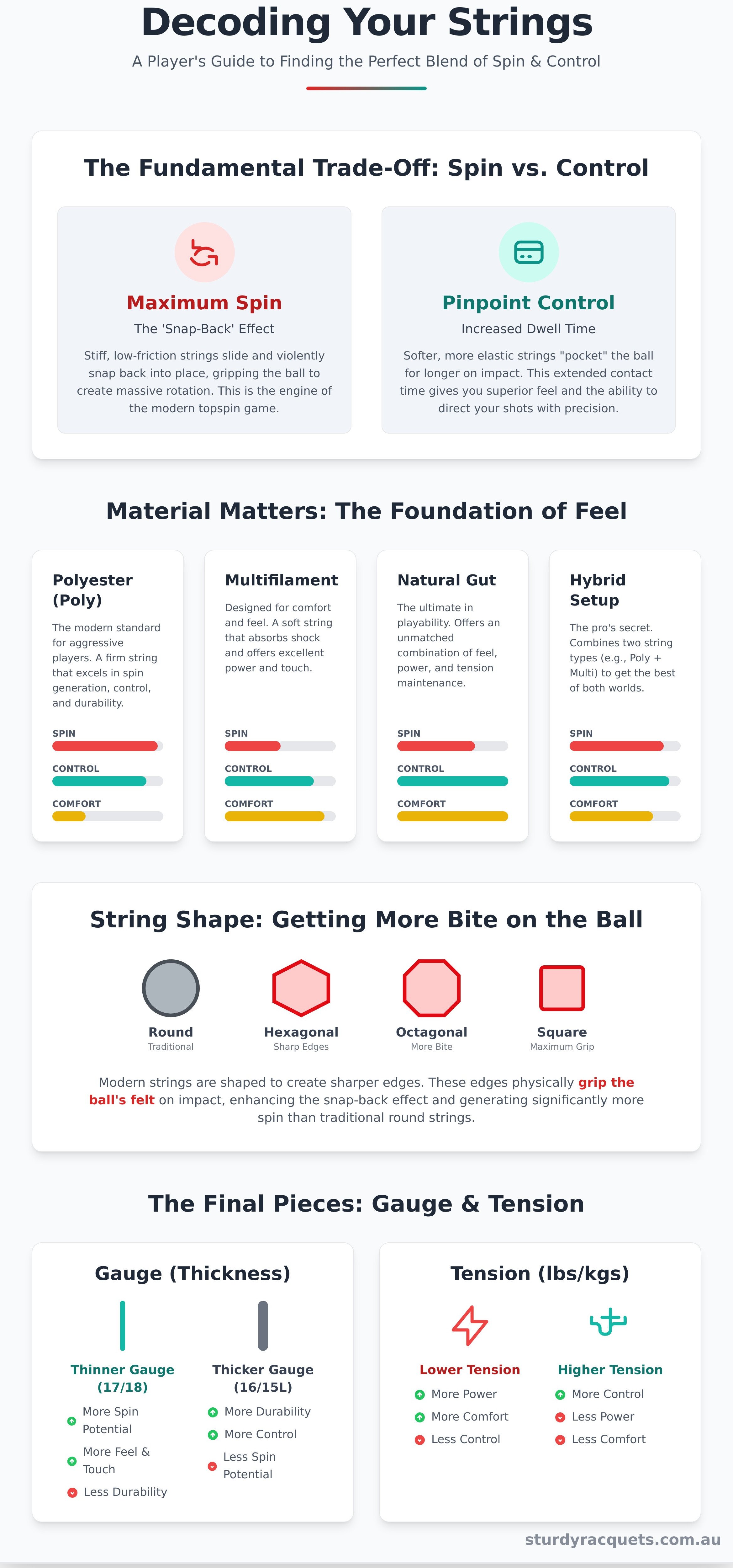
At its heart, the challenge lies in a trade-off between grip and give. You want strings that bite the ball for spin but also pocket it for control. Let's break down the two main forces at play.
The 'Snap-Back' Effect: Your Secret to Heavy Topspin
This is the engine behind the modern topspin game. When you brush up the back of the ball, low-friction main strings slide out of alignment against the cross strings. Think of it like stretching a rubber band. As the ball leaves your racquet, these main strings violently ?snap back? into their original position. This rapid movement grips the ball?s felt and launches it forward with a massive amount of rotation. Stiff polyester (poly) strings are the undisputed kings of snap-back, making them a top choice for aggressive players.
Dwell Time: The Key to Pinpoint Accuracy
Dwell time is simply how long the ball stays connected to your stringbed during impact. A longer dwell time gives you a much better ?feel? for the shot, allowing you to guide the ball with exceptional accuracy. Softer, more elastic strings like natural gut and multifilaments excel here. They create a deeper pocketing effect, cupping the ball for a split-second longer. The specific Tennis string composition plays a huge role in how much a string can stretch, directly impacting your control and comfort.
Here?s the classic trade-off: The stiff, slick polys that provide amazing snap-back often have a shorter dwell time, which can feel 'boardy' or unforgiving. Conversely, the soft, comfortable strings with fantastic dwell time can feel less spin-friendly. The secret is finding the right balance for your game, which is exactly what we'll explore next.
Decoding the Specs: What to Look For in a Spin & Control String
Walking into the world of tennis strings can feel overwhelming, but it doesn't have to be. Understanding three key specifications-material, shape, and gauge-is the secret to finding the best tennis strings for spin and control for your unique game. This guide will break down exactly what to look for on product descriptions, empowering you to make a confident and informed choice that will elevate your performance on the court.
Material Matters: Polyester vs. Multifilament vs. Hybrid
The material of your string is the foundation of its performance. Each type offers a distinct blend of spin, control, comfort, and durability.
- Polyester (Poly): The modern standard for spin and durability. These firm strings are perfect for aggressive players with fast swings who generate their own power and need the string to help tame it.
- Multifilament: Designed for comfort, feel, and power. These softer strings are made of hundreds of microfibers, which helps absorb shock and provides excellent ball pocketing for superior touch and control. They are a fantastic choice for players with sensitive arms.
- Natural Gut: The ultimate in playability, offering an unmatched combination of feel, power, and tension maintenance. While it's the most premium option, its performance is legendary for a reason.
- Hybrid: The perfect compromise for many players. A hybrid setup uses two different strings (typically a durable poly in the mains and a softer multifilament or natural gut in the crosses) to deliver the best of both worlds: spin and control from the poly, with comfort and feel from the softer string.
String Shape and Texture: Getting More Bite on the Ball
This is where modern spin technology truly shines. While traditional strings are perfectly round, many of the best tennis strings for spin and control now feature a shaped or textured profile. These strings come in common shapes like hexagonal, octagonal, square, or twisted to create sharper edges that literally grip the ball on impact.
This increased friction is essential; a deeper understanding of the physics behind tennis spin reveals how this "bite" allows the string to grab the ball's fuzz and impart massive rotation. If your goal is heavy topspin, a shaped polyester string is your top choice.
Gauge (Thickness): Finding the Balance Between Feel and Durability
Gauge simply refers to the string's thickness. It's a crucial factor that involves a direct trade-off between playability and lifespan. The numbering system can seem backward at first: a higher number means a thinner string.
- Thinner Gauges (17, 18): Offer enhanced spin potential and a much better feel. The ball sinks deeper into the stringbed, creating more snapback for extra rotation. The downside is that they break more quickly.
- Thicker Gauges (15L, 16): Provide exceptional durability and more control, making them ideal for hard hitters and chronic string breakers. However, they feel stiffer and offer less spin potential than their thinner counterparts.
Top 5 Strings for the Ultimate Blend of Spin and Control
Ready to find your perfect match? We've done the hard work and narrowed down the huge range of options to bring you our top picks. These are the market-leading strings that deliver an exceptional combination of bite and precision, shot after shot. Whether you're a tour-level pro or a dedicated club player, this list has some of the best tennis strings for spin and control available in Australia today.
The Tour Favourite: Luxilon ALU Power
You can't talk about control and spin without mentioning ALU Power. This iconic polyester string is a benchmark on the pro tour for a reason. It offers a firm, connected feel that gives players incredible confidence to swing out, knowing the ball will land exactly where they aim. While it excels at generating spin, its true strength is its top-notch control and feel.
- Key Strengths: Exceptional control, fantastic feel, and great spin potential.
- Best For: Advanced players with full, fast swings who generate their own power and prioritise precision.
The Spin Monster: Babolat RPM Blast
If you live and breathe topspin, RPM Blast is your weapon of choice. Its famous octagonal shape is engineered to physically grip the ball, a key factor in how string patterns create spin by maximising string snap-back. The response is firm and low-powered, rewarding aggressive baseliners who love to dictate play with heavy, dipping shots from the back of the court.
- Key Strengths: Massive spin generation and a highly controlled response.
- Best For: Aggressive baseliners with modern, fast swings looking to dominate with spin.
The All-Rounder: Solinco Hyper-G
A modern classic, Solinco Hyper-G strikes a fantastic balance between performance and playability. This square-shaped co-polyester string is renowned for its spin-friendly nature and excellent tension maintenance. It plays slightly softer than ALU Power or RPM Blast, offering a bit more comfort and pop without sacrificing the control needed for pinpoint accuracy. It's a true do-it-all string.
- Key Strengths: Great spin, reliable control, and impressive tension stability.
- Best For: Intermediate to advanced players seeking a perfectly balanced performance string.
The Comfort-Control Hybrid: Wilson NXT Control
Not everyone wants or needs a stiff polyester. Wilson NXT Control is a premium multifilament designed to mimic the feel and control of natural gut. It provides an arm-friendly response that's perfect for players with sensitive elbows or those who prefer a more traditional feel. It offers fantastic touch and precision, making it one of the best tennis strings for spin and control when used in a hybrid setup with a poly in the mains.
- Key Strengths: Superb comfort, excellent feel, and precise control.
- Best For: Players needing arm-friendly comfort or those creating a hybrid string bed for enhanced feel.
The Pro Secret: Hybrid Stringing for a Custom Feel
Once you?ve experimented with full beds of polyester or multifilament, you might find yourself wishing you could combine the best qualities of each. What if you could have the sharp bite of a poly with the soft feel of a multifilament? You can! Welcome to the world of hybrid stringing-the ultimate solution for customising your racquet?s performance.
The concept is simple: we use one type of string for your mains (the vertical strings) and a different type for your crosses (the horizontal strings). This allows you to blend characteristics like spin, control, comfort, and durability to create a string bed that?s perfectly tailored to your game. It?s a fantastic way to find the best tennis strings for spin and control without compromising on arm comfort.
Why Go Hybrid? The Best of Both Worlds
The magic of a hybrid setup lies in how the main and cross strings work together. The main strings dominate the racquet's feel and are primarily responsible for generating spin. By using a spin-friendly polyester in the mains, you get that incredible grip on the ball. We then pair it with a softer multifilament or natural gut in the crosses to absorb shock, enhance feel, and add a touch of power, reducing the harshness often associated with a full bed of poly.
Popular Hybrid Combinations for Spin and Control
Ready to get started? Here are a few tour-proven and club-favourite combinations our stringers at Sturdy Racquets highly recommend:
- Classic Pro Setup: Luxilon ALU Power (Mains) + Natural Gut (Crosses). This is the gold standard used by countless pros. It offers an exceptional blend of power, control, spin, and unmatched feel.
- The Durable Performer: Solinco Hyper-G (Mains) + Synthetic Gut (Crosses). A fantastic, budget-friendly option that provides massive spin potential and great control from the poly, with a forgiving synthetic gut to soften the string bed.
- Arm-Friendly Spin: A soft poly like Luxilon Element (Mains) + Wilson NXT (Crosses). This setup is perfect for players who want the spin benefits of polyester but need maximum comfort and vibration dampening to protect their arm.
Is a Hybrid Setup Right for You?
A hybrid is an excellent choice if you love the control a polyester string gives you but find a full bed too stiff or unforgiving on your arm. It's also the perfect path for players who love to tinker and fine-tune their gear to gain that extra edge on the court.
The possibilities are nearly endless, and finding your perfect match is a rewarding process. Not sure where to begin? That's what we're here for. Ask our expert stringers for a personalised hybrid recommendation!
Don't Forget Tension: The Final Piece of the Puzzle
You've done the research and selected a fantastic set of strings. But hold on-the job isn't finished yet! Choosing the string is only half the battle. The absolute best string in the world won't perform as expected if it's not strung at the right tension for your game. Tension is the final, critical variable that fine-tunes the relationship between power, control, and spin, turning a good setup into a great one.
Lower Tension vs. Higher Tension
Think of string tension as a dial for your racquet's performance. Turning it up or down creates a significant difference in how the ball feels and reacts off the stringbed. Here?s a simple breakdown of the trade-offs:
- Lower Tension: Creates a greater "trampoline effect," launching the ball with more power. This also allows the strings to bite into the ball for longer (increased dwell time) and snap back more dramatically, boosting spin potential and comfort.
- Higher Tension: Reduces the trampoline effect, providing a more controlled and predictable response. The ball spends less time on the strings, which can feel more direct but may reduce power and spin generation for some players.
For most modern polyester strings, a great starting point for the average club player is somewhere in the 48-54 lbs range. This offers a fantastic blend of playability and performance.
Finding Your Perfect Number
So, where do you begin? The best approach is to start in the middle of your racquet?s recommended tension range and play with it for a few sessions. From there, you can begin to fine-tune. If you want more control, try increasing the tension by 2 lbs on your next restring. Craving a bit more pop and spin? Drop it by 2 lbs.
Remember, finding the perfect tension is a personal journey. What works for a pro or your hitting partner might not work for you. Experimentation is key to unlocking the full potential of the best tennis strings for spin and control. Don't be afraid to try a few different setups until you find that "just right" feeling.
Avoid the unforced error of guessing your tension. Getting expert advice and a professional string job ensures your strings perform exactly as they were designed to. Ready to dial in your racquet? Get your racquet strung to perfection at Sturdy Racquets. Our knowledgeable team is here to help you find the perfect setup for your game.
Find Your Perfect String, Unleash Your Best Game
Choosing the right string is a true game-changer. As we've covered, factors like a string's shape and material, a custom hybrid setup, and the perfect tension all work together to create incredible spin and pinpoint accuracy. Understanding these elements is the first step to taking full control of your shots and adding serious bite to your game.
Ultimately, finding the best tennis strings for spin and control is about matching the right technology to your unique playing style. The perfect setup is out there, and our team of passionate players is here to help you discover it. With Australia's biggest range of racquets and gear and a professional in-store racquet stringing service, we provide the expert advice you need to make the right choice with confidence.
Ready to transform your shots? Explore our huge range of tennis strings online. and get ready to play your best tennis yet!
Frequently Asked Questions
Which string material is best for players with tennis elbow?
For players with tennis elbow, arm comfort is the top priority. We highly recommend softer strings like a premium multifilament or natural gut. These materials absorb significantly more impact shock than stiff polyester strings, which helps reduce stress on your arm and joints. While polyesters are fantastic for spin, their stiffness can aggravate sensitive elbows. A hybrid setup, with a soft multifilament in the crosses, can be a great compromise for comfort and performance.
How often should I replace my spin and control strings?
A great general rule is to restring as many times per year as you play per week. However, the best tennis strings for spin and control, especially polyesters, lose tension and playability much faster than other strings. To maintain that crisp feel and maximum spin potential, competitive players often replace these high-performance strings every 10-20 hours of play. If your strings feel dead or you have to work harder to generate spin, it?s definitely time for a change.
Does a thicker or thinner string give more control?
It?s a fantastic question with a bit of nuance! Generally, a thinner string (a higher gauge, like 17 or 18) provides more control and feel. Thinner strings physically embed into the ball more on impact, which enhances bite and spin potential. This improved feedback gives you a better connection to the ball for more precise shot-making. Thicker strings (lower gauge, like 16) offer exceptional durability and a more muted, predictable response that some players prefer for control.
Will using a shaped polyester string automatically give me more spin?
While a shaped polyester string is a key ingredient for massive spin, it won't automatically do all the work. These strings-with their triangular, square, or octagonal edges-are designed to grab the ball and amplify the spin you generate with your technique. To truly unlock their potential, you need a fast, modern swing with a steep upward angle on the ball. Think of shaped strings as a top-notch tool that rewards great technique with exceptional rotation.
What is the main difference between Luxilon ALU Power and Babolat RPM Blast?
These are two of the most popular polyester strings, but they offer a different feel on court. Luxilon ALU Power is famous for its exceptional blend of control, power, and a crisp, connected feel-it?s a benchmark for a reason. Babolat RPM Blast, with its iconic octagonal shape and slick coating, is engineered specifically for maximum spin generation. It typically feels a bit softer and more muted than ALU Power, making it a huge favourite among aggressive baseliners looking for heavy topspin.
Can I use the same tension for a polyester string as a multifilament?
Absolutely not! This is one of the most common restringing mistakes we help players avoid. Polyester strings are significantly stiffer than multifilament or synthetic gut. As a golden rule, you should string a full bed of polyester at least 5-10% lower in tension. For example, if you love your multifilament at 55 lbs, you should try your polyester around 48-52 lbs. Stringing a poly too tight creates a harsh, board-like feel that?s tough on your arm.
Share:
7 Clear Signs You Need a New Tennis Racquet
Natural Gut vs Polyester Strings: The Ultimate Player's Guide