



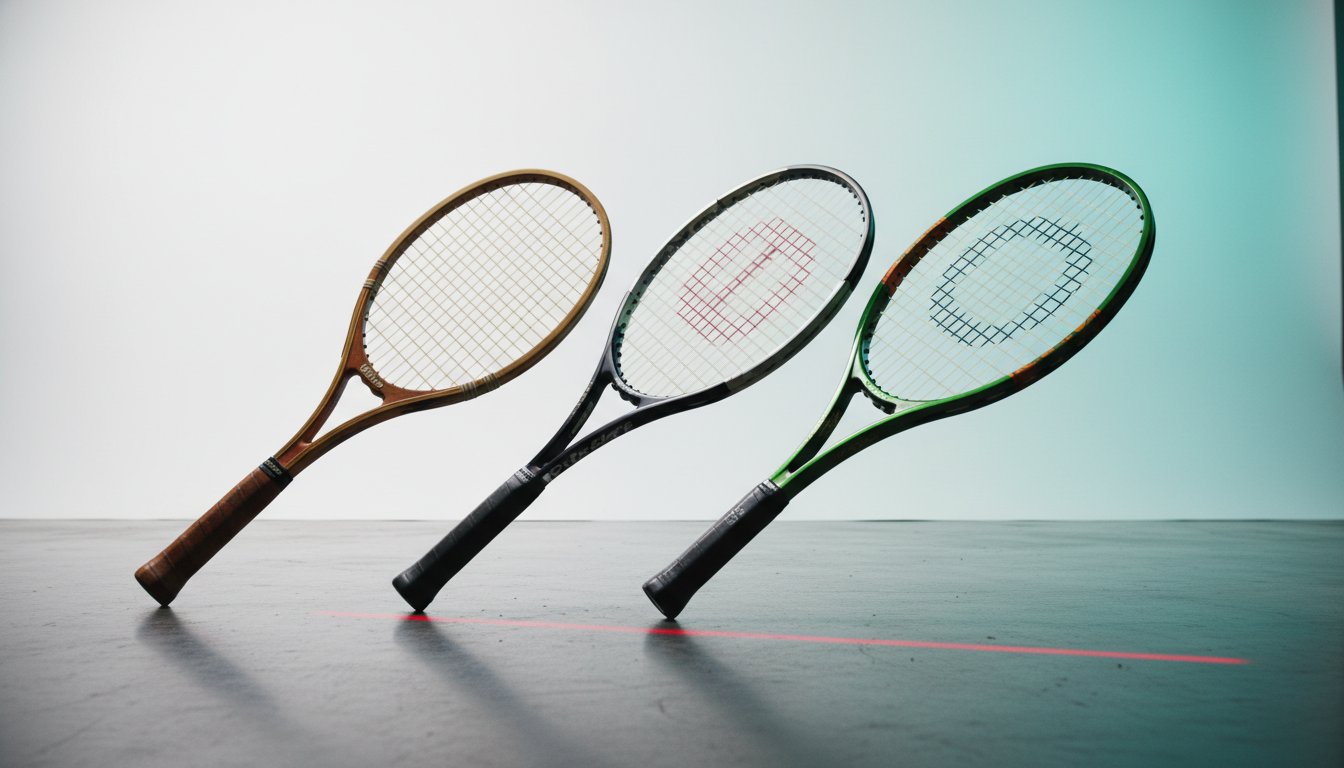
What if the world?s most iconic tennis brand wasn't born on a court, but in a Chicago meat-packing plant? It?s a surprising start for a brand that now dominates courts from Kooyong to your local club. We get it; it?s easy to get lost in the sea of Pro Staffs, Blades, and Burns. For decades, Wilson's model names and tech shifts can feel like a tangled web, making it tough to connect the classic wooden frames of the past to the high-tech carbon fibre racquets we see at the Australian Open today.
That's why we've put together The Complete History of Wilson Tennis: From 1913 to Today. This is your definitive guide to the brand's 110-year journey. You'll finally understand the evolution from animal gut to basalt fibres and see exactly which legends, from Jack Kramer in the 1940s to Roger Federer and Serena Williams, wielded which iconic models to make history. Get ready to explore the key innovations and player partnerships that turned a humble side business into a global tennis powerhouse.
Key Takeaways
- Discover Wilson's surprising origins in 1913, the starting point of our deep dive, 1. The Complete History of Wilson Tennis: From 1913 to Today, and learn how a meat-packing company became a global tennis leader.
- Understand the game-changing impact of the Jack Kramer Autograph. This best-selling racquet defined an era, a key moment you'll read about in 1. The Complete History of Wilson Tennis: From 1913 to Today.
- Follow the evolution of the iconic Pro Staff 85, a racquet that revolutionised power for legends like Pete Sampras. It's a crucial chapter in 1. The Complete History of Wilson Tennis: From 1913 to Today, and our article explores its full impact.
- Explore Wilson's modern innovations and its deep connection to the Australian Open. Our guide, 1. The Complete History of Wilson Tennis: From 1913 to Today, also covers local Aussie pros, making this truly 1. The Complete History of Wilson Tennis: From 1913 to Today.
From Meat Packing to Match Point: The 1913 Origins
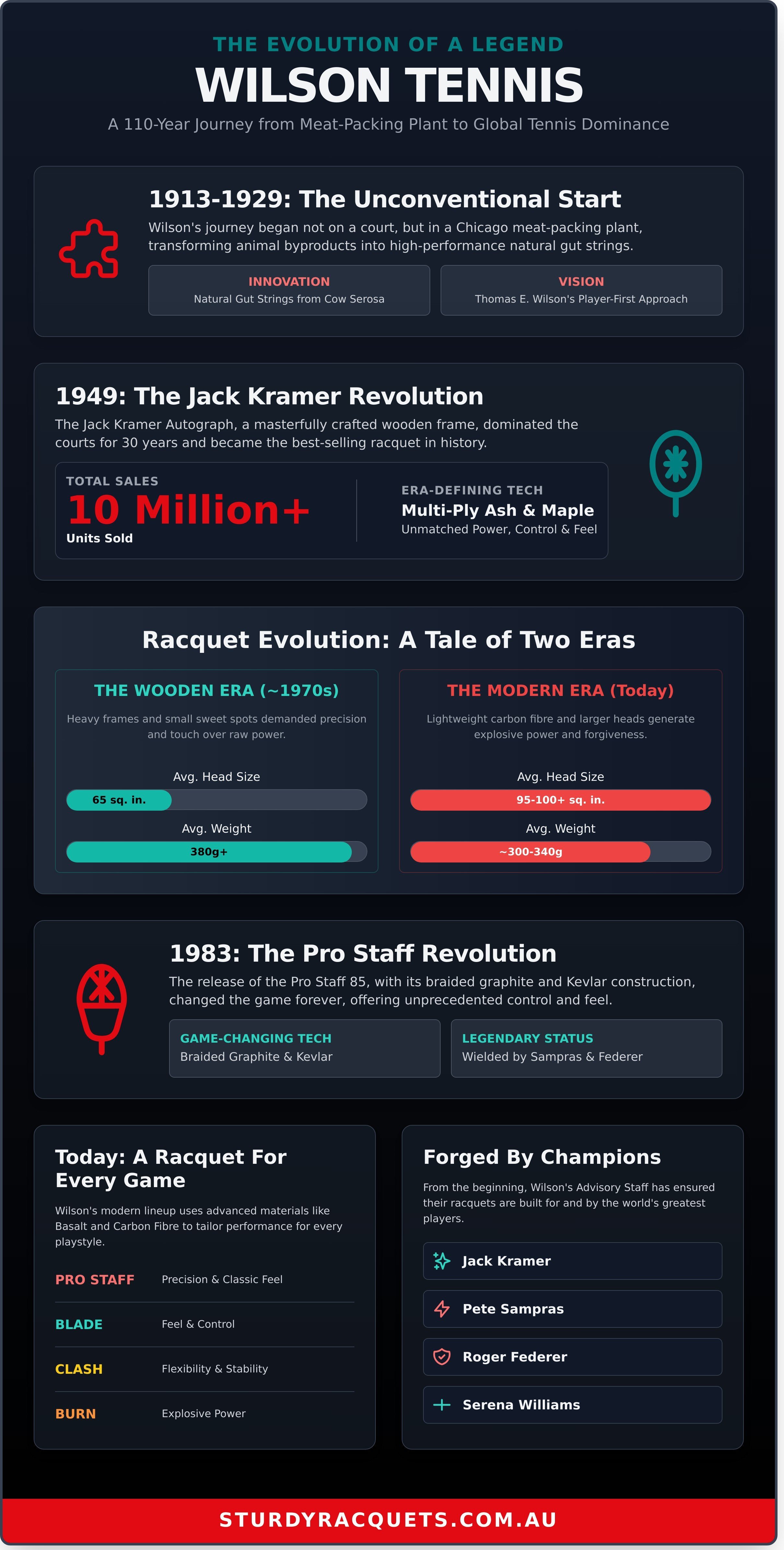
Every great story has a surprising start, and the story of Wilson tennis is no exception. It didn't begin in a high-tech lab or on a pristine court. It began in a Chicago meat-packing plant. In 1913, a company named Ashland Manufacturing Company was founded with a clever, if unconventional, business model: using animal byproducts from the slaughterhouse to create products like violin strings, surgical sutures, and, most importantly, tennis racquet strings. This resourceful beginning laid the groundwork for what would become a global tennis powerhouse, a foundational chapter in The Complete History of Wilson Tennis: From 1913 to Today.
The "Waste Not" Innovation of Natural Gut
The secret to their early success was found in a specific part of cow intestines called the serosa. This thin, fibrous membrane possesses a unique combination of collagen fibres that give it incredible tensile strength, elasticity, and "feel"-qualities that were, and still are, perfect for high-performance tennis strings. By 1923, Wilson had perfected the process, transforming an abattoir byproduct into the world?s most sought-after performance tennis string. This wasn't just about using leftovers; it was the birth of a specialised sports lab dedicated to unlocking peak performance from unexpected materials.
Thomas E. Wilson?s Visionary Leadership
The company?s trajectory changed forever in 1916 when Thomas E. Wilson, a charismatic and ambitious executive, took control and rebranded it as Wilson & Co. He saw a future far beyond byproducts. His vision was to create a premier American sporting goods brand built on quality and innovation. This rebrand wasn't just a name change; it was a declaration of intent. Wilson immediately began pioneering the modern pro sponsorship model by partnering with top athletes to gain credibility and drive sales. This player-first approach culminated in the 1929 creation of the Wilson Advisory Staff, an industry-first initiative that brought professional athletes directly into the product development process. It was a fantastic move that ensured their gear was made for champions, by champions.
With its first factory established in Chicago, Wilson adopted the simple yet powerful slogan: "Everything That Helps Your Game." This guiding principle fueled their expansion throughout the 1920s. As tennis exploded in popularity across America, Wilson was perfectly positioned to supply the growing demand. They weren't just selling racquets and strings; they were equipping a new generation of players. This rapid expansion, detailed in the comprehensive Wilson Sporting Goods history, cemented the brand's identity as a cornerstone of American tennis, setting the stage for decades of innovation to come.
The Era of Wood and the Jack Kramer Revolution (1940s-1970s)
As tennis exploded in popularity after World War II, Wilson was perfectly positioned to dominate the courts. While the early history of Wilson is famously rooted in a Chicago meatpacking firm, this mid-century period cemented its identity as a tennis innovator. The game was evolving, and players needed equipment that could keep up. Wilson didn't just meet that demand; they defined it for an entire generation with one legendary frame.
The Jack Kramer Autograph: A 30-Year Dynasty
Introduced in 1949, the Wilson Jack Kramer Autograph wasn't just a racquet; it was an institution. For over 30 years, it was the weapon of choice for countless professionals and serious amateurs, eventually selling more than 10 million units to become the best-selling racquet of all time. Its success wasn't an accident. The frame was built with exceptional craftsmanship, featuring intricate multi-ply laminations of ash and maple that delivered a fantastic blend of power, control, and feel. This racquet perfectly suited the "Big Game" style of serve-and-volley tennis that Kramer himself championed. Its legacy is so strong that its "Autograph" naming convention directly inspired the iconic "Pro Staff" line decades later.
Life with a wooden racquet was different. Players were working with heavy frames, often weighing over 380 grams, and tiny head sizes around 65 square inches. This technology dictated a game built on precision, touch, and getting to the net. The raw power we see today simply wasn't possible. This chapter of The Complete History of Wilson Tennis: From 1913 to Today shows how equipment and playstyle were completely intertwined.
Breaking the Wood Ceiling with the T2000
By the late 1960s, the limits of wood were clear. Wilson shattered those limits in 1967 with the T2000. It was a radical departure: a sleek, powerful frame made of chrome-plated tubular steel. While other pros used it first, a young and fiery Jimmy Connors made the T2000 a legend in the 1970s. The racquet's design was a perfect match for his revolutionary, aggressive baseline game and devastating two-handed backhand.
The T2000 offered a few game-changing advantages:
- More Power: The steel frame was stiffer, transferring significantly more energy to the ball than flexible wood.
- Larger Sweet Spot: Its unique head shape offered more forgiveness on off-centre hits.
- A New Sound: The innovative "wire-wrap" stringing system, where strings looped around the outside of the frame, produced a distinctive and loud "ping" that became the soundtrack of a new, more aggressive era of tennis.
This bold leap from wood to metal was a pivotal moment, paving the way for the graphite composites that would follow. It proved Wilson wasn't afraid to take risks to push the sport forward. This innovative DNA is still evident in the design of the powerful Wilson racquets available today, each one a descendant of these groundbreaking frames.
The Pro Staff Revolution: Sampras, Federer, and Graphite
If one racquet could define an era of dominance, it's the Wilson Pro Staff. Launched in 1983, the Pro Staff Original 85 wasn't just another frame; it was a statement. Forged from a revolutionary blend of braided graphite and Kevlar, it offered an unparalleled combination of feel, stability, and pinpoint control that would shape the professional game for decades. This chapter in The Complete History of Wilson Tennis: From 1913 to Today is defined by two of the sport's greatest champions and the iconic black racquet they wielded.
Pete Sampras and his Pro Staff 85 were a perfect match. In his hands, the racquet's demanding 85-square-inch head became a surgical tool. It required immense skill, but rewarded the user with unmatched precision on serves and volleys. Sampras won all 14 of his Grand Slam titles with this frame, cementing its legendary status. For an entire generation of players, the Pro Staff was the ultimate symbol of an attacking, all-court game. It was heavy, unforgiving, and absolutely brilliant.
Braided Graphite: The Secret Sauce
What made the Pro Staff feel so unique? The secret was its construction. Wilson?s innovative process involved braiding strands of graphite and Kevlar together, creating a frame that absorbed shock and vibration like nothing else. This technique provides the signature "Wilson Feel": a connected, solid response on impact that competitive players trust. While the original 85 was a masterclass in control, modern Pro Staff 97 versions offer a larger sweet spot and more power to suit today's faster game. For true enthusiasts, the original models made in the St. Vincent factory remain holy grail items for collectors due to their legendary quality control.
The Federer Impact on Gear Design
As the game evolved, so did the Pro Staff. Roger Federer, who began his career with the 85, became the driving force behind its modernisation. He worked closely with Wilson labs to develop a frame that retained the classic Pro Staff feel but with a larger, more powerful 90-square-inch head, and later, the 97. This collaboration culminated in the Pro Staff RF97 Autograph, a racquet designed to his exact specifications. This player-led design process is a hallmark of Wilson's modern innovations, reflecting a deep commitment to athlete-centric engineering.
Federer's influence extended beyond technical specs. He pushed for a minimalist, elegant aesthetic, leading to the introduction of the sophisticated "Velvet Paint" finish and clean, laser-etched graphics. This "tuxedo" look became instantly iconic and set a new standard for premium racquet design. Choosing a frame with this level of heritage and performance is a big decision for any serious player, often leading to a tough choice between legendary brands. If you're weighing your options, our guide on Wilson vs. Babolat: Which Racquet Brand is for You? offers fantastic advice to help you decide.
From Sampras's raw power to Federer's effortless grace, the Pro Staff has remained the benchmark for feel and precision, proving its place as a cornerstone in the story of Wilson Tennis.
Modern Innovations: Clash, Blade, and the 2026 Landscape
While legends were forged with the Pro Staff, Wilson's commitment to innovation didn't stop in the 20th century. The modern game demanded something new: racquets that could manage incredible power, generate heavy spin, and provide a connected feel unlike anything before. Wilson answered the call, creating some of the most revolutionary frames of the last two decades. This modern chapter is a vital part of The Complete History of Wilson Tennis: From 1913 to Today, showcasing a brand that refuses to rest on its legacy.
The Blade: The Most Popular Frame on Tour
Walk the practice courts of any professional tournament, and you'll see a sea of green. The Wilson Blade isn't just popular; it's a dominant force. Since its debut with the "K-Blade" in 2008, this line has been engineered for one thing: connecting aggressive players to the ball. Its signature thin, flexible beam (often around 20.6mm) and dense 18x20 string pattern provide exceptional feel and pinpoint control, allowing players to swing big with confidence.
The Blade's evolution has been a masterclass in refinement. From the introduction of Braided Graphite + Basalt for enhanced feel to the v8 and v9's DirectConnect technology, which fuses the carbon fibre handle directly to the end cap, each update has sharpened its performance. It's no wonder top-tier pros like Stefanos Tsitsipas, Aryna Sabalenka, and Emma Raducanu trust the Blade to dictate points from the baseline. It?s the ultimate tool for the modern attacker.
Clash and Shift: Engineering the Future
In February 2019, Wilson launched the Clash 100 and completely shattered the conventional wisdom that a racquet had to be stiff to be powerful and stable. The Clash offered something previously thought impossible: a frame that was incredibly flexible yet didn't twist on impact. It achieved this through two key technologies:
- FORTYFIVE�: A patented carbon mapping construction that allows the frame to bend with the modern swing path. This increases ball pocketing and dwell time, giving players an amazing connected-to-the-ball feel.
- StableSmart: A unique frame geometry that provides rock-solid stability, even with a low stiffness rating around 55 RA (significantly lower than the 65-70 RA of most modern frames).
Building on this spirit of player-centric design, Wilson launched the "Shift" project in early 2023. Instead of developing a racquet in secret, Wilson released unpainted prototypes to players and coaches around the world, using their direct feedback to refine the final product. The goal was to create the ultimate modern spin machine.
Beyond performance, Wilson is looking toward a greener future. The company has set a goal to significantly reduce its environmental impact by 2026. This includes using Agiplast, a bio-based polymer from castor beans, for grommets and bumpers in frames like the Blade v8, and switching to 100% recycled cardboard for racquet packaging. This dedication to forward-thinking design confirms Wilson's place at the forefront of the industry, a consistent theme throughout The Complete History of Wilson Tennis: From 1913 to Today.
Feeling inspired by Wilson's latest tech? Explore our fantastic range of Wilson Blade, Clash, and Shift racquets today and find the perfect frame for your game.
Wilson in Australia: A Century on Melbourne Courts
Wilson's global legacy isn't just a story forged in its Chicago headquarters. It has a vibrant and powerful chapter written right here on Australian soil. For decades, the iconic "Big W" has been an essential part of the tennis landscape down under, from the sun-scorched hard courts of Melbourne Park to local club competitions across the country. This local connection is a vital part of The Complete History of Wilson Tennis: From 1913 to Today, bringing a century of innovation directly to Aussie players.
The Australian Open Connection
Since 2006, Wilson has been the Official Ball of the Australian Open, a partnership built on performance and trust. The Wilson AO ball isn't just any tennis ball; it's specifically engineered for our unique and demanding conditions. Featuring a resilient Dura-Weave felt, it?s designed to withstand the abrasive Plexicushion court surface and extreme summer heat, providing consistent playability and durability when temperatures soar past 35�C. This commitment to quality is felt in every rally of the tournament.
Melbourne Park has been the stage for some of Wilson's most unforgettable moments. Who could forget Roger Federer?s incredible comeback victory in 2017, clinching his 18th Grand Slam with the Pro Staff RF97 Autograph? Or Serena Williams capturing her historic 23rd major title that same year with her Wilson Blade SW104. These victories, powered by Wilson technology, are etched into Australian sporting history.
Just as the AO ball is built for our climate, your racquet needs the right care to perform at its peak. For exceptional advice on keeping your gear in top shape, explore our guide on Racquet Care 101: Stringing, Grips, and Maintenance.
The brand's influence extends to our local heroes, too. Aussie legends from Pat Rafter, who mastered the serve-and-volley with his Pro Staff Classic 6.0, to modern-day warrior Alex de Minaur, who battles with the precision of the Wilson Blade 98, have all trusted their careers to Wilson.
From Chicago to Brooklyn: Your Wilson Specialist
That incredible heritage lives on, and at Sturdy Racquets in Brooklyn, Victoria, we help you connect with it. Buying a Wilson racquet is about more than just picking a model off the shelf; it's about choosing a piece of technology that fits your game perfectly. Our knowledgeable team acts as your guide through Wilson's timeline of innovation. We'll help you decide if the classic control of the Pro Staff line suits your touch game or if the revolutionary bending technology of the Clash series is better for generating easy power.
A high-performance frame is only half the equation. The final, critical step in harnessing over a century of Wilson engineering is professional stringing. The right string and tension combination acts as the engine for your racquet, unlocking its true potential and feel. This is where expert advice makes all the difference, ensuring your racquet performs exactly as it was designed to. It?s what turns a good racquet into your perfect racquet.
Ready to become part of the legacy? Find your perfect match and get the expert advice you deserve. Shop the latest Wilson 2025-26 range at Sturdy Racquets today!
Write Your Own Chapter in Wilson's History
From its 1913 origins in a Chicago meatpacking company to the revolutionary Pro Staff that defined the game for Pete Sampras and Roger Federer, Wilson has spent over 110 years at the forefront of tennis innovation. This deep dive into The Complete History of Wilson Tennis: From 1913 to Today shows a relentless commitment to helping players perform at their best, a legacy that continues with modern frames like the Blade and Clash.
Now it's your turn to feel that champion's edge. As an Authorized Wilson Australian Retailer, we're here to help you find the perfect racquet for your game. Our passionate racquet specialists offer knowledgeable advice you can trust, and our expert in-store stringing in Brooklyn, VIC, ensures your new frame is perfectly tuned for match day. Don't leave your equipment to chance.
Ready to make your mark? Explore the Biggest Wilson Racquet Range in Australia and find the gear that will help you write your own story on the court.
Frequently Asked Questions About Wilson Tennis
Who founded Wilson Sporting Goods?
Thomas E. Wilson founded the company that would become Wilson Sporting Goods in 1916. He was the former president of a meatpacking firm and acquired the Ashland Manufacturing Company, which initially used animal byproducts for products like tennis racquet strings. Wilson quickly pivoted the company's focus to creating high-performance athletic equipment. His vision was to build a brand synonymous with quality for athletes everywhere, a mission that continues to drive the company over a century later.
What was the first tennis racquet Wilson ever made?
Wilson's first truly revolutionary tennis racquet was the steel T2000, introduced in 1967. While the company produced many popular wood racquets before this, the T2000 represented a massive leap forward in power and design technology. It was famously wielded by American champion Jimmy Connors throughout the 1970s. Its unique metal frame offered a level of pace and control that wooden frames simply couldn't match, changing the game forever and cementing Wilson's legacy of innovation.
Why is the Wilson Pro Staff 85 so famous?
The Wilson Pro Staff 85 is famous because it was the racquet of choice for tennis legends Pete Sampras and Stefan Edberg. Released in 1983, its iconic blend of braided graphite and Kevlar provided an unmatched level of feel, stability, and control for advanced players. Sampras used this exact frame to win 14 of his Grand Slam titles, making it a symbol of precision and dominance in the serve-and-volley era. It's still considered a benchmark for player's racquets.
Which pro players currently use Wilson racquets?
Many of the world's top ATP and WTA pros trust Wilson racquets. As of 2024, stars like Stefanos Tsitsipas, Aryna Sabalenka, and Australia's own Alex de Minaur all compete with versions of the Wilson Blade. The Wilson Pro Staff line remains iconic, forever linked to Roger Federer's 20 Grand Slam titles. This widespread professional endorsement is a fantastic testament to the brand's continued performance and reliability at the sport's highest levels.
What is the difference between Wilson Blade and Wilson Clash?
The main difference between the Wilson Blade and Clash lines is their feel and design philosophy. The Blade series is built for aggressive players who want a connected-to-the-ball feel, offering more control and feedback with a slightly stiffer frame. In contrast, the Clash series is engineered for exceptional flexibility and arm-friendly comfort. It uses FORTYFIVE� carbon mapping to create a unique pocketing sensation, providing easy power for a very broad range of playing styles.
Are old wood Wilson racquets still playable today?
While old wood Wilson racquets are fantastic collector's items, they aren't practical for modern competitive tennis. Their small head sizes, often around 65 square inches, and heavy weight make them very unforgiving compared to today's graphite frames, which average 98-100 square inches. They are perfectly playable for a casual hit and offer a great sense of nostalgia. Just don't expect to generate the heavy topspin and power that modern racquets are designed for!
Where are Wilson tennis racquets manufactured now?
Wilson tennis racquets are designed and engineered at their global headquarters in Chicago, USA, with the majority of manufacturing taking place in China. This global production model is standard across the high-performance sporting goods industry. While the physical location of the factories has evolved, the commitment to innovation and quality remains a constant theme throughout The Complete History of Wilson Tennis: From 1913 to Today. Every racquet is built to the brand's strict performance specifications.
How do I know if my Wilson racquet is a fake?
You can often spot a fake Wilson racquet by inspecting the cosmetic details and the price. Counterfeits typically have sloppy paint jobs, blurry logos, and poor-quality grommets. A genuine Wilson will have a crisp butt cap logo and often a hologram of authenticity on the frame. Price is the biggest giveaway; if a new racquet that retails for A$350 is being sold for A$90, it's almost certainly fake. Always purchase from an authorised Australian dealer to guarantee you're getting the real deal.
Share:
How Much to Restring a Tennis Racquet in Australia? (2024 Price Guide)
The Complete Guide to the Wilson Pro Staff Series: Precision for Every Player (2026 Edition)