



The most expensive string on the market won't save your game if it's destroying your elbow by the second set. Many players feel forced to choose between the spin of a stiff polyester and the comfort of a soft multifilament, but you don't have to settle for one or the other. Finding the perfect hybrid stringing setup for tennis is the most practical way for the everyday player to balance high-level performance with physical longevity. It's the secret to getting a personalised feel that matches your baseline or net game without breaking the bank on frequent restringing.
We understand the frustration of strings that break too quickly or setups that leave your arm feeling sore after a single match. You deserve a racquet that works with your body, not against it. This guide will show you how to master the hybrid setup to achieve the ideal blend of power and control for your specific needs. We'll preview the best durable tennis string combinations for frequent players and explain arm-friendly restringing options that provide better value for money. Whether you're a heavy hitter or a touch player, you'll learn exactly how to configure your mains and crosses for the best results on court.
Key Takeaways
- Discover how to combine durable polyester strings with soft synthetic materials to find the perfect balance of spin and arm safety.
- Decide between traditional and reverse configurations to prioritise either long-lasting durability or enhanced power and feel.
- Learn how to match specific string types with high-quality performance tennis racquets to improve your control on court.
- Master the tension gap between your mains and crosses to ensure your hybrid stringing setup for tennis performs consistently every match.
- Find out why professional stringing services and machine calibration are vital for maintaining a reliable reference tension.
What is a Hybrid Stringing Setup for Tennis?
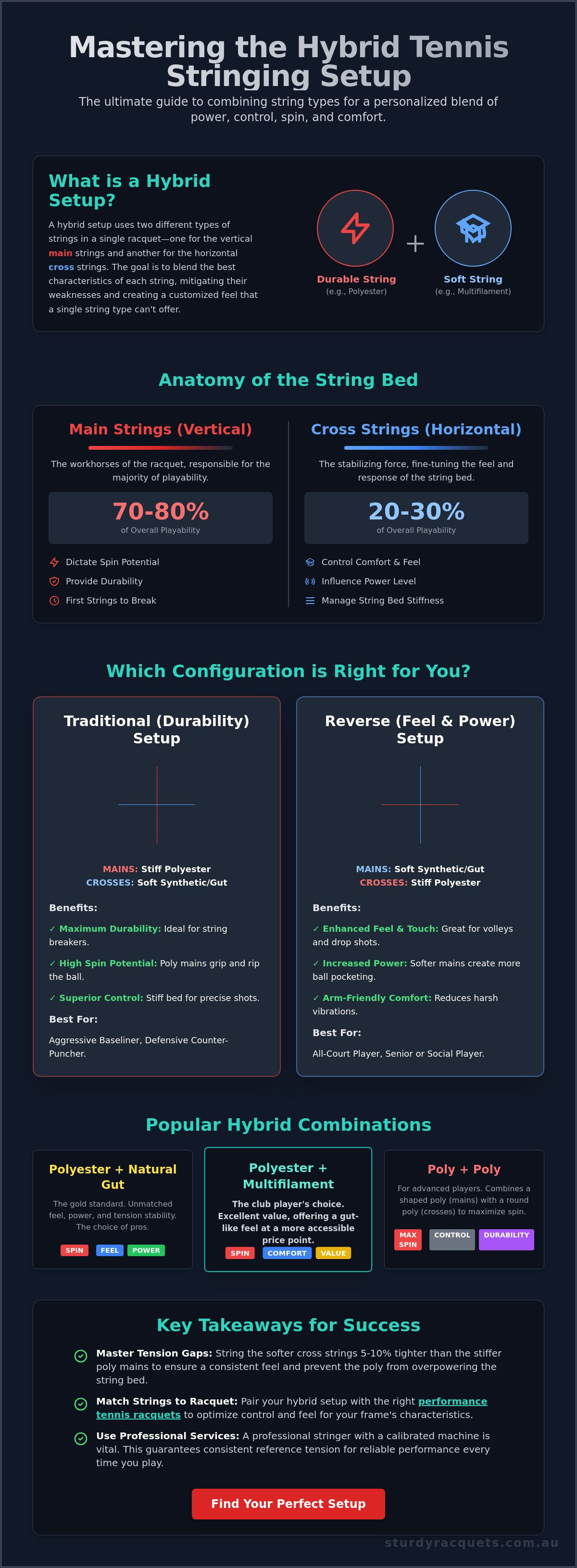
A hybrid stringing setup for tennis is a custom configuration designed to mitigate the weaknesses of a single-string bed by using two distinct materials for the vertical and horizontal lines. In this arrangement, you select one type of string for the mains (the vertical strings) and a different type for the crosses (the horizontal strings). The primary goal is to combine the durability and spin of polyester with the comfort and feel of softer materials. This approach has become the standard for players who want elite performance without the punishingly stiff feel of a full polyester string bed. By mixing different types of tennis strings, you can create a personalised feel that a single set simply cannot match.
To better understand this concept and see how it works in practice, watch this helpful video:
The Anatomy of the String Bed
To master your setup, you first need to understand how the two sets of strings interact. The main strings are the workhorses of the racquet. They move the most during impact and are responsible for about 70% to 80% of the racquet's overall playability, spin potential, and durability. Because they take the brunt of the force, they're usually the first to break. The cross strings act as a stabilising force. They control the "string bed stiffness" and provide much of the comfort, feel, and power. When these two materials work together, they create a "snap-back" effect. This happens when the mains slide across the crosses and quickly snap back into place, which is exactly what generates heavy topspin on the ball.
Common String Combinations
Choosing the right pairing depends on your priorities on the court. Here are the most effective combinations used by players today:
- Polyester and Natural Gut: This is the gold standard for professional feel. It offers incredible tension stability and power while remaining gentle on the arm.
- Polyester and Multifilament: This is the most popular choice for club players. It provides a similar feel to natural gut but at a more accessible price point, making it excellent for those using high-performance tennis strings on a budget.
- Poly-on-Poly Hybrids: Some advanced players mix two different polyesters. They might use a shaped, textured string in the mains for spin and a smooth, round string in the crosses to help the mains slide more easily.
By understanding these basics, you can start to experiment with your own hybrid stringing setup for tennis. The right mix will keep you on the court longer and give you the confidence to swing out on every shot.
Mains vs. Crosses: Which Configuration is Right for You?
Deciding which string goes in the mains versus the crosses is the most critical decision in your hybrid stringing setup for tennis. The mains are the vertical strings that move the most during impact, meaning they dictate the primary feel and performance of the racquet. Most players start with a "Traditional" hybrid, which places a stiff polyester in the mains and a softer material in the crosses. This configuration is built for those who want to rip the ball with spin without breaking a string every hour. If you flip this and put the soft string in the mains, you have a "Reverse" hybrid. This choice isn't just about durability; it fundamentally shifts how the ball leaves your strings and how much vibration reaches your arm.
To help you choose the right path, consider how these configurations match different playing styles:
- The Aggressive Baseliner: Poly mains provide the spin and durability needed for long rallies.
- The All-Court Player: A reverse hybrid offers better touch and feel for volleys at the net.
- The Defensive Counter-Puncher: Poly mains offer maximum control to keep the ball deep.
- The Senior or Social Player: Soft mains protect the arm and shoulder from harsh vibrations.
The Durability Setup (Poly Mains)
Baseliners who hit with heavy topspin should almost always stick with polyester mains. Because the mains take the brunt of the friction, using a durable material there prevents the strings from sawing through each other. This setup creates a lower launch angle, which is the angle the ball takes as it leaves the racquet. A lower launch angle provides the "dip" needed to keep hard-hit balls inside the baseline. It's a reliable choice for hard hitters who don't want to worry about their strings snapping mid-match. If you're looking to experiment with this feel, you can explore premium tennis string sets to find a combination that suits your power level.
The Comfort Setup (Natural Gut/Multi Mains)
If you have a history of tennis elbow, soft mains are your best friend. This reverse setup uses multifilament or natural gut in the mains to absorb shock before it travels down the frame. Many tour professionals have switched to this because it offers incredible touch and a larger sweet spot. While the softer mains will fray faster against the polyester crosses, the extra power you gain is undeniable. It's a premium feel that makes every shot feel more connected. Managing the cost is the only hurdle, but for players who value arm health, the trade-off is usually worth it.
Australian hard courts are notoriously fast and can be tough on the body. A hybrid setup allows you to tune your racquet for these specific conditions. If the court is playing too fast on a hot afternoon, poly mains help you keep the ball under control. If you need more help generating pace during a night match, soft mains provide that extra boost. Matching your configuration to your environment is the final step in mastering your game.
Customising Your Hybrid Setup for Power and Control
Transitioning from a full bed of one string type to a hybrid stringing setup for tennis is the most effective way to fine-tune your performance on the court. Many players find that a full bed of polyester feels too harsh over time, while a full bed of synthetic gut lacks the "bite" needed for a modern game. Think of your string choice as a precision tool for correcting racquet deficiencies and enhancing your natural strengths. If you've recently invested in performance tennis racquets, you might find the frame provides excellent control but lacks the comfort you need for a long tournament. A hybrid setup allows you to keep the frame you love while adjusting the output to your liking.
The interaction between string textures is a hidden secret for generating extra spin. By pairing a shaped or "gear-edged" string in the mains with a smooth, round string in the crosses, you significantly reduce the friction where the strings intersect. This allows the mains to slide further and snap back with more force, which is the primary engine behind heavy topspin. It's a simple technical adjustment that can turn a "dead" feeling racquet into a spin-generating machine without requiring a change in your swing technique.
The Power Seeker's Matrix
If you want more depth on your shots with less effort, start by looking at thinner gauge tennis strings. A 1.20mm or 1.25mm string has more elasticity than a thicker version, which translates directly to higher ball speed. You can pair a high-energy multifilament in the mains with a thin polyester in the crosses to get a "trampoline" effect that still offers some spin potential. Dropping the tension in your cross strings by two or three pounds can also open up the sweet spot. This makes the racquet much more forgiving on off-centre hits, which is vital when you're under pressure at the baseline.
The Control Enthusiast's Matrix
Players with fast, aggressive swing speeds often find that soft strings feel too "mushy" or unpredictable. To fix this, use a thicker 1.30mm polyester in the mains for a more stable and predictable string bed. This provides the "dead" feel that many high-level players prefer because it allows them to swing out fully without the ball flying long. If you're using a soft string for comfort but hate the lack of feedback, try a high-tension cross setup. Keeping the crosses tight helps firm up the string bed, giving you the crisp response needed for precise ball placement and confident volleys.
Tension and Maintenance: Getting the Most from Your Hybrid
A hybrid stringing setup for tennis requires a more nuanced approach than a standard full bed. Because you're mixing two materials with different elasticities, they'll naturally lose tension at different rates. The golden rule for most players is to string your mains and crosses at different tensions to balance the feel. If you use the same tension for a stiff polyester and a soft multifilament, the string bed can feel uneven or unpredictable. By adjusting the tension, you ensure that both strings reach their optimal performance window at the same time, giving you a consistent response from the first ball to the last.
One challenge specific to Australian players is the impact of extreme heat on a hybrid bed. Our high temperatures and fast hard courts can cause strings to "bag out" or lose their elasticity much faster than in cooler climates. If you leave your racquet in a hot car or a bag without thermal lining, the softer string in your hybrid will likely lose its tension stability before the polyester does. This creates a "dead" feeling where you lose both power and control. To keep your gear in top shape, always store your racquet in a temperature-controlled environment and check for signs of tension loss after every few sessions.
Calculating the Tension Differential
A 2 to 4 pound difference is the standard starting point for most players. If you're putting a stiff polyester in the mains, you should generally string it 2 to 4 pounds lower than the softer cross strings. This prevents the racquet from feeling like a wooden board. Larger racquet head sizes often benefit from slightly higher tensions to maintain stability across the wider string bed. You can use these tension adjustments to tune the feel of a properly fitted tennis racquet, making it feel more powerful or more controlled depending on your needs. If you're ready to refresh your setup, you can book a session with our professional racquet stringing team to find your perfect reference tension.
When to Restring Your Hybrid
Don't wait for your strings to snap before you head to the stringing machine. In a hybrid setup, you'll often see "notching," where the harder main strings have literally cut deep grooves into the softer crosses. Once these notches become deep, the strings can no longer slide and snap back, which kills your spin potential. Most experts recommend the 20-hour rule: even if the strings haven't broken, the playability usually drops off significantly after 20 hours of hitting. For a deeper dive into maintenance schedules, you can read our guide on how often to restring your racquet to ensure you're never playing with a dead string bed.
Professional Stringing Services for Australian Players
Executing the perfect hybrid stringing setup for tennis requires more than just the right materials. It demands a level of precision that is difficult to achieve without professional equipment. While many enthusiasts consider DIY stringing, the complexity of a hybrid bed means that even a minor error in tension or knot tying can ruin the playability of the racquet. Professional stringers use electronic machines that are calibrated to the gram, ensuring that the 2 to 4 pound tension gap you've carefully calculated is actually what ends up on the racquet. This consistency allows you to establish a "reference setup," which is a baseline you can trust every time you step onto the court.
Consulting with an expert stringer also helps you find the right balance for your specific frame. They can provide guidance on how different string textures will interact within your racquet's specific drill pattern. This level of customisation doesn't just improve your performance; it also protects your gear. A professional knows how to pull tension at a consistent speed to avoid "string burn," a common issue where the friction of the pull damages the coating of the softer string. By getting your hybrid setup right the first time, you increase the longevity of your strings and avoid the cost of premature breakage.
The Expert Advantage
Professional stringers have the experience to identify the ideal gauge for your playing style and racquet pattern. If you have an open string pattern that eats through strings, they might suggest a thicker 1.30mm polyester to provide more substance. They also avoid common mistakes like incorrect knot tying, which can lead to significant tension loss in the first few minutes of play. Maintaining your gear also extends to the court. Using high-quality tennis court accessories, such as thermal-lined bags and protective covers, ensures that the professional tension job stays stable despite the Australian heat. An expert will often check your grommets and bumper guard during the restringing process to ensure your frame is in peak condition.
National Support and Gear
You don't need to be a professional tour player to access elite-level maintenance. Choosing a dedicated racquet sports hub ensures you have access to the latest 2026 string technology, including the newest co-polyester formulations designed for maximum arm comfort. Many Australian players now take advantage of specialist retailers that offer national shipping, allowing you to order your preferred custom string combinations from anywhere in the country. This access to a wider inventory means you can experiment with "reverse" hybrids or rare gauges that your local club might not stock. If you're ready to stop settling for a one-size-fits-all approach, it's time to elevate your game with a custom setup designed specifically for your swing. Explore our range of premium tennis strings and start building your ideal hybrid configuration today.
Elevate Your Game with a Custom Setup
Mastering your hybrid stringing setup for tennis is the most effective way to upgrade your performance without switching frames. You've learned how to balance stiff polyesters with soft multifilaments to protect your arm while maintaining elite spin. By choosing the right configuration for your swing speed and managing your tension gaps, you can significantly extend the life of your equipment. This personalised approach ensures your racquet works with your body, not against it.
We're dedicated to helping players find their ideal configuration through our expert in-store stringing services. Our team is trusted by athletes across the country for providing reliable, high-performance gear that stands up to the heat of Australian hard courts. With fast national shipping on all essential accessories, getting the latest technology is simple. Explore our professional tennis strings and find your perfect hybrid match today! Your best game is just a restring away, and we're here to support you every step of the journey.
Frequently Asked Questions
What is the best hybrid stringing setup for beginners?
Beginners should start with a combination of synthetic gut and a soft multifilament. This setup provides a massive sweet spot and excellent shock absorption while you develop your technique. It's much more forgiving than a stiff polyester and helps prevent early fatigue during long practice sessions. This pairing ensures you get a comfortable introduction to customised string beds without the harshness of competitive tournament strings.
Does a hybrid stringing setup help with tennis elbow?
A hybrid stringing setup for tennis is an excellent solution for players suffering from tennis elbow. By placing a soft multifilament or natural gut in the main strings, you significantly reduce the vibration that travels to your arm. This reverse setup prioritises comfort without sacrificing the spin potential provided by polyester cross strings. It's a proven way to stay on the court longer if you have sensitive joints.
Should I put the polyester string in the mains or the crosses?
Place the polyester in the mains if you want maximum spin and durability for an aggressive baseline game. Conversely, putting the polyester in the crosses while using a softer string in the mains creates a more comfortable feel with more power. Most competitive players choose poly mains to prevent the strings from moving too much during heavy hitting, which keeps the string bed predictable.
How much tension should I use for a hybrid setup?
You should generally string your softer strings 2 to 4 pounds tighter than your stiff polyester strings. This differential balances the string bed and prevents the racquet from feeling overly stiff or "boardy." If you're switching from a full bed, start with your usual tension on the soft string and drop the poly tension by about 5% to maintain a familiar and comfortable feel.
How long does a hybrid stringing setup last compared to a full bed?
Hybrid setups typically have a shorter peak performance life than a full bed of polyester because the harder string notches the softer one over time. While a full bed might stay intact longer, a hybrid often loses its snap-back effect after about 15 to 20 hours of play. You'll notice the strings start to stick together or fray, which is a clear sign that the playability has dropped.
Shop polyester stringsShop multifilament strings
Can I use two different brands of strings in a hybrid setup?
Yes, you can absolutely mix different brands to create your ideal setup. Professional stringers frequently combine a high-end natural gut from one manufacturer with a durable co-polyester from another. This flexibility is the main advantage of a hybrid, allowing you to cherry-pick the best characteristics from different manufacturers to suit your specific racquet and playing style.
Is a hybrid setup more expensive than a regular stringing job?
The labor cost for a hybrid setup is usually the same as a standard restringing job since the installation process is identical. However, the total price depends entirely on the strings you choose to combine. Using a hybrid stringing setup for tennis can actually save you money if you pair a half-set of expensive natural gut with a more affordable polyester cross string.
What string gauge is best for a hybrid configuration?
A 17 gauge or 1.25mm string is the most versatile choice for a hybrid configuration as it balances spin and durability. If you find you're breaking strings too quickly, moving to a thicker 16 gauge or 1.30mm for the mains will provide more longevity. Thinner 18 gauge strings are often used in the crosses by touch players who want to maximise the sliding effect for extra topspin.
Share:
The Complete Guide to Pre-Strung Tennis Racquets for 2026
How Long Do Tennis Shoes Last on Hard Courts? The 2026 Durability Guide