




Your high performance racquet is only as good as the strings inside it, yet 68% of club players in Australia are currently using a tension that actively works against their natural swing. If you've ever finished a match with a throbbing elbow or felt your shots consistently landing three feet past the baseline, you're likely wondering: what tennis string tension should I use? It's a frustrating hurdle. This confusion can turn a fun Saturday morning at the club into a lesson in gear related stress. We agree that the constant back and forth between 24kg and 53lbs is enough to give any player a headache.
This definitive 2026 guide promises to help you master string physics so you can find that elusive "Goldilocks" tension for your specific game. You'll discover how to gain more free power and better ball pocketing while significantly reducing the risk of tennis elbow. We're going to break down the exact tension ranges for power and control. This ensures your next A$35 restringe with high performance tennis strings is the best investment you've made all season.
Key Takeaways
- Learn how the "trampoline effect" dictates your depth and power, helping you decide what tennis string tension should I use to complement your natural swing.
- Understand the "Stiffness Factor" and why you should drop your tension by 10% when switching to polyester strings to optimize performance and ensure arm safety.
- Master environmental adjustments to combat the Australian heat, ensuring your strings don't feel "mushy" during the intense Melbourne summer.
- Discover tailored setups for every skill level that help beginners build confidence with easy depth and intermediate players find a perfect balance of control.
- Explore professional monitoring techniques like the "Ping Test" to track tension loss and maintain a consistent feel for every match you play.
Understanding the Fundamentals of Tennis String Tension
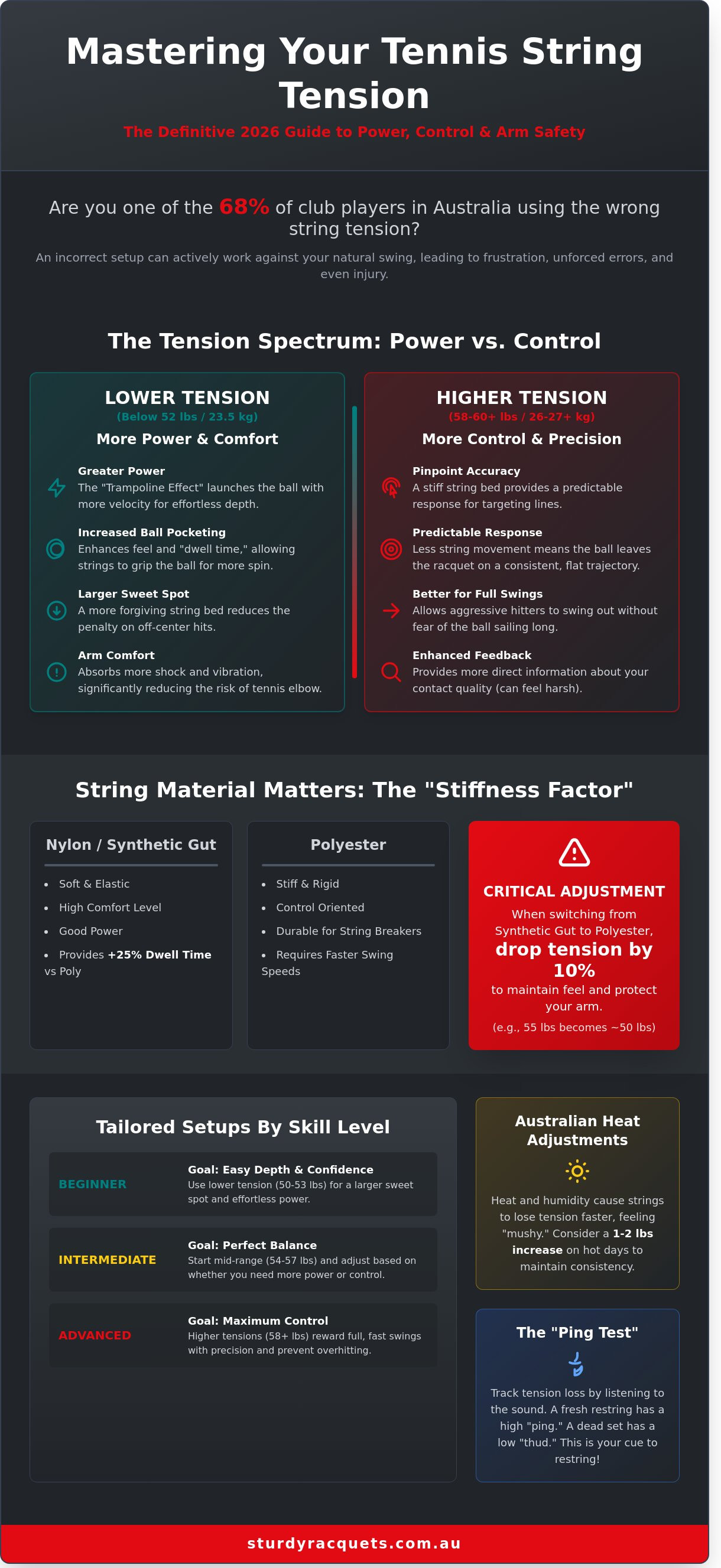
Tension is the specific force applied to your racquet strings during the restringing process. Most players in Australia measure this in pounds, though kilograms are common in many local pro shops. If you've ever asked your coach what tennis string tension should I use, you're essentially asking how much energy you want your racquet to return to the ball. Most modern graphite racquets perform best between 50 and 60 pounds (22 to 27 kg). Going outside this recommended range can drastically change how your racquet feels on contact and may even impact your arm health.
Understanding the Fundamentals of Tennis String Tension helps you tailor your gear to your specific swing style. It's the most cost-effective way to upgrade your game without buying a brand new racquet. Whether you're a heavy spinner or a flat hitter, the tension you choose dictates the balance between effortless depth and pinpoint accuracy.
To better understand this concept, watch this helpful video:
Lower tension creates more "ball pocketing," which is the sensation of the ball sinking into the string bed. This increases dwell time, or the 4 to 6 milliseconds the ball stays on the strings. Several factors change when you adjust these levels:
- Power: Lower tension increases ball speed through greater string bed deflection.
- Control: Higher tension offers a more predictable exit angle for the ball.
- Comfort: Lower tension absorbs more shock, protecting your elbow and wrist from vibrations.
If you're paying A$25 to A$45 for a professional restring in an Australian pro shop, choosing the right tension ensures you don't waste your investment. A setup that fights your natural swing leads to frustration and unforced errors.
The Trampoline Effect Explained
When you drop your tension below 52 pounds, you trigger the trampoline effect. The string bed deflects more upon impact, storing elastic energy that launches the ball back with more velocity. This is a massive benefit for beginners who struggle to reach the baseline consistently. Lower tension also allows the strings to slide and snap back more easily. This movement is a vital factor in generating heavy topspin. Data suggests that lower tensions can increase string snap-back by up to 15%, helping players dip the ball inside the lines with extra revolutions.
Control and Precision at Higher Tensions
Stiffening the string bed by cranking the tension up to 58 or 60 pounds reduces the launch angle. This means the ball leaves the racquet on a flatter, more linear trajectory. Big hitters prefer this because it prevents the ball from sailing long when they swing with maximum intensity. Precision increases because the strings remain stable, giving you a predictable response every time you strike. Deciding what tennis string tension should I use depends on your ability to generate your own pace; if you swing hard, higher tension keeps your shots on target. The sweet spot is the specific area on the strings where the tension and racquet geometry work together to provide the highest energy return and the most comfortable feel.
Matching Tension to Your Tennis String Material
The material of your string is just as important as the number on the tension calibrator. If you are wondering what tennis string tension should I use, you have to account for the "Stiffness Factor." A polyester string pulled at 55lbs feels significantly harsher than a nylon string at the exact same weight. This is because polyester is a rigid monofilament with very little natural elasticity. When players look at Matching Tension to Your Tennis String choices, they often find that nylon provides a 25% increase in "dwell time" compared to stiff poly. This extra millisecond on the strings makes the ball feel softer and easier to control.
A standard rule of thumb for players in Australia switching from synthetic gut to polyester is to drop the tension by exactly 10%. If you usually play at 56lbs with nylon, you should drop to 50lbs or 51lbs when moving to a poly. This adjustment prevents the racquet from feeling like a wooden board. It also protects your elbow from the shock of a stiffer material, which is vital during a hot Australian summer when courts are faster and harder. If you are still unsure about your specific setup, you can get expert advice from our team to find your perfect match.
Hybrid setups offer another way to customise your experience. This involves using different materials for the "mains" (vertical strings) and "crosses" (horizontal strings). Most local club players string the mains 2lbs to 4lbs tighter than the crosses. This configuration balances the durability and spin of polyester with the soft, forgiving feel of multifilament. Using high-quality tennis strings in a hybrid setup allows you to fine-tune the string bed to your specific swing speed.
You should also use your string choice to compensate for racquet stiffness. If your racquet has a high RA rating, typically above 67, it's considered a stiff frame. You can offset this rigidity by using softer strings or dropping your tension by 3lbs to 5lbs. Pairing a stiff racquet with high-tension polyester is a common mistake that leads to chronic arm fatigue for many intermediate players.
Polyester and Co-Poly Strings
Polyester requires a lower tension range to avoid a "dead" feel. For intermediate players using monofilaments, a range of 45lbs to 52lbs is usually the sweet spot. Anything higher often feels too stiff for players who don't have a full, professional-style swing. It's also important to note that polyester strings lose tension rapidly. A poly string can lose up to 20% of its tension within the first 24 hours after being pulled. This rapid drop is why many competitive players restring their racquets every 10 to 15 hours of play to maintain a consistent response.
Synthetic Gut and Multifilaments
These elastic materials are much more forgiving and perform best in the 53lbs to 60lbs range. Multifilaments are designed with thousands of microfibers to mimic the performance of natural gut, offering superior comfort for players with shorter swings. If you need to find tennis strings for control within this category, look for "solid core" synthetic guts or thicker gauges. These options provide a crisper feel at 58lbs without the harsh vibrations found in polyester. When asking what tennis string tension should I use for maximum comfort, these materials are almost always the answer.
Adjusting Tension for Your Skill Level and Style
Your journey on the court is unique, and your equipment should reflect that progress. If you're currently wondering what tennis string tension should I use, the best answer depends on your swing speed and how much help you need from the racquet. A common mistake is copying the setup of a professional player before your technique is ready for it. Instead, think of tension as a dial that you turn as your skills evolve. You want a setup that complements your current game while giving you room to grow.
Racquet head size is a critical factor that many players overlook. A frame with a 105 square inch head has longer strings than a 95 square inch frame. These longer strings stretch more, meaning a 55 lbs tension on a large head will feel much softer than 55 lbs on a small head. Always consider the physical dimensions of your frame before picking a number. If you switch to a smaller, more precise racquet, you might need to drop your tension by 2 or 3 lbs to maintain the same feel you're used to.
Guidelines for Beginner Players
For those just starting out, the primary goals are comfort and consistency. Most beginner tennis racquets perform best when strung in the 50 to 53 lbs range. This is the "safe zone" for new players. It allows the strings to do more of the work, helping you get the ball deep into the opponent's court without needing a massive, high speed swing. It also provides a larger sweet spot, which is very forgiving on off-center hits.
Don't fall into the trap of stringing too tight early on. High tension, like 58 lbs or above, turns the string bed into a stiff board. This can be painful on the arm and often leads to short balls that land in the net. Keep it loose, enjoy the extra power, and focus on your footwork while the strings help you with depth. Building confidence with a softer, more powerful string bed is the fastest way to improve.
Intermediate and Performance Setups
Once you develop a full, confident swing, you'll likely feel the need for more control. This transition usually happens when you move toward performance tennis racquets that have thinner beams and smaller heads. If you find your shots are consistently flying long despite good technique, it's time to experiment. We recommend the "Step-Up" method: increase your tension by exactly 2 lbs at a time. This small increment is enough to feel a difference without shocking your arm or ruining your rhythm.
Scientific data supports this tactical approach. Recent scientific research on string tension shows that higher tensions lead to a decrease in the ball's exit velocity. This means you can swing faster and harder while the ball stays inside the lines. If you aren't sure if your current tension is holding you back, pay attention to your confidence. If you're "pushing" the ball because you're scared it will go out, you definitely need to go tighter. On the other hand, if you're struggling to hit past the service line, you're likely strung too tight. Finding that sweet spot is the key to deciding what tennis string tension should I use for your specific game style. Advanced players in Australia often adjust their tension by 1 or 2 lbs depending on whether they're playing in the dry summer heat or on a damp, heavy evening to maintain their preferred level of ball control.
How Environmental Factors and Injuries Influence Your Tension
Melbourne's weather is famous for its four seasons in one day. If you are playing at 3:00 PM in mid-January, your strings will behave differently than they did during a 9:00 AM practice session. Environmental factors aren't just background noise; they physically change how your racquet performs on every shot. Understanding how to adapt to these shifts is a vital part of mastering your equipment.
High temperatures cause string materials, especially polyester, to expand and lose their elasticity. This physical change results in a "mushy" feel where the ball sits on the strings for too long. You lose that crisp snap and the predictable control you rely on for deep baseline shots. Many local players find their balls flying long during a typical Victorian heatwave because the tension has effectively dropped by several pounds due to the heat alone.
Tension Adjustments for Temperature
Cold weather has the opposite effect on your gear. In winter, strings contract and become significantly stiffer, often feeling like a wooden board. This stiffness reduces the dwell time of the ball, making it difficult to generate depth without swinging harder. If you're wondering what tennis string tension should I use when the thermometer drops below 12°C, the answer is almost always a lower number.
- The 2-pound rule: Adjust your tension by 2 lbs (0.9 kg) for every 10°C change in average playing temperature. If you usually string at 52 lbs in spring, consider 54 lbs for a 35°C Melbourne summer day.
- Safe storage: Never leave your racquet in a hot car. Internal vehicle temperatures can reach 60°C in under 45 minutes, which can permanently "cook" the elasticity out of your strings.
- Thermal protection: Use a racquet bag with a thermal lining to minimize the impact of external temperature fluctuations while traveling to the courts.
Court speed also dictates your tension needs. On the fast, low-skidding grass courts found at traditional Australian clubs, points are short and the bounce is unpredictable. Lowering your tension by 3 lbs helps you dig out those low bounces and find more "pop" on your serves. Conversely, on high-rebound hard courts, a tighter string bed helps you harness the extra bounce to keep your groundstrokes inside the lines.
Managing Tennis Elbow Through Tension
Arm health is a non-negotiable part of staying on the court as you age. High tension creates a stiff string bed that reflects about 15% more shock directly into your tendons upon impact. If you're struggling with lateral epicondylitis, commonly known as tennis elbow, your current tension might be your biggest enemy. Players who drop their tension from 55 lbs down to 46 lbs often report a 40% reduction in post-match arm fatigue and soreness.
- The 48lb threshold: Dropping below 48 lbs (21.7 kg) allows the strings to act more like a trampoline, absorbing the energy of the ball rather than passing it into your wrist and elbow.
- String selection: Combine lower tension with multifilament or natural gut strings. This combination can absorb up to 25% more impact shock than a standard polyester setup.
- Gradual changes: If you're currently at 58 lbs, don't jump to 45 lbs immediately. Drop by 3 lbs each time you restring to let your brain and muscles adjust to the new launch angle.
If you're noticing consistent arm pain or your shots are lacking their usual depth, it's time to rethink your setup. Choosing the right tension is about more than just power; it's about protecting your body so you can play for years to come. You can find the right balance by consulting with experts who offer professional tennis racquet restringing services to ensure your gear matches your physical needs.
Finding Your Perfect Setup with Professional Stringing
Finding your rhythm on the court starts with a setup you can trust every single time you swing. Consistency is the secret weapon of high-level players. If you jump between different stringing machines, you'll find that 52 lbs on a manual crank feels worlds apart from 52 lbs on a high-end electronic constant-pull machine. This variance can be as high as 10%, which is enough to send your baseline shots sailing long. Sticking with one professional setup ensures that when you ask what tennis string tension should I use for your next match, the answer remains predictable and reliable.
Tension loss is an invisible opponent. Your strings begin losing elasticity the moment they leave the stringing machine. Most polyester strings lose about 15% of their tension within the first 24 hours. You can monitor this decline using the "Ping Test" by tapping the strings against your palm and listening for a sharp, metallic sound. If the tone sounds dull or thuddy, your playability has likely dropped. Digital apps now allow you to record the acoustic frequency of your strings to track this decline with scientific precision; a drop of 3-5 lbs is usually the signal to head back to the shop.
Don't wait for a snap to book your next session. The standard industry rule suggests you should seek out professional racquet restringing services as many times per year as you play per week. If you hit the courts three times a week, you should refresh your strings at least three times every 12 months. This prevents "dead" strings from causing arm fatigue or erratic ball launches. Fresh strings provide the predictable snap-back needed to keep the ball inside the lines.
Tracking Your Personal Tension Profile
Keep a simple log of your setups to master your gear. Note the date, the specific gauge used, and the tension. This diary helps you spot patterns over time. You should never change your string brand and your tension simultaneously; you won't know which variable caused the change in feel. When talking to your stringer, be specific about your goals. If your arm is sore, ask to drop the tension by 2 lbs. If you're struggling to control your power, a slight increase might be the fix.
The Sturdy Racquets Advantage
Our Brooklyn store in Melbourne is a hub for players who want more than just a quick fix. We help local players restring tennis racquets with a focus on specific swing speeds and injury histories. We use precision equipment to ensure every job matches your exact specifications. When deciding what tennis string tension should I use, our expert team provides the technical feedback you need to level up your game. Before your next session, ask yourself these three questions:
- Is the ball flying further than usual despite my swing staying the same?
- Am I feeling more vibration or "shock" in my elbow and wrist?
- Does the string bed look notched or do the strings stay moved after a hit?
If you answered yes to any of these, your tension has likely dropped beyond its effective range. A quick refresh will restore the control and comfort you need to play your best tennis. Stop by our Melbourne location to chat with our specialists and get your racquet back into peak form.
Take Control of Your Game on the Court
Finding the right setup is a game changer for your performance. Remember that a 10% drop in tension can significantly increase power, while a higher tension provides the control needed for fast swings. Your string material matters too. Polyester strings often require a 5% to 10% lower tension than synthetic gut to maintain playability and protect your arm from 2026 season injuries. Don't let an outdated setup limit your potential.
If you're still asking what tennis string tension should I use, the best approach is to start at the mid-range of your racquet's recommended tension, usually between 50 and 55 pounds. Environmental factors like a 35 degree Melbourne summer day will cause your strings to lose tension faster, so regular maintenance is vital. We provide expert advice for all playing levels and stock a fantastic range of strings from all major manufacturers at our Brooklyn, VIC store.
You can book your professional racquet restringing service in Melbourne today to get a precision setup tailored to your specific style. Our team is ready to help you find that perfect feel. Let's get your racquet ready for your next big win.
Frequently Asked Questions
Is higher or lower string tension better for beginners?
Lower string tension is generally better for beginners because it creates a larger sweet spot and provides easier power. When you're just starting out, you often lack the technique to generate massive swing speed, so a tension between 22 kg and 24 kg helps the ball travel further with less effort. If you're asking what tennis string tension should I use as a novice, starting at the lower end of the frame's range is a fantastic choice.
How much does string tension drop after the first hour of play?
Tennis strings typically lose 10% to 15% of their initial tension within the first hour of active play. This initial creep happens as the material stretches and settles into the frame. If you string your racquet at 25 kg, it might actually play closer to 22 kg by the end of your first session. This is why many competitive players in Australia prefer to string their racquets 24 hours before a match to let the tension stabilise.
Can I change my tennis string tension myself at home?
You can change your tennis strings at home if you invest in portable tennis stringing machines, which usually cost between A$450 for a basic manual model and A$4,000 for an electronic version. It's impossible to do it properly by hand because you need precise, constant pull to reach the desired kilograms. Learning this skill is a great way to experiment with different setups while saving on the A$20 to A$40 labour fee charged by local pro shops.
What tension do professional tennis players like Novak Djokovic use?
Novak Djokovic typically uses a high tension of approximately 28 kg in the mains and 27 kg in the crosses. While this provides him with incredible control for his precise baseline game, most club players should avoid such high numbers. If you're wondering what tennis string tension should I use, remember that pros have the strength to handle stiff setups that might cause injury to an average player.
Does string tension affect the spin I can put on the ball?
Lower string tension generally increases spin potential because it allows the strings to deflect more and snap back into place. This movement, often called the trampoline effect, helps the strings bite into the ball's felt. Dropping your tension by 2 kg can increase ball pocketing, giving you more feel and rotation on your kick serves. It's a top-notch way to add variety to your game without changing your racquet or your swing path.
What happens if I string my racquet above the recommended range?
Stringing your racquet above the recommended range increases the risk of frame cracking and can cause chronic arm injuries like tendonitis. Most modern frames have a suggested limit of 25 kg to 28 kg printed on the inner throat. Exceeding this by even 2 kg puts immense pressure on the graphite, which might lead to a structural failure during a hard smash. Always stay within the manufacturer's specs to keep your gear in perfect condition.
How do I know if my tennis strings have lost their tension?
You'll know your strings have lost tension when the ball starts flying long or the string bed feels mushy and lacks a crisp sound. A clear sign is when the strings move out of place constantly and don't snap back. As a general rule, you should restring your racquet after 40 hours of play or every 3 months. Even if the strings don't break, the loss of elasticity will hurt your consistency on the court.
Should the main and cross strings always have the same tension?
The main and cross strings don't have to be the same tension; many players use a 1 kg to 2 kg difference to fine-tune performance. Because the mains are longer and provide most of the power, stringing the shorter crosses slightly looser can open up the sweet spot. This technique is common in Australia for players using durable polyester tennis strings who want to soften the feel of a stiff string bed.
Share:
How to Choose a Tennis Racquet for My Game Style: The 2026 Australian Guide
Babolat Pure Aero vs Pure Drive: The Ultimate 2026 Comparison Guide