


Ever looked down at your shredded running shoes after a tough match and wondered if there's a better way? You're not alone. Many players are confused by technical jargon and worried about spending hundreds on the wrong gear. Choosing the right pair of tennis shoes isn't just about style-it's one of the most important decisions for your performance and safety on the court.
That's where we come in! Consider this your friendly, expert guide to finding the perfect fit. We'll help you cut through the confusion and show you exactly what to look for based on your preferred Australian court surface, your unique playing style, and your foot type. Get ready to step onto the court with total confidence, knowing your new shoes will provide the comfort, durability, and support you need to play your best game and prevent injury.
Why Your Running Shoes Are Holding You Back on the Court
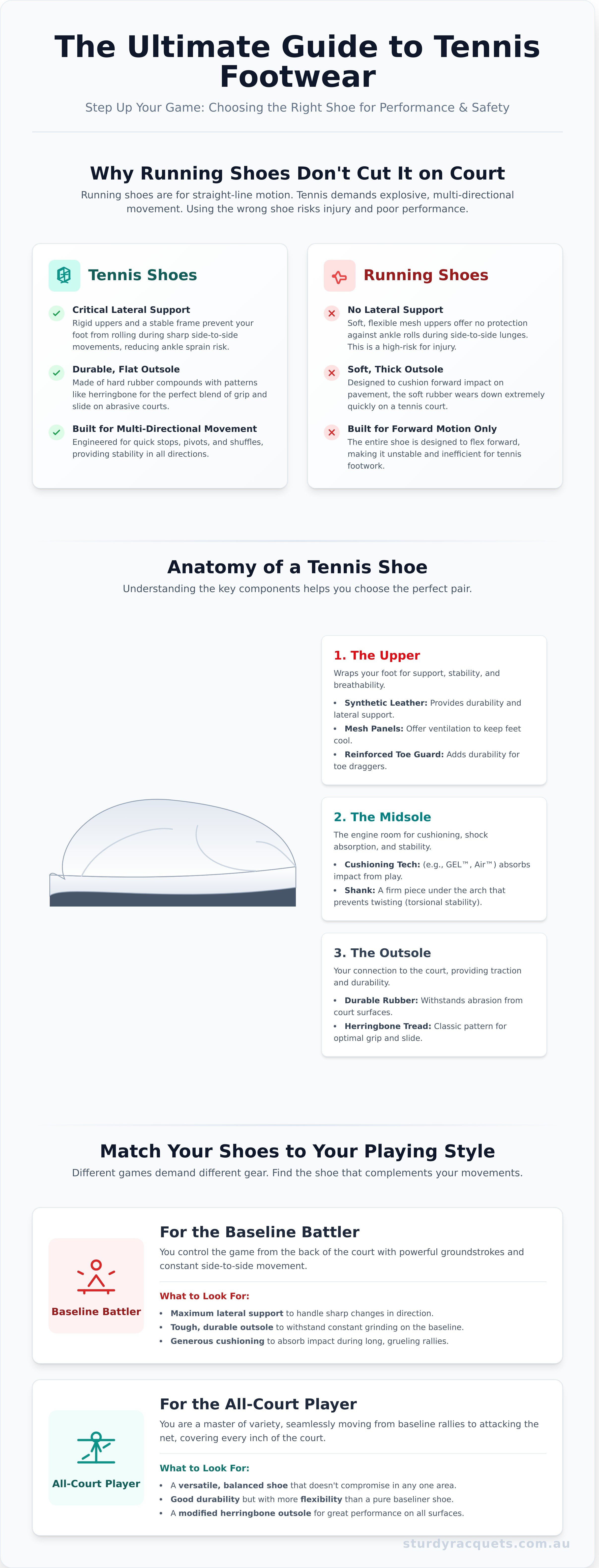
It’s one of the most common mistakes we see new players make: hitting the court in their favourite pair of running shoes. While they might be comfortable for your morning jog, they are simply not designed for the unique demands of tennis. Running is a repetitive, forward-motion activity. Tennis, on the other hand, is a game of explosive, multi-directional movements: quick stops, sharp pivots, and constant side-to-side shuffling.
Using the wrong footwear doesn't just hinder your performance; it significantly increases your risk of injury and will destroy your runners in no time. Getting the right gear is the first step to playing your best and staying safe.
For a fantastic visual guide on what makes a great tennis shoe, check out this helpful video from the experts:
The Critical Difference: Lateral Support
The most important feature that separates proper tennis shoes from runners is lateral support. This refers to the stability built into the sides of the shoe to keep your foot from rolling during side-to-side movements. Tennis shoe uppers are constructed with tougher, more rigid materials that cradle your foot. The fundamental design differences in running shoes vs. tennis shoes mean that a runner's soft, breathable mesh upper offers almost no protection against ankle rolls when you lunge for a wide forehand. This lack of structure is a recipe for a nasty sprain.
Outsole Design: Durability and Traction
Flip the shoes over, and the contrast is just as clear. Running shoes have thick, soft soles with deep grooves designed to cushion impact on pavement and flex forward. On an abrasive tennis court, this soft rubber will wear down incredibly fast. Tennis shoe outsoles are made from dense, durable rubber compounds built to last. They are also flatter and feature specific tread patterns, like the classic herringbone, to provide the perfect balance of grip for explosive starts and slide for controlled stops on court surfaces.
Anatomy of a Tennis Shoe: Key Features Explained
Ever felt a bit lost scrolling through product descriptions filled with technical jargon? You're not alone! Understanding the basic anatomy of a tennis shoe is the first step to making a fantastic buying decision. Unlike regular running shoes, which are built for forward motion, tennis shoes are engineered for the sharp, lateral movements of the game. Let's break down the essential components so you know exactly what to look for.
The Outsole: Your Connection to the Court
Think of the outsole as the tyre of your shoe-it’s where the rubber meets the road, or in this case, the court. Its primary jobs are to provide top-notch traction and withstand the abrasive nature of tennis courts.
- Materials: Most outsoles are made from durable, hard-wearing rubber compounds designed to resist wear and tear.
- Tread Patterns: The pattern is crucial for grip. A full herringbone pattern (zig-zag) is the gold standard for clay and hard courts, offering exceptional grip for starts and stops. A modified herringbone pattern provides a great balance of grip and give, making it a versatile choice for all court surfaces.
The Midsole: Cushioning, Stability, and Shock Absorption
The midsole is the engine room of the shoe, sitting between your foot and the outsole. It’s responsible for absorbing the shock from constant running and jumping, providing comfort, and ensuring your foot is stable. This is where brands showcase their signature tech, like ASICS' GEL™ or Nike's Air units, all designed to cushion impact. A key component here is the shank-a firm piece, often made of plastic, located under the arch. This small piece is critical for torsional stability, and detailed research on how shoe construction affects performance shows why specialist footwear is vital for preventing injuries during rapid side-to-side movements.
The Upper: Support, Breathability, and Comfort
The upper is everything that wraps around your foot. Its main function is to hold your foot securely and comfortably, providing support during aggressive lateral cuts. Modern tennis shoes use a combination of materials to achieve the perfect balance:
- Synthetic leather offers fantastic support and durability.
- Mesh panels are integrated to improve breathability and flexibility, keeping your feet cool during a long match.
- A reinforced toe guard is an essential feature for players who drag their toes, especially during serves, adding extra durability where it's needed most.
Match Your Shoes to Your Playing Style
Just like your racquet, your shoes are a critical piece of equipment that should complement your game. The best tennis shoes for you will support your unique movements on the court, helping you play with more confidence and stability. Whether you're a baseline grinder or a net-rusher, your footwear needs will be different.
Not sure which category you fall into? Don't worry! We're here to help you identify your style and find the perfect shoe to match. Let's break down the three most common playing styles.
For the Baseline Battler
Do you dominate from the back of the court, hitting powerful groundstrokes and moving side-to-side to control the rally? If so, you're a baseline battler. Your game demands maximum stability and durability.
- What you need: Exceptional lateral support to handle quick, sharp changes in direction along the baseline.
- Look for: Heavier, more stable shoes with a tough, durable outsole and plenty of cushioning to absorb impact during long matches. These shoes are built to last.
For the All-Court Player
The all-court player is a master of variety, seamlessly transitioning from baseline rallies to attacking the net. If you mix up your strategy and cover every inch of the court, this is you.
- What you need: A versatile shoe that offers a fantastic balance of support, durability, and flexibility.
- Look for: A moderate-weight shoe that provides stability for lateral movement but is still light enough for forward sprints. A durable toe cap is a must-have to protect against toe dragging.
For the Serve-and-Volleyer
Are you an aggressive player who loves to charge the net after your serve? The serve-and-volleyer's game is all about speed, agility, and explosive forward movement.
- What you need: A lightweight and flexible shoe that won't weigh you down as you sprint forward.
- Look for: A shoe with less outsole weight for maximum speed. A reinforced toe cap is still important for players who slide into volleys, and a snug fit will keep you feeling connected to the court.
Choosing for the Court Surface: An Australian Focus
Your racquet and strings are vital, but your connection to the court starts with your shoes. The surface you play on dramatically affects how you move, and wearing the wrong shoe can impact your performance and even risk injury. Here in Australia, we're lucky to play on a variety of courts, so matching your footwear to the surface is one of the smartest decisions you can make. Let's break down the best options for where you play most.
Hard Court Shoes: The Versatile All-Rounder
As the most common surface across Australia, hard courts demand a lot from your footwear. This unforgiving surface requires shoes with specific features to keep you playing your best. Look for:
- A tough outsole: Made from a durable rubber compound, this is essential to handle the high abrasion and prevent premature wear.
- Exceptional cushioning: A supportive midsole is non-negotiable. It absorbs shock to protect your joints during long, demanding rallies.
These are the perfect all-round tennis shoes for most Aussie players. Shop our range of hard court tennis shoes.
Clay Court Shoes: Masters of Grip and Slide
For those who love the slide, a specific clay court shoe is a true game-changer. The key feature is a full herringbone tread pattern on the outsole. This clever design provides the perfect balance of grip for quick stops and starts while allowing for controlled slides into your shots. The grooves are also designed to release clay to prevent clogging, so you maintain fantastic traction. The upper is often a tighter-knit mesh to stop that fine red dust from getting inside.
Grass & Synthetic Grass Shoes: All About Traction
Playing on natural or synthetic grass requires a delicate touch. The outsole on these shoes features small rubber 'nubs' or 'pimples' that grip the surface without tearing it up-a must for maintaining the court. This design provides reliable traction on a potentially slippery surface. These shoes are typically more flexible and have a flatter profile than hard court models, helping you stay low and connected to the court for those quick volleys at the net.
Finding the Perfect Fit: Sizing, Support, and Foot Type
You can have the most advanced shoe in the world, but if the fit is wrong, you're setting yourself up for trouble. A poor fit doesn't just lead to painful blisters; it can cause serious issues like rolled ankles, shin splints, and foot fatigue. Think of a well-fitting shoe as the foundation of your game-it’s the key to unlocking comfort, safety, and peak performance on the court.
How to Measure Your Feet for Tennis Shoes
Getting the right size is more than just knowing your number. For a truly accurate fit, always measure your feet at the end of the day when they are slightly swollen from activity. When trying on a pair, make sure you’re wearing the same type of socks you play in. You should be able to fit a thumb's width (about 1.25 cm) between your longest toe and the end of the shoe. This extra space prevents your toes from jamming into the front during quick stops.
Understanding Your Foot Arch and Pronation
Your foot's arch type determines how it rolls inward (pronates) to absorb shock. Identifying your arch is simple with the 'wet test': get your foot wet and step onto a piece of cardboard. The shape of your footprint will tell you what you need.
- Flat Feet (Overpronation): If you see a full, wide footprint, you likely have flat feet. You'll need stability tennis shoes with firm midsole support to prevent your foot from rolling too far inward.
- High Arches (Supination): A footprint showing just your heel and the ball of your foot means you have high arches. Your foot doesn't roll inward enough, so look for cushioned, flexible shoes to help with shock absorption.
- Neutral Arches: A print with a distinct curve along the inside means you have a neutral arch. You're in luck! Most shoe types will work well for you.
A Quick Fit Checklist
Before you head to the checkout, run through this final mental checklist. The perfect pair should feel fantastic right out of the box.
- Heel: Your heel should be snug and secure, with absolutely no slipping when you walk or jog.
- Midfoot: The shoe should feel comfortably secure around the middle of your foot-not squeezed or tight.
- Toes: You must have enough room in the toe box to wiggle and splay your toes freely.
- Comfort: There should be no pinching, rubbing, or uncomfortable pressure points anywhere.
Armed with this knowledge, you're ready to find a shoe that works with you, not against you. Explore our fantastic range at Sturdy Racquets and find your perfect match today!
Your Perfect Pair Awaits: Step Up Your Game
Finding the right footwear is one of the most important investments you can make in your game. As we've covered, leaving your running shoes in the gym and choosing a shoe built for the court is crucial for performance and safety. By understanding the key features and matching them to your playing style and our unique Australian court surfaces, you set yourself up for success with every pivot, sprint, and slide.
Now that you’re armed with the knowledge to make a great choice, the next step is finding that perfect pair. At Sturdy Racquets, our team of passionate players is here to offer expert advice. We proudly stock Australia's biggest range of tennis shoes, ensuring you'll find the ideal fit for your game. With fast, free shipping on all orders over A$150, you’ll be dominating the court in no time.
Ready to step up your game? Shop our huge range of tennis shoes!
Frequently Asked Questions About Tennis Shoes
How often should I replace my tennis shoes?
As a general rule, avid players should look at replacing their tennis shoes every 3-4 months, or after about 45-60 hours of intense on-court action. If you play more casually, once a year might be sufficient. A key sign is a worn-down outsole-if the tread pattern is gone, you’ve lost crucial grip. Also, check the midsole cushioning; if it feels flat and less supportive, it's time for a new pair to protect your joints.
What is the real difference between men's and women's tennis shoes?
The key difference isn't just the colour scheme! It's all about the fit, which is based on anatomical differences. Women's shoes are generally built on a narrower last, particularly in the heel, to prevent slipping. They often feature a wider forefoot to accommodate a different foot shape. Some models also have unique cushioning densities, designed to support the specific biomechanics and average weight distribution of female players, ensuring a more stable and comfortable game.
Can I use my tennis shoes for pickleball or netball?
Your tennis shoes are a fantastic choice for pickleball, as both sports demand quick lateral movements and a durable outsole for hard courts. However, we don't recommend them for netball. Netball involves more vertical jumping and pivoting, requiring shoes with higher ankle support and different cushioning to absorb impact. Using the wrong shoe can increase injury risk, so it’s always best to use sport-specific footwear for optimal performance and safety on the court.
How do I clean my tennis shoes to make them last longer?
To keep your shoes in top-notch condition, avoid the washing machine at all costs! The heat can damage the adhesives and synthetic materials. Instead, use a soft brush and a mixture of mild soap and warm water to gently scrub away dirt from the uppers and outsole. Remove the insoles and laces and wash them separately. Always let your shoes air dry naturally, away from direct sunlight or heaters, to preserve their shape and integrity.
Are expensive tennis shoes actually worth the extra money?
Often, the extra investment is absolutely worth it, especially for regular players. A premium pair, often priced over A$200, typically features advanced cushioning technologies, more durable outsole compounds, and lighter, more supportive upper materials. While a A$120 pair is great for beginners, the more expensive models provide superior stability and comfort that can reduce fatigue and prevent injuries during long matches. Think of it as an investment in your performance and your health.
What is a 'break-in' period and do all new shoes need one?
The 'break-in' period is the time it takes for new shoes to soften and conform to the unique shape of your feet. While many modern shoes feel fantastic right out of the box, some high-performance or stability-focused models can be a bit stiff initially. We always recommend wearing your new pair around the house or for a couple of short, light hitting sessions before playing a full match. This helps prevent blisters and ensures maximum comfort when you really need it.
Share:
Pickleball Adelaide: Your Ultimate Guide to Courts, Clubs & Gear
What is Paddle Ball? Your Guide to Padel in Australia (2026)