



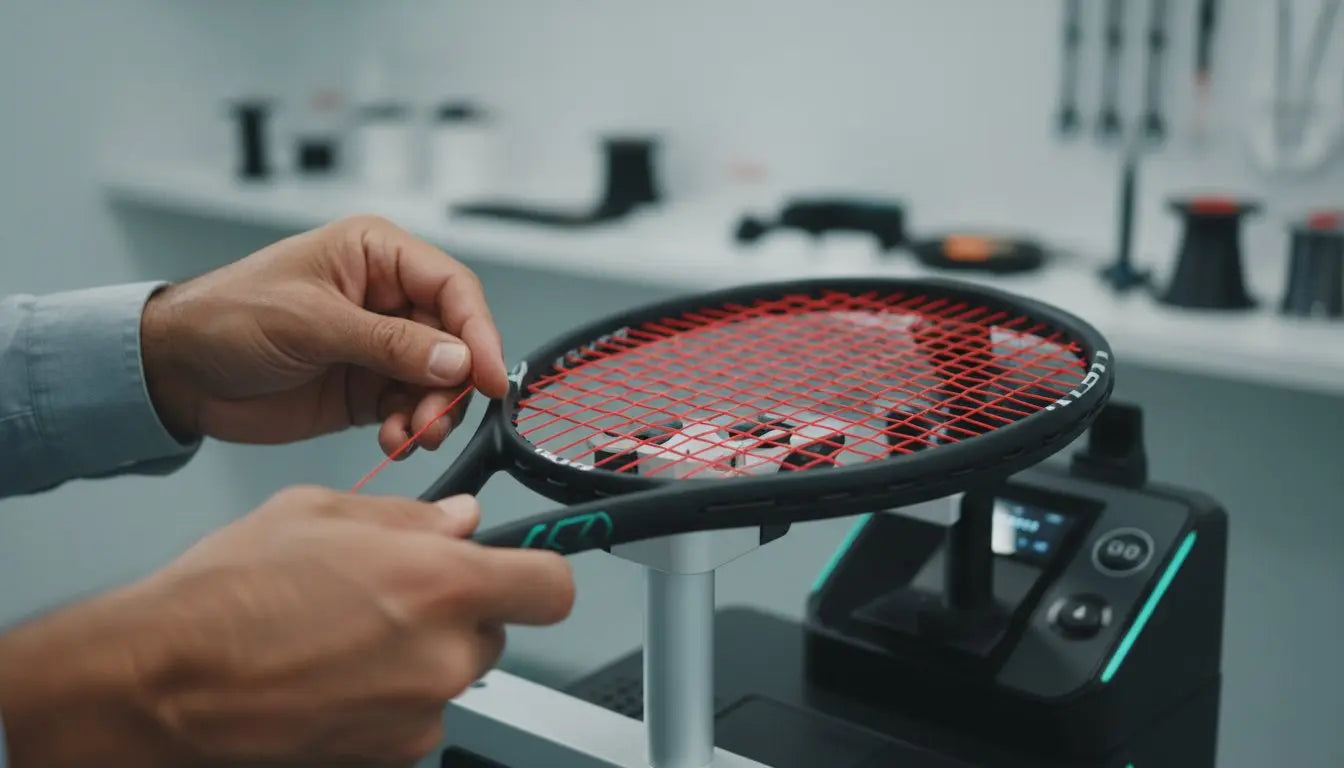
Why does your racquet feel like a stiff board one week and a loose trampoline the next, even when you request the same tension? This inconsistency is a major frustration for players in 2026, and it highlights the massive gap in a good tennis stringer vs bad. When you are searching for how to find a good tennis stringer, you are looking for a technician who treats your frame like a precision instrument. Understanding the qualities of a professional stringer is essential because a bad job leads to shots flying long or physical frame damage. Whether you are hunting for a tennis stringer near me or a certified tennis stringer, identifying the signs of a bad stringer and what makes a good racquet technician will help you avoid unforced errors before you hit the court.
It is easy to assume that a machine does all the work, but top organizations like the USRSA require technicians to pass 50 minute practical exams to prove their skill. We agree that your equipment is too expensive to trust with an amateur who might cause premature breakage or pull uneven tension. You will learn how to spot the technical hallmarks of elite service so you can enjoy a consistent on-court feel every time. We will preview the specific certifications to look for and explain how to find a reliable technician to protect your investment. To get started, you can browse the [top rated tennis strings for control] to see what suits your style of play.
Key Takeaways
- Identify the visual hallmarks of expertise, such as neat knots and the absence of tool marks, to ensure your equipment receives professional-grade care.
- Recognize technical red flags like weave errors and crushed grommets that can lead to premature string breakage or permanent frame damage.
- Learn to distinguish a good tennis stringer vs bad, how to find a good tennis stringer, and the qualities of a professional stringer when searching for a tennis stringer near me or a certified tennis stringer to avoid the signs of a bad stringer and understand what makes a good ra.
- Understand why modern constant-pull electronic machines are the 2026 standard for achieving the consistent tension accuracy required for high-performance play.
- Discover how professional stringing methods protect the structural integrity of your racquet while maximizing the playability of the latest string technologies.
What Makes a Good Racquet Stringing Job vs a Bad One?
Professional racquet stringing is a delicate balance of frame protection, tension accuracy, and knot security. A master technician knows that every racquet is a complex carbon fiber structure that requires careful handling. Players often struggle to understand the difference between a good tennis stringer vs bad, how to find a good tennis stringer, qualities of a professional stringer, tennis stringer near me, certified tennis stringer, signs of a bad stringer, what makes a good ra when their performance starts to slip. In 2026, the global tennis strings market has reached a value of approximately $550.75 million, and these advanced materials require expert installation to avoid premature "deadness." If a stringer rushes the process, they often skip essential steps like proper frame mounting. This leads to "ghosting," where the string slides through the clamps and loses tension before the racquet even leaves the shop.
Many big-box retail stores prioritize speed over quality, often treating racquets like commodities rather than precision tools. In contrast, a specialist focuses on the nuances of tennis string materials and properties to ensure the result matches your playing style perfectly. This meticulous approach is one of the essential qualities of a professional stringer. It is why a technician who has passed the USRSA 50 minute practical exam is always a better choice than a general sports store employee who lacks specialized training.
To better understand this concept, watch this helpful video:
The Symptoms of Inconsistent Stringing
If you request a 55lb tension but the racquet feels like 48lb, the culprit is usually poor mounting or an uncalibrated machine. This inconsistency creates a dangerous "launch angle" effect on the court. When crosses are too loose, the main strings move excessively, causing your shots to sail long. It's incredibly frustrating to execute a perfect swing only to see the ball fly past the baseline due to equipment failure. While you can purchase high-quality tennis strings to improve your spin and control, even elite materials will underperform if the installation is flawed. A professional ensures that every string is pulled to the exact poundage requested, providing a reliable string bed.
Why Stringing Quality Impacts Your Game
Poor stringing quality takes a heavy psychological toll during a match. You can't swing freely or aim for the lines if you don't trust your equipment. Beyond the scoreboard, a bad job can cause physical injury. Uneven tension increases frame vibrations, which is a leading cause of arm fatigue and "tennis elbow." Experts in 2026 are seeing a rise in "arm-friendly" polyester strings, but these only work if the stringer maintains the integrity of the material. Learning to spot the signs of a bad stringer and what makes a good ra is the first step toward protecting your health and your investment in the game.
Qualities of a Professional Stringer: Hallmarks of Expertise
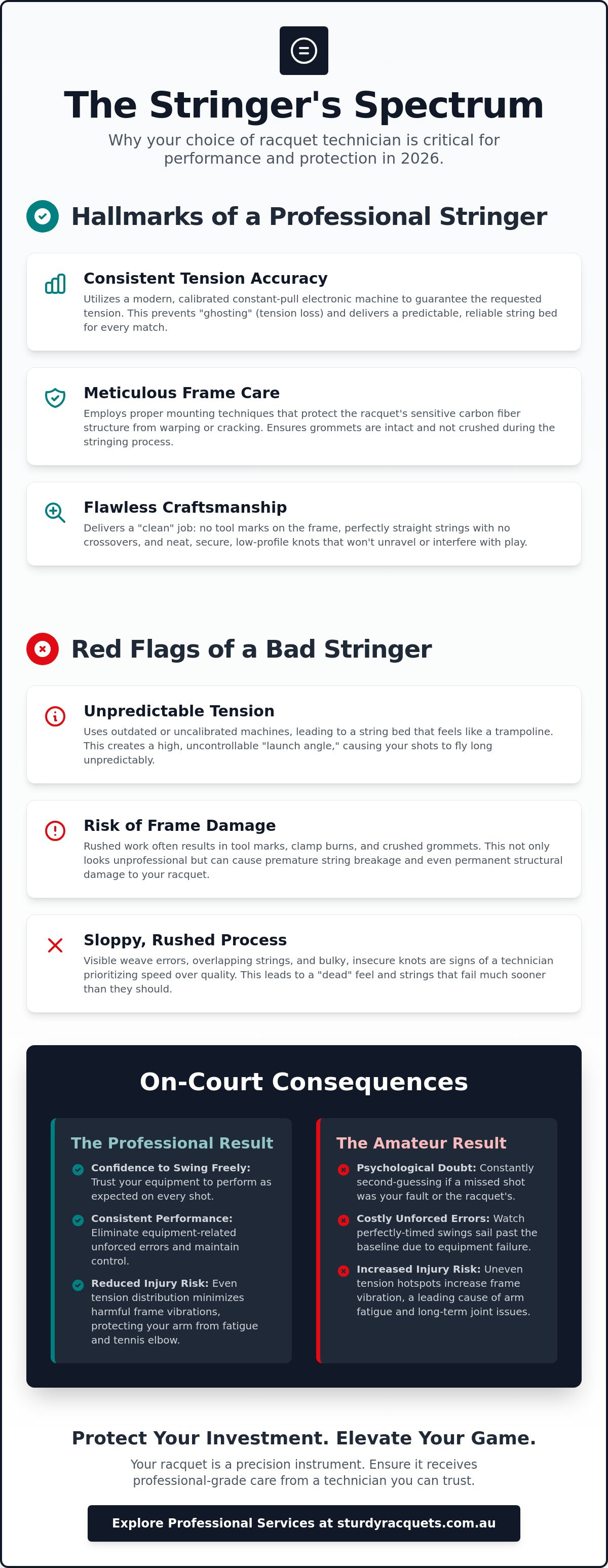
A professional stringer is more than just a machine operator. They're craftsmen who understand that the technical execution of a restring is just as vital as the string itself. When you're looking for a good tennis stringer vs bad, how to find a good tennis stringer, qualities of a professional stringer, tennis stringer near me, certified tennis stringer, signs of a bad stringer, what makes a good ra, you should look for "clean" work. This means no overlapping strings, zero tool marks on the frame, and perfectly trimmed knots. High-end equipment in 2026 often features thinner beams and more sensitive carbon layups. A technician must know how these high-performance tennis racquets react under high tension to avoid structural failure.
Consistency is the ultimate hallmark of expertise. You should receive the exact same on-court feel every time you drop off your gear. This level of precision requires a professional-grade, calibrated constant-pull electronic machine. Unlike manual crank machines that can vary by several pounds depending on the user's pull speed, electronic machines ensure every string is identical. This is especially important for the 44.7% of players who use polyester strings, as these stiff materials are unforgiving if the tension is inconsistent. To verify a technician's credentials, you can Find a USRSA Certified Stringer who has been tested on these specific technical standards.
Mastery of Knots and Tie-offs
Tie-offs are often where amateurs fail. A pro uses a "Parnell knot" because it sits flat and maintains tension without slipping. Standard "bulk" knots are often too large and can lead to immediate tension loss in the outer strings. You can spot a poor job by looking for "cinched" knots that have been pulled so hard they've crushed or deformed the plastic grommet. These small details separate a master technician from a hobbyist.
Mounting and Frame Protection
Modern frames require a 6-point mounting system to distribute pressure evenly. This setup prevents the racquet from warping or cracking during the stringing process. Professionals also use "load spreaders" at the 12 and 6 o’clock positions to protect the most vulnerable parts of the head. Improper mounting can permanently change a racquet’s shape and ruin its intended aerodynamics. If you have questions about your specific frame, feel free to speak with a racquet specialist for advice.
Red Flags: Signs of a Bad Stringer to Avoid
Spotting the technical errors of an amateur technician can save your expensive equipment from permanent damage. While we've discussed the technical precision of a master, it's just as vital to recognize the physical evidence of poor workmanship. One of the most obvious signs of a bad stringer is visual damage to the frame. Look for deep scratches near the grommet holes, which often occur when pliers slip during the tie-off process. Crushed or deformed grommets are another warning sign. These plastic inserts protect the frame's carbon fiber, and when they're flattened by excessive force, the string can eventually cut directly into the racquet head. This is a clear distinction in the debate of good tennis stringer vs bad, how to find a good tennis stringer, qualities of a professional stringer, tennis stringer near me, certified tennis stringer, signs of a bad stringer, what makes a good ra.
Weave errors are even more critical because they directly impact the string's longevity and your performance. A mis-weave, where the cross string goes over or under the wrong main string, creates a stress point. This mistake causes the strings to saw against each other during impact, leading to a break after only a few hours of play. You should also check for inconsistent spacing. If the gaps between strings aren't uniform across the bed, the tension is likely uneven. This lack of symmetry ruins the predictable sweet spot you expect from your gear.
The "Ghosting" and Friction Effect
High-volume shops often prioritize speed, leading to a phenomenon known as string burning. When a technician pulls the cross strings through the mains too quickly, the friction generates heat. This heat creates notches in the main strings before you even hit a ball. This friction damage significantly reduces the snap-back effect required to generate heavy topspin. If your strings feel dead or locked in place immediately after a restring, friction heat is the likely culprit. This is why a precision-focused specialist is always worth the investment over a low-cost, high-speed alternative.
Frame Warping and Structural Integrity
Improper mounting on a machine with fewer than 6 points of contact can physically warp your racquet. You can perform a table test by placing your racquet on a flat surface. If it doesn't sit perfectly level or if the head appears wider or shorter than factory specifications, the frame has been stressed beyond its limits. Understanding frame geometry is essential when browsing quality tennis racquets for different playing levels, as modern thin-beam designs are particularly susceptible to this type of damage. A warped frame loses its aerodynamic properties and can eventually crack under the pressure of high-tension strings.
How to Find a Good Tennis Stringer Near You
Finding the right technician is like finding a trusted mechanic for your car. You need a formal vetting process to ensure your gear is in safe hands. Understanding the difference in a good tennis stringer vs bad starts with checking credentials. When you're searching for how to find a good tennis stringer, you should prioritize a certified tennis stringer with USRSA or ERSA backing. These organizations require technicians to pass rigorous testing, including a 50-minute practical stringing exam. If you are looking for a tennis stringer near me, don't just go to the most convenient location. Ask about their equipment. A pro uses a constant-pull electronic machine to ensure the qualities of a professional stringer are met with every pull. This avoids the signs of a bad stringer, such as the tension loss found with manual crank machines. Identifying what makes a good ra is the first step toward a consistent game.
When you read local reviews, look specifically for mentions of "stringing consistency" or "on-court feel." While general customer service is nice, it doesn't guarantee technical expertise. You want to know if players' racquets feel the same every time they return for service. A specialist who records your stringing history is a major plus. This data allows them to account for string "settling" and environmental changes, providing you with a predictable response on every shot. If you're ready to experience a precision pull, book your next restringing appointment with our expert team today.
Questions to Ask Your Potential Stringer
Don't be afraid to interview your technician. Ask if they clean their clamps daily. Dirty clamps are a primary cause of string slippage and the "ghosting" damage mentioned earlier. Inquire about their experience with specific materials. For example, natural gut is a premium material that requires delicate handling and specific knot techniques. A pro will also record your history, noting the date, string type, and tension used. This level of detail ensures your next restring feels identical to your last one.
The Importance of Local Specialist Shops
Dedicated racquet specialists almost always outperform general sporting goods stores. High-volume retailers often have high staff turnover, meaning your racquet might be handled by a different person every time. A specialist shop is staffed by people who actually play the game and understand the "feel" of a fresh string bed. They can provide tailored advice based on your skill level and physical needs. For the best results, seek out professional racquet restringing in Melbourne or your local major hub where expertise is a priority.
The Sturdy Racquets Standard: Professional Australian Stringing
At Sturdy Racquets, we don't just pull strings; we engineer a better game for our community. We understand the frustration of navigating the gap between a good tennis stringer vs bad, how to find a good tennis stringer, qualities of a professional stringer, tennis stringer near me, certified tennis stringer, signs of a bad stringer, what makes a good ra. That's why our technicians undergo rigorous training to handle the delicate carbon layups found in 2026 racquet designs. Our "precision pull" method ensures that every pound of tension is accounted for, eliminating the "ghosting" issues common in high-volume retail shops. We take pride in helping our customers move away from the frustration of shots sailing long and toward pinpoint accuracy on every swing.
Before any frame leaves our workshop, it undergoes a rigorous final inspection. This includes the "Ping Test," where we check the acoustic frequency of the string bed to verify tension consistency. We also examine every tie-off knot and grommet to ensure zero structural stress. Our goal is to provide a string bed that feels identical every time you step onto the court. This dedication to the craft is what separates a passionate specialist from a simple machine operator.
Our Equipment and Technician Training
We utilize premium constant-pull electronic machines that we calibrate weekly for zero-margin error. Our technicians prioritize grommet care and use specialized load spreaders to protect your frame's integrity during the entire process. We provide a 100% technical consistency guarantee for every player across Australia. By focusing on the small details, we ensure your equipment performs at its peak for longer.
Book Your Professional Restring
You can visit our specialist workshop in Brooklyn, Victoria, or take advantage of our convenient national shipping network. It's easy to get your gear to us, no matter where you play. To truly feel the difference of a professional setup, we recommend pairing your fresh restring with high-quality tennis balls during your next hitting session. Don't let a poor stringing job lead to unforced errors or equipment damage. Schedule your professional racquet maintenance today and join a community that values technical excellence and on-court performance.
Elevate Your Game with Expert Technical Support
Your racquet is the most important tool in your bag. It deserves more than a "big-box" amateur approach. By understanding the nuances of a good tennis stringer vs bad, how to find a good tennis stringer, qualities of a professional stringer, tennis stringer near me, certified tennis stringer, signs of a bad stringer, what makes a good ra, you are taking control of your performance. You've learned that precision knots and 6-point mounting systems are non-negotiable for frame safety. These technical details ensure your gear stays within factory specifications for years to come.
We take this responsibility seriously at our 5-star rated workshop in Melbourne. Our team features Certified Master Racquet Technicians who use precision electronic constant-pull machines to deliver zero-margin results. We don't just replace strings; we optimize your entire setup so you can hit the court with total confidence. It's time to stop guessing and start playing with equipment you can trust. Experience the difference of professional racquet restringing and see how technical excellence transforms your baseline game. We're excited to help you reach your full potential on the court.
Frequently Asked Questions
How can I tell if my tennis racquet was strung too loose?
You will notice your shots sailing past the baseline despite having a normal swing. This happens because the string bed deflects too much, acting like a trampoline and increasing the launch angle of the ball. A loose bed also lacks the snap-back needed for spin. If your 55lb request feels like 48lb, the technician likely failed to account for tension loss during the tie-off process.
What are the signs that a stringer has damaged my racquet frame?
Look for deep scratches near the grommet holes or flattened plastic inserts. Crushed grommets indicate that the technician used excessive force with pliers during tie-offs. In extreme cases, a frame might fail the table test by sitting unevenly on a flat surface. This warping occurs when a stringer uses a mounting system with fewer than 6 points of contact, causing the head to compress or widen.
Is a certified tennis stringer really better than a local club stringer?
A certified technician has passed standardized exams, such as the USRSA 50 minute practical test, ensuring they meet professional benchmarks. While some club stringers are talented, certification guarantees mastery of the Parnell knot and frame protection. Choosing a professional ensures you avoid the common signs of a bad stringer and receive a consistent on-court feel every time you play.
Why do my strings move around so much after a fresh restring?
String movement usually indicates low tension or significant friction damage during the stringing process. If the crosses were pulled too quickly, they might have notched the mains, locking them into place or reducing their elasticity. Polyester strings, which hold a 44.7% market share in 2026, should snap back into place; if they don't, the tension maintenance was likely poor during the restring.
What is "string burning" and how does it happen?
String burning occurs when a technician pulls the cross strings across the mains at high speed, creating friction heat. This heat creates microscopic notches in the main strings, weakening the material before you even hit a ball. It's a common mistake in high-volume shops that prioritize speed over quality. This friction can reduce the string's life by up to 30% and ruins its overall playability.
How do I know if my stringer is using a constant-pull machine?
You can identify a constant-pull electronic machine by watching the tension head after it reaches the desired weight. It will continue to make small adjustments to compensate for string stretch. Manual crank machines, by contrast, lock into place immediately. Constant-pull technology is the 2026 industry standard for ensuring that a 52lb request actually results in 52lb of tension on every single string.
Can a bad stringing job cause tennis elbow?
Improperly strung racquets increase shock and vibration, which are primary triggers for tennis elbow. If a stringer pulls uneven tension across the bed, the sweet spot becomes unpredictable, forcing your arm to compensate for the dead feel. This physical strain is one of the most serious consequences of a good tennis stringer vs bad choice, as equipment should protect your health.
What should I do if I find a weave error in my new strings?
You should immediately stop playing and return the racquet to the technician for a full restring at no cost. A weave error, where a cross goes over or under the wrong main, creates a massive stress point that will cause the string to snap prematurely. It's a clear technical failure and a major red flag regarding the technician's attention to detail and professional standards.
Share:
How to Choose a Tennis Racquet: The 2026 Australian Buyer’s Guide
Tennis Overgrip vs Replacement Grip: The Complete 2026 Guide to Racquet Feel