



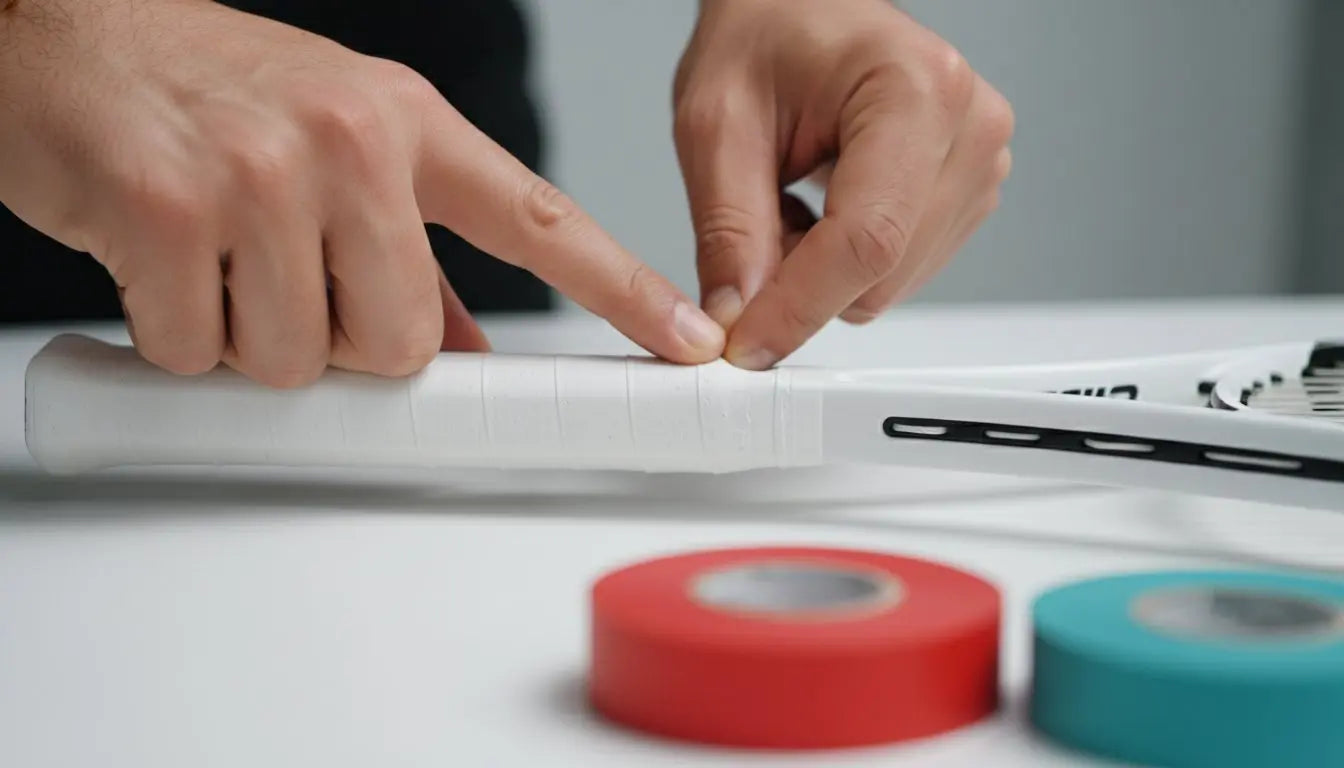
What if a mere 3 millimetres of difference in your racquet handle was the only thing standing between a clean cross-court winner and a painful case of tennis elbow? Most players spend over A$350 on the latest frame technology but completely overlook the one part of the racquet they actually touch. You've likely felt the frustration of a racquet twisting on an off-centre hit or your hand sliding mid-point during a 38-degree January afternoon in Melbourne. Learning how to choose a tennis grip is the fastest way to fix these issues and gain a competitive edge.
We understand that a grip that feels "locked in" is the foundation of a confident game. This 2026 guide will help you master the art of selecting the perfect size and type to improve your control, stop blisters, and handle the intense Australian heat. You'll learn how to identify your ideal measurement and discover durable overgrips for sweaty hands to keep your racquet steady. We'll also explain the difference between grip numbers so you can prevent common tennis injuries like wrist strain and keep playing your best all season long.
Key Takeaways
- Learn how the correct handle circumference unlocks maximum racquet head speed and protects your arm from common injuries during long matches.
- Discover how to choose a tennis grip using two simple on-court and at-home measurement techniques to ensure a perfect fit every time.
- Understand the difference between base layers and overgrips to better manage sweat and maintain a secure hold in the intense Australian summer heat.
- Master the professional "smaller is better" rule for handle sizing, allowing you to easily customize your equipment for a bespoke, comfortable feel.
- Get expert tips on professional regripping techniques to ensure your equipment is tournament-ready with perfect tension and zero performance-hindering lumps.
Why Your Tennis Grip Size is the Most Important Spec You're Ignoring
Grip size refers to the total circumference of your racquet handle. In Australia, these measurements typically range from 4 inches (often labeled as L0) to 4 5/8 inches (L5). While many players spend hours researching frame weight or string patterns, the handle size is the foundation of every shot. Mastering how to choose a tennis grip is vital because it determines how effectively you transfer power from your arm to the ball. The right fit allows for an optimal wrist snap, which is the primary driver of racquet head speed and heavy topspin.
Playing with an incorrect size leads to immediate technical and physical issues. If the handle is poorly fitted, you'll likely feel the racquet twisting in your palm during off-center hits. This often results in a "death grip" habit, where you squeeze the handle with 30% more force than required just to maintain control. This excessive tension is a primary trigger for lateral epicondylitis, or tennis elbow, a condition that impacts roughly 40% of recreational players at some stage in their journey.
The Dangers of an Improper Fit
A handle that is too small forces the small muscles in your forearm to overwork to keep the frame stable. On the other hand, a grip that is too large inhibits your dexterity, making it difficult to switch between forehand and backhand grips during fast-paced net exchanges. Excessive grip torque during a 180 km/h serve increases the mechanical load on the elbow joint by 20% if the handle diameter fails to match the player's natural hand span.
Modern Trends: Why Pro Players are Sizing Down
The "old school" rule of leaving a full finger-width gap between your fingertips and palm is fading. Many modern professionals now choose smaller handles to facilitate the "windshield wiper" forehand, a technique that relies on extreme wrist mobility to generate high RPMs. Smaller grips provide a greater sense of "feel" and allow for the aggressive wrist snap seen in today's game. When you are looking for professional grade tennis racquets, you must balance this desire for spin with the need for long-term comfort.
- Small handles (L1-L2): These enhance topspin and wrist flick but require more forearm strength to stabilize.
- Large handles (L4-L5): These offer superior stability for volleys and flat hitters but can feel restrictive during baseline rallies.
How to Measure Your Tennis Grip Size: The Two Proven Methods
Getting your equipment right starts with the physical connection between your hand and the handle. Most players don't realise their dominant hand is often slightly larger than their non-dominant one because of developed muscle mass. Always measure the hand you use to hold the racquet to get an accurate result. Learning how to choose a tennis grip effectively prevents common issues like "tennis elbow" or racquet twisting during heavy hits.
Method 1: The Index Finger Test
This is the gold standard for a quick check when you're already at the court. Hold your racquet handle using an Eastern Forehand grip; your palm should be placed against the same flat bevel as the strings. Once you have a firm hold, try to slide the index finger of your non-hitting hand into the space between your ring finger and your palm.
- The Snug Fit: Your index finger should fit comfortably in the gap with very little room to spare.
- Too Small: If there isn't enough space to fit your finger, the grip is too small. This requires more muscle strength to keep the racquet stable.
- Too Large: If there's a significant gap around your index finger, the handle is too bulky, which can limit your wrist snap on serves.
Method 2: The Ruler Test (Anatomical Measurement)
The ruler test is the most reliable way to find your size when you're browsing versatile tennis racquets for all playing levels online. Open your hitting hand with your fingers extended and close together. Align a ruler with the second lateral (horizontal) crease of your palm. Measure from that line straight up to the very tip of your ring finger.
This measurement gives you the exact circumference you need. For example, a measurement of 111 millimetres typically aligns with a Size 3 handle. It's a precise way to ensure your new gear feels natural from the first point.
Tennis Grip Size Chart: US vs. EU
Australia uses both European (0-5) and US (inches) sizing systems. Knowing the conversion helps you shop with confidence across different brands. In the Australian market, most adult women find their match in a Size 2, while the average adult male typically uses a Size 3.
- Size 0 (4 inches): Best for juniors transitioning to full-size frames.
- Size 1 (4 1/8 inches): Common for older juniors or adults with very small hands.
- Size 2 (4 1/4 inches): The standard starting point for most female players.
- Size 3 (4 3/8 inches): The most popular size for male club players.
- Size 4 (4 1/2 inches): Suitable for players with larger hands.
- Size 5 (4 5/8 inches): Reserved for players with exceptionally large hands.
If you fall between two sizes, we recommend choosing the smaller handle. You can always add an overgrip to increase the size by about half a step, but it's nearly impossible to shave down a handle that's too big. If you're unsure about your measurement, check out our latest quality grip enhancements and overgrips to fine-tune your feel.
Choosing Between Replacement Grips and Overgrips for Your Style
Your racquet handle consists of two distinct layers that serve different purposes. The base grip, or replacement grip, is the thick, cushioned material wrapped directly onto the handle's pallet. It provides the primary shock absorption and defines the handle's shape. In contrast, an overgrip is a thin, disposable layer designed to sit on top of the base. Understanding the difference is a vital step in learning how to choose a tennis grip that suits your specific level of play.
Material science plays a huge role in your decision. You generally have two choices: tacky or dry. Tacky grips provide a sticky surface that helps the racquet stay glued to your palm, which is excellent for players with drier hands. Dry grips use porous materials to wick moisture away. For Australian players facing 35-degree heat during the summer season, high-absorbency overgrips are the standard choice to ensure the racquet doesn't slip during a high-pressure match.
When to Replace Your Base Grip
You should consider a new base grip if you can no longer feel the sharp edges of the handle bevels. Over time, the internal foam compresses and loses its ability to dampen shock. A fresh replacement grip can restore the original comfort of your racquet, effectively reducing the risk of tennis elbow. If you notice the underlying wood or synthetic handle material peaking through the wrap, visit our range of essential tennis accessories and court gear to find a durable replacement.
The Overgrip Advantage: Customizing Your Feel
Overgrips offer a cost-effective solution for maintaining a consistent feel without the expense of a full replacement. At roughly A$5 to A$7 each, they allow you to refresh your racquet's texture every few sessions. These thin wraps also help you fine-tune your handle size; adding one overgrip typically increases the circumference by 1/16th of an inch. This precision is helpful when you're mastering how to choose a tennis grip for a customized fit. Frequent overgrip changes prevent the accumulation of sweat and bacteria that can lead to skin irritation during humid afternoon sessions.
Solving the 'In-Between' Dilemma: Pro Tips for Customizing Your Handle
If you find yourself stuck between two sizes while learning how to choose a tennis grip, follow the golden rule of the pro shop: always go smaller. You can easily build a handle up, but shaving one down is nearly impossible without ruining the racquet's structural integrity. Most modern handles consist of molded polyurethane or carbon fiber. Attempting to sand these down often leads to uneven surfaces and a permanent loss of the handle's bevel definition. Picking the smaller size gives you a blank canvas to create a custom fit that feels perfect in your palm.
For a permanent and professional fix, many Australian players use heat shrink sleeves. These specialized plastic tubes slide over the bare handle and shrink tight when a heat gun is applied. A full-size sleeve adds exactly 1/8 inch (one full grip size), while a half-size version adds 1/16 inch. This method costs roughly A$15 to A$25 at a specialist shop and provides a firm, uniform surface that maintains the original feel of the racquet better than layers of tape ever could.
Building Up Your Grip Properly
Using a single overgrip is the most common way to add about 1.6mm to your handle thickness. You can customize the feel by adjusting the overlap as you wrap. A heavy 50 percent overlap creates a cushioned, thick sensation that many players find comfortable for baseline play. However, you must be careful with the double overgrip technique. While it provides extra sweat absorption, it often rounds out the handle. You need to feel those eight distinct bevels to switch between a service grip and a forehand grip quickly. If the handle becomes too cylindrical, you lose your orientation during fast rallies.
Selecting Gear Based on Your Final Grip Size
Your grip choice influences the overall racquet specifications more than you might think. When you browse the best tennis racquets for beginners, remember that adding a shrink sleeve adds approximately 15 to 20 grams to the handle. This weight addition shifts the balance point toward the hand, making the racquet feel more head-light and maneuverable at the net.
For those investing in high-performance tennis racquets, this shift can alter your swing weight and power potential. It is a smart move to talk to an expert about how your preferred grip thickness will interact with the frame's factory balance. Ensuring these elements work together is a key part of mastering how to choose a tennis grip for long-term success on the court.
Expert Grip Customisation and Selection at Sturdy Racquets
Sturdy Racquets is more than a retail store. We are a community hub for players who want to get the most out of their equipment. Our team understands that learning how to choose a tennis grip is only half the battle. The other half is the application. Most players wrap their own handles, but a professional regripping service ensures your base grip is applied with 2kg of consistent tension. This eliminates the tiny lumps and overlaps that often lead to blisters or hand fatigue during a long third set.
Our commitment to the Australian tennis community means we only stock gear that survives our unique environment. Whether you are playing through 40-degree summer days in Melbourne or high humidity in Queensland, your grip needs to stay tacky. We also recommend combining your grip selection with our professional stringing services. While the grip manages your physical connection to the frame, the strings manage your connection to the ball. Together, they create a cohesive setup tailored to your specific swing speed and style.
Visit Our Brooklyn Store for a Custom Fitting
Ruler measurements provide a great baseline, but nothing replaces the tactile feedback of holding a racquet in person. At our Brooklyn, Victoria showroom, you can test different handle sizes to see how they actually feel in motion. Our knowledgeable staff will help you validate your measurements and find the right texture for your sweat level. If you find your hand slipping during serves, we might suggest a perforated overgrip or a specific moisture-wicking material. We are located right in Brooklyn, VIC, providing local players with a reliable spot for immediate maintenance and expert advice before their next match.
Shop Online with Confidence
If you cannot make it to our showroom, our online store makes it easy for players nationwide to find the perfect tennis gear for their game. We provide detailed specifications and expert-vetted accessories to ensure you make a smart buying decision from your own home. Every item in our range is selected because it meets our high standards for durability and performance.
- Fast Shipping: We get your gear to you quickly so you don't miss a session.
- Expert Selection: Only the best accessories make it into our inventory.
- Community Support: We are always available to answer questions about how to choose a tennis grip via email or phone.
Avoid Unforced Mistakes. Get your grip size right today by reaching out to our expert team or browsing our latest collection online.
Master Your Handle for the 2026 Season
Getting your handle setup right isn't just a minor detail; it's the foundation of your entire swing. Whether you're playing in the 40-degree heat of a Melbourne summer or a crisp winter morning, the right grip prevents the racquet from twisting and protects your elbow from strain. You've now mastered how to choose a tennis grip using the 30-second index finger and ruler measurement methods. Remember that a grip that's too small leads to excessive wrist snap, while one that's too large limits your ability to generate spin on the ball.
If you're still feeling stuck between sizes, our team in Brooklyn, VIC, provides expert in-store advice to help you find that perfect fit. We offer professional racquet customisation and stringing services to ensure your gear matches your specific playing style. We stock a wide range of climate-tested grips specifically selected for harsh Australian conditions so you don't lose your hold during a crucial tie-break. You can browse our full range of professional tennis accessories and grips to find the perfect match for your racquet today. We'll see you on the court with a setup that feels like a natural extension of your arm.
Frequently Asked Questions
What is the most common tennis grip size for men and women?
Most men in Australia use a size 3 (4 3/8 inches) or size 4 (4 1/2 inches) handle. For women, the 85% majority opt for a size 1 (4 1/8 inches) or size 2 (4 1/4 inches). You can check your fit by ensuring a 1 centimetre gap exists between your fingertips and palm when holding the racquet. Selecting the right dimensions is a vital step when finding the right tennis racquet size for your hand.
Can I change my tennis grip size without buying a new racquet?
You can increase your handle size by 1/16 of an inch using a heat shrink sleeve for roughly A$15. It's much harder to decrease a size, though you can replace the standard 1.5mm thick replacement grip with a thinner 1.0mm version to shave off a fraction of the circumference. Our team often suggests tennis racquet customisation services for players who find themselves stuck between two standard sizes.
How often should I change my tennis overgrip?
You should replace your overgrip every 6 to 10 hours of court time to ensure maximum traction. If you notice the material peeling or if your hand slips during a 100km/h serve, it's definitely time for a fresh wrap. Keeping a pack of high performance tennis overgrips in your bag ensures you always have the friction needed to control the ball accurately.
What happens if my tennis grip is too small?
A grip that's too small forces your forearm muscles to work 25% harder to prevent the racquet from twisting on impact. This extra tension limits your range of motion and saps your power during long matches. Learning how to choose a tennis grip correctly ensures you don't compromise your technique or tire your arm out before the third set begins.
Is there a difference between tennis and pickleball grip sizes?
Pickleball paddles feature smaller handles that usually measure between 4 inches and 4 1/4 inches in circumference. This is significantly smaller than tennis racquets, which often reach 4 5/8 inches for larger hands. If you're transitioning between sports, look for comfortable pickleball paddle grips that match the specific needs of the shorter, lighter paddle.
How do I know if I need a tacky or a dry overgrip?
Choose a dry overgrip if you play in temperatures above 30 degrees or if your palms produce 20% more moisture than average. Tacky grips are perfect for players who want a "glued" feel and play in cooler, drier conditions. Using absorbent tennis racquet wraps is the best solution for humid Australian summers when maintaining a firm hold becomes a challenge.
Does the grip size include the overgrip?
Manufacturer sizes only account for the bare handle and the base replacement grip, not any additional layers. Adding one standard overgrip will increase the total handle circumference by about 1.6mm. Factoring in this extra thickness is essential as you master how to choose a tennis grip that feels natural during high intensity rallies.
Can a wrong grip size cause tennis elbow?
Yes, an ill-fitting handle is a contributing factor for the 40% of club players who suffer from tennis elbow. When the size is off, you compensate by squeezing the handle with excessive force, which inflames the tendons in your forearm. Investing in tennis elbow prevention gear and getting a professional grip measurement can save you months of recovery time.
�
�
�
Share:
Stylish Tennis Bags for Women: The Ultimate 2026 Buying Guide
Best Tennis Shoes for Clay Courts Australia: The 2026 Ultimate Buyer’s Guide