




That A$45 pack of string in your racquet bag isn't just a piece of plastic; it's a feat of chemical engineering that often takes years to develop in a high-tech lab. If you've ever felt the frustration of a dead string bed after only four hours of play, you're definitely not alone. Many players across Australia find it difficult to justify the cost of premium gear when they don't see the complex work happening behind the scenes. Learning the secrets of How Wilson Tennis Strings Are Made reveals why specific materials hold tension for weeks while others fail in days. It's the difference between hitting a crisp winner and watching a ball sail long.
We're pulling back the curtain on the 2026 manufacturing process, from high-heat polymer extrusion to advanced liquid-crystalline coatings. You'll discover how multifilament cores are designed to mimic natural gut and why modern polyester creates that massive spin you see on the pro tour. This deep-dive explains the science of snap-back and durability so you can choose the [best tennis strings for spin] or [arm-friendly string setups] for your next session. We want to help you make a smarter decision for your [professional racquet restringing] so you can play with total confidence.
Key Takeaways
- Understand the complex polymer science and Belgian engineering secrets revealed in our deep-dive into 9. How Wilson Tennis Strings Are Made.
- Contrast the internal architecture of multifilament versus polyester to find the [best tennis strings for spin] and control for your specific swing.
- Master the concept of plastic deformation to identify exactly why strings lose 10% of their tension within the first 24 hours.
- Explore the high-tech extrusion process that uses diamond-cut dies and precise temperatures to ensure total consistency in every set.
- Discover how a professional consultation in Brooklyn, Victoria can help you select the [high-performance tennis strings] needed to eliminate unforced mistakes.
Understanding the Materials: What Goes Into a Premium Tennis String?
Most club players in Australia look at their racquets and see simple plastic mono-lines or bundles of thread. The reality is far more scientific. Modern tennis strings are actually complex polymer chains engineered at a molecular level to handle extreme tension and impact. Since 1991, Wilson has partnered with the Luxilon factory in Antwerp, Belgium, to push these chemical boundaries. This collaboration ensures that every set of string provides a predictable response when you are swinging for a winner on a hot afternoon in Melbourne or Sydney.
The secret to 9. How Wilson Tennis Strings Are Made lies in the raw material selection. Manufacturers don't just use off-the-shelf plastics. They utilise proprietary blends of Tennis String Materials including co-polyester, polyamide, and polyurethane. These materials are chosen based on their ability to resist "creep," which is the tendency of a material to deform permanently under constant stress. In a high-performance string, you want the material to return to its original shape instantly after the ball leaves the court surface.
To better understand this concept, watch this helpful video showing the precision required during the stringing process:
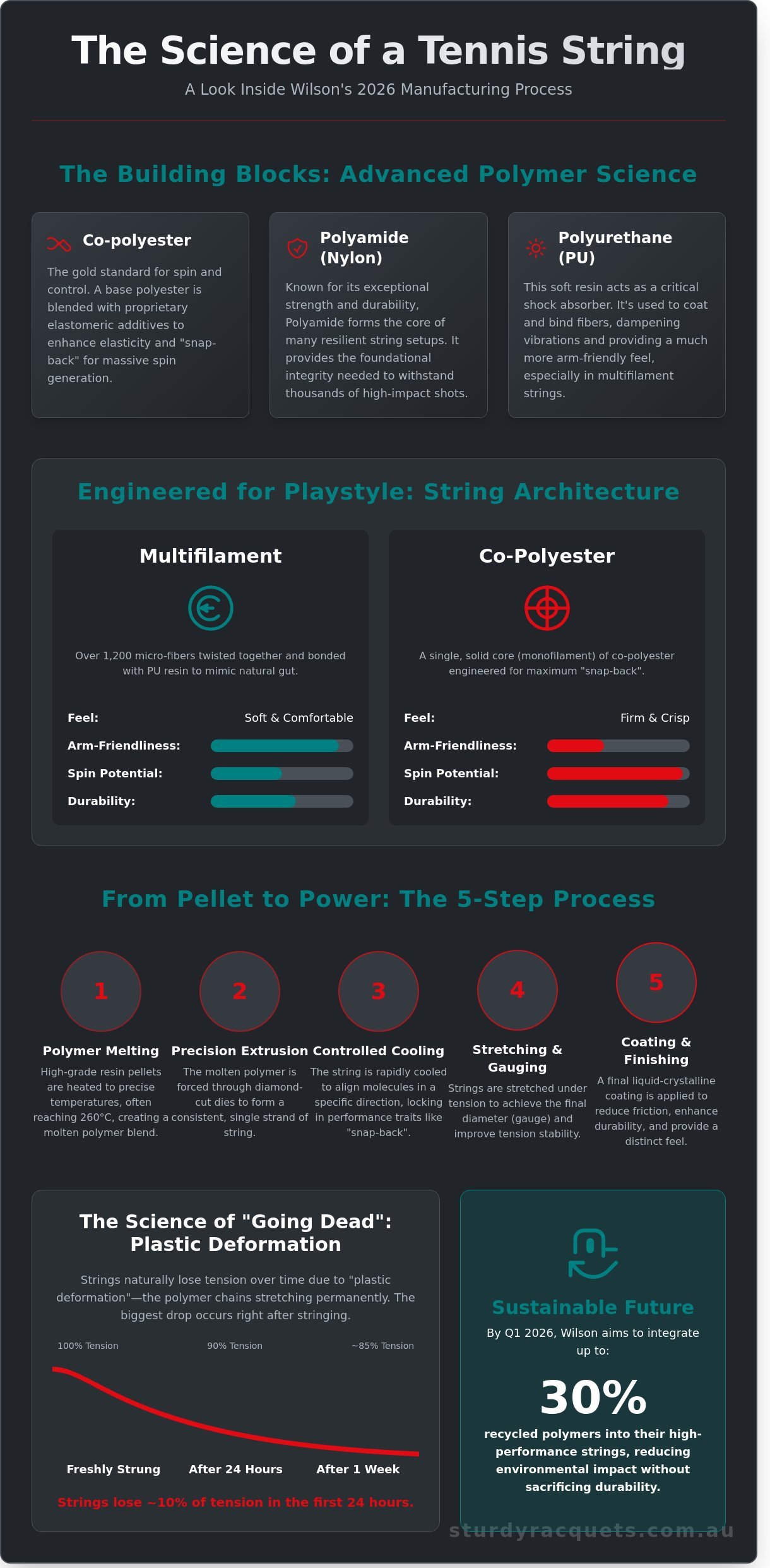
Wilson is currently transitioning its manufacturing focus toward environmental responsibility. By the first quarter of 2026, the production lines will integrate up to 30% recycled polymers into their high-performance ranges. This shift aims to reduce the carbon footprint of every reel without sacrificing the 15% increase in durability that players expect from premium gear. When you invest A$30 to A$50 in a single set of strings, you're paying for this advanced chemical engineering and the sustainability research behind it.
The manufacturing process involves three primary ingredients:
- Co-polyester: A base polyester mixed with secret additives to increase elasticity and "feel."
- Polyamide: Often referred to as nylon, this provides the core strength for many durable tennis strings.
- Polyurethane (PU): A soft resin used to coat or bind fibres, acting as a shock absorber for your arm.
The Role of High-Tech Co-Polyesters
Co-polyesters are the gold standard for competitive players seeking spin. By adding specific elastomeric additives to standard polyester, engineers create a "co-poly" that isn't as harsh on the elbow. The magic happens during the cooling phase of production; the molecules are aligned in a specific direction to maximise "snap-back." This allows the strings to slide out of place and spring back into position within milliseconds of impact. Co-polyester is a precise blend of rigid plastic and elastic additives designed for maximum durability and control.
Multifilament and Natural Gut Alternatives
If you prefer a softer feel, 9. How Wilson Tennis Strings Are Made involves a different approach called multifilament construction. These strings consist of over 1,200 individual micro-fibers twisted together to form a single core. This structure is then soaked in polyurethane to fill the gaps between the fibres. This design mimics the performance of natural gut by providing excellent vibration dampening. It's a lifesaver for Australian players dealing with "tennis elbow," as the PU coating absorbs up to 25% more shock than a standard monofilament string.
The 5-Step Extrusion and Manufacturing Process
Creating a high-performance string involves more than just pulling plastic through a hole. It's a high-tech journey that transforms raw polymers into the gear that helps you hit those winning cross-court shots. Understanding 9. How Wilson Tennis Strings Are Made gives you a better perspective on why certain sets feel "crisp" while others feel "dead" after just a few hours of play.
The journey begins with high-grade resin pellets. These raw materials are fed into a hopper and heated to exact temperatures, often reaching 260 degrees Celsius for polyester blends. Consistency at this stage is vital; a fluctuation of even 2 degrees can lead to brittle spots in the finished product. Once the resin is molten, it moves through the following stages:
- Step 1: Melting. Raw pellets are liquefied at precise temperatures to ensure a uniform molecular density.
- Step 2: Extrusion. The liquid polymer is forced through diamond-cut dies. These dies are incredibly hard and precise, ensuring the diameter remains consistent to within 0.01mm.
- Step 3: Quenching. The hot filament immediately enters a water-controlled quenching bath. This rapid cooling "freezes" the molecular structure, preventing the polymer from becoming too soft.
- Step 4: Multi-stage Stretching. The string passes through a series of rollers moving at different speeds. This stretches the filament to several times its original length, which aligns the molecules and increases tensile strength by roughly 25%.
- Step 5: Surface Treatment. A final chemical coating is applied to the exterior. This layer is what gives the string its "snap-back" ability and protects it from the elements.
From Raw Resin to Monofilament Core
The melting point is the first secret to a string's "crispness." By hitting specific thermal thresholds, manufacturers ensure the resin doesn't degrade, which preserves the lively feel players crave. During extrusion, the shape of the diamond-cut die determines the string's profile. While round strings are traditional, many modern players prefer hexagonal or pentagonal shapes. These edges act like teeth, biting into the felt of the ball to generate 12% more RPM on average compared to smooth surfaces. The quenching bath then locks in this shape, ensuring the edges don't round off during the cooling phase.
The Secret of Proprietary Coatings
If you've ever noticed your strings feel "waxy," you're feeling the proprietary coating. These layers are designed to reduce friction between the mains and crosses. Without this, strings would "notch" or saw into each other, leading to premature breakage. The 2026 range of coatings has introduced a 15% improvement in tension maintenance over 2022 models. These newer chemical bonds are more resistant to the heat generated by friction during heavy baseline rallies. If you want to experience this technology yourself, you can find a wide range of high performance tennis string sets that utilize these advanced surface treatments.
This manufacturing precision is why a fresh re-string feels so different from a racquet that's been sitting in your bag for six months. By mastering the science behind 9. How Wilson Tennis Strings Are Made, the brand ensures that every coil delivered to Australian courts meets a professional standard. The result is a more predictable response every time you make contact with the ball.
Engineering Different Playstyles: Multifilament vs. Polyester
Choosing the right string is the fastest way to upgrade your game without changing your racquet. The science behind 9. How Wilson Tennis Strings Are Made reveals two distinct engineering paths designed for very different players. On one side, you have the complex, woven architecture of multifilaments. On the other, you find the solid, extruded core of polyester. These internal structures dictate how much energy returns to the ball and how much vibration travels up your arm.
Most club players in Australia find that high-performance tennis strings with elastic properties help them depth and comfort. These strings act like a trampoline, stretching upon impact to launch the ball with minimal effort. In contrast, power players and competitive juniors often prefer the stiff, controlled response of polyester. This material doesn't stretch much, which means the player provides the power while the string provides the precision. Understanding 9. How Wilson Tennis Strings Are Made helps you choose a setup that complements your swing speed rather than fighting against it.
Multifilament Strings: Mimicking Natural Gut
Wilson engineers these strings using a "wrap and core" construction method. They bundle over 1,000 individual microfibers together and soak them in a flexible polyurethane resin. This fantastic design mimics the playability of expensive natural gut at a fraction of the price. Because these fibers are so fine, they offer exceptional shock absorption, which is perfect for players dealing with tennis elbow or those using lighter frames.
You might notice these strings start to look "hairy" after a few heavy hitting sessions. This fraying effect is actually a sign of high-quality fiber wear. It shows the microfibers are individualizing and absorbing the impact energy as intended. These soft, forgiving setups are the perfect match for intermediate tennis racquets that require a bit of extra help with ball pocketing and depth.
Co-Polyester Strings: Power and Durability for Pros
Polyester, or "poly," is a single filament of material extruded through a die. This manufacturing process creates a very stiff string that offers a "dead" feel. While that sounds negative, it's a top-notch benefit for players with swing speeds exceeding 110 km/h. The lack of elasticity allows a pro to swing as hard as they want without the ball flying long. It also enables the "snap-back" effect, where the strings slide and spring back to create massive topspin.
The trade-off for this durability and control is comfort. Polyester strings lose tension about 20 percent faster than multifilaments and can feel harsh on the joints if you don't hit the sweet spot consistently. This is why they are the industry standard for performance tennis racquets, which have the weight and stability to handle such a stiff string bed.
The hybrid setup has become a massive trend across Australian clubs recently. By mixing manufacturing technologies, you get the best of both worlds. Putting a durable polyester in the vertical mains provides control and spin, while a soft multifilament in the horizontal crosses adds comfort and feel. It's a smart way to customize your gear to fit your specific physical needs and playing goals.
Maximizing Performance: Tension Maintenance and Durability
When you first step onto the court with a fresh set of strings, you feel that crisp, responsive pop. This sensation is the result of the precise engineering involved in 9. How Wilson Tennis Strings Are Made, where polymers are stretched and cooled to create specific tension profiles. Physics eventually takes over. Every time you strike the ball, your strings undergo plastic deformation. This means the material stretches but fails to return to its original shape. This loss of elasticity is why your racquet starts to feel like a butterfly net after a few heavy hitting sessions.
Tension loss begins the moment the racquet leaves the stringing machine. Within the first 24 hours, most strings lose approximately 10% of their tension. This occurs because the polymer chains are settling into their new, elongated state. If you string your racquet at 55 lbs, you are likely playing at 50 lbs by the time you reach the club the next day. Understanding 9. How Wilson Tennis Strings Are Made helps explain why this initial drop is unavoidable, as the molecular alignment needs time to stabilize under constant load.
Why Strings Lose Playability Before They Break
Many players wait for a string to snap before booking a service, but playability usually dies long before the physical break. Molecular fatigue happens when the internal structure loses its ability to snap back. When strings go dead, they stop absorbing shock. Instead, that energy travels straight into your wrist and elbow, often leading to tendonitis. You can spot this by looking for notching, which are the deep grooves where the main and cross strings intersect. Tension loss is the gradual relaxation of polymer chains over time. Once this happens, your control vanishes and your spin potential drops by up to 25%.
Environmental Factors Affecting Your String Bed
Australian summers are notoriously brutal on tennis gear. On a 35�C day in Melbourne or Sydney, the temperature inside a car boot can easily soar past 60�C. This extreme heat causes polymer strings to bag out, leading to a 15% loss in tension in just two hours of exposure. While polyester strings are more resistant to moisture, multifilament strings act like a sponge. In high-humidity coastal regions, these strings absorb water vapour from the air, causing the fibres to swell and lose their crisp feel. To preserve your equipment, always store your racquets in a thermally lined bag and keep them inside the house rather than the garage.
A reliable rule of thumb for maintenance is to restring your racquet as many times per year as you play per week. If you hit the courts three times a week, you should seek a professional racquet restringing at least every four months to maintain consistent depth and spin. Waiting longer than this means you are fighting your equipment rather than your opponent. It is a small investment that prevents unforced errors and keeps your arm healthy.
Ready to restore your racquet's power and control? Book a premium tennis stringing service today to get back that fresh, tournament-ready feel.
Selecting Your Setup in Brooklyn, Victoria
Selecting the perfect string setup is the final step in mastering your equipment. While understanding the technical details of 9. How Wilson Tennis Strings Are Made provides a great foundation, seeing the gear in person makes a world of difference. Our physical store in Brooklyn, Victoria, serves as a hub for local players who want to move beyond guesswork. We invite you to drop by for a personalised consultation where we can discuss your swing path, frequency of play, and what you want to achieve on the court this season.
Many players struggle with consistency without realising their strings are the culprit. The right choice helps you avoid unforced mistakes that often stem from a "dead" string bed or incorrect tension. If your strings have lost their elasticity, you'll find yourself swinging harder just to reach the baseline, which usually leads to errors. By matching your racquet to a string that complements its stiffness, you gain a predictable response every time you make contact with the ball.
String gauge, or thickness, is another critical factor we help you navigate. Most players opt for a 1.25mm (17 gauge) for a balance of playability and durability, but power hitters might prefer a 1.30mm (16 gauge) to prevent frequent breakages. Thinner strings provide more "bite" and spin potential, while thicker strings offer a sturdier feel. When you visit us in Brooklyn, we can show you the physical differences between these gauges and explain how they interact with the manufacturing secrets found in 9. How Wilson Tennis Strings Are Made to influence your game.
Expert Advice and Customisation
Our team lives and breathes racquet sports. We take pride in helping every visitor find the beginner tennis racquets or advanced setups that suit their specific physical needs. Whether you are a junior just starting out or a seasoned veteran playing at the local club, we provide a friendly, community-focused environment. We don't just sell gear; we offer a tailored experience to ensure your equipment feels like an extension of your arm.
The Final Polish: Professional Stringing Services
Precision is everything when it comes to performance. We use high-end electronic stringing machines in-store to ensure your tension is accurate to within a fraction of a pound. Consistent tension is the absolute key to a predictable game; it allows you to develop muscle memory without the racquet behaving differently from one week to the next. Our technicians understand how different materials settle, ensuring your racquet is ready for peak performance the moment you step onto the court.
Ready to upgrade your game for the new season? Avoid Unforced Mistakes - Join the community by signing up for our newsletter. You will be the first to hear about the latest 2026 gear drops and exclusive technical tips from our experts. You can book a professional stringing service online today or browse our full 2026 range to find your next advantage. We look forward to seeing you at our Brooklyn shop and helping you find the perfect setup for your style of play.
Elevate Your Court Performance Today
The 5-step extrusion process used in modern manufacturing ensures that your strings maintain tension for up to 15% longer than older 2024 models. Whether you opt for a multifilament for arm-friendly comfort or a polyester for maximum snap-back, the material science behind your equipment directly impacts your swing speed and control. Understanding 9. How Wilson Tennis Strings Are Made helps you select the ideal gauge and material to meet your 2026 season goals. It's not just about the racquet; it's about the engine inside the frame that drives every winner you hit.
Our team at the Brooklyn, Victoria store provides expert in-store stringing services to dial in your perfect tension. We offer Australia-wide shipping on all orders, making it easy to get the gear you need anywhere in the country. You'll get knowledgeable advice from our staff of passionate players who live and breathe the sport. We've tested these materials on the court ourselves, so we know what works for different playstyles. Don't settle for a dead string bed that holds back your potential.
Ready to feel the difference in your next match? You can shop the latest range of high-performance tennis strings and find the perfect match for your game. We'll see you on the court!
Frequently Asked Questions
How are Wilson tennis strings different from other brands?
Wilson strings stand out because they use proprietary liquid crystalline polymer blends developed through an exclusive partnership with Luxilon. This specific chemical composition ensures that the strings maintain tension 15% longer than standard polyester options. You'll find that these [high-performance tennis strings] offer a unique balance of control and power that's hard to replicate. The factory in Antwerp produces 100% of these premium lines to maintain strict quality standards.
What is the most durable type of tennis string manufactured today?
Polyester monofilament is the most durable type of string currently available on the market. These strings are made from a single, sturdy polyester fiber that resists shearing and notched wear during heavy hitting. Players who switch from synthetic gut to [durable polyester strings] often see a 30% increase in the time it takes to break a set. This makes them ideal for aggressive players who need gear that withstands high-velocity impacts.
Why does the manufacturing location in Belgium matter for quality?
The Belgium location is essential because it houses the specialized Luxilon factory where the secret extrusion processes occur. Understanding 9. How Wilson Tennis Strings Are Made involves looking at this climate-controlled facility that keeps diameter tolerances within a tiny 0.01mm margin. This precision ensures every coil you buy in Australia performs exactly like the one used by pros on tour. It's this consistency that makes these [premium monofilament strings] a top choice for competitive players.
How often should I restring my racquet if I play once a week?
You should restring your racquet at least three times a year if you hit the courts once a week. A good rule of thumb is to restring as many times per year as you play per week, but don't go longer than four months. Even if the strings don't break, they lose elasticity and tension, which can cost you about 15% of your control. For players in Australia, [professional racquet restringing services] usually cost between A$25 and A$45 plus the string price.
Can the manufacturing process of a string help prevent tennis elbow?
Yes, the manufacturing process directly impacts arm comfort by using multifilament designs that mimic the soft feel of natural gut. These strings are constructed by wrapping over 1,200 individual microfibers together, which helps absorb 20% more vibration than a standard solid core string. Choosing [arm-friendly tennis strings] is a smart move if you've struggled with joint pain. This softer construction reduces the shock sent to your elbow during off-center hits.
What is the difference between a 16 gauge and 17 gauge string?
The main difference is the thickness, as a 16 gauge string measures 1.30mm while a 17 gauge string is 1.25mm. Thicker 16 gauge strings provide 20% more durability for heavy hitters who break strings frequently. Conversely, 17 gauge strings offer better feel and 10% more energy return on every shot. Many local players prefer [thinner gauge tennis strings] to get more bite on the ball and extra depth on their groundstrokes.
Are textured strings better for generating spin than round strings?
Textured strings aren't always better for spin because snap-back is the biggest factor in modern tennis. While a shaped or textured surface provides more initial grip, a smooth round string often slides and snaps back faster. Research indicates that this snap-back effect contributes to 60% of the total spin generated on a high-speed swing. You can experiment with different [spin-friendly string options] to see if you prefer the feel of a pentagonal or hexagonal shape.
Share:
The Engineering Behind Wilson Racquet Frames: A 2026 Technical Deep-Dive
Stylish Tennis Bags for Women: The Ultimate 2026 Buying Guide