



Table of Contents
-
Why Pickleball Paddle Grip Size is the Foundation of Your Technique
-
Performance Impact: How Grip Size Dictates Control and Power
-
Ergonomics and Injury Prevention: Avoiding "Pickleball Elbow"
-
Adjusting Your Grip: Customisation for the Australian Climate
Why Pickleball Paddle Grip Size is the Foundation of Your Technique
When you step onto the Pickleball court, your paddle becomes an extension of your arm. But what connects you to the paddle? The handle. This single point of contact is the most critical interface in your entire game, translating every intention from your brain to the ball. While we often focus on a paddle’s weight, core material, or surface texture, the importance of pickleball paddle grip size is frequently underestimated. It’s not just about comfort—it’s the bedrock of your technique, power, and long-term health on the court.
Grip size refers to the circumference of the paddle's handle, including the base grip it comes with. Think of it as the handle's thickness. While manufacturers offer a “standard” size, human hands are anything but standard. Relying on a one-size-fits-all approach often leads to a subtle but significant mismatch that can undermine your performance. The connection between your hand and the paddle handle initiates the entire kinetic chain—the sequence of movements from your fingers, through your wrist and elbow, up to your shoulder. If this first link is weak or inefficient, the entire chain is compromised, forcing you to compensate in ways that can lead to poor shots and even injury.
Circumference vs. Length: Clearing the Confusion
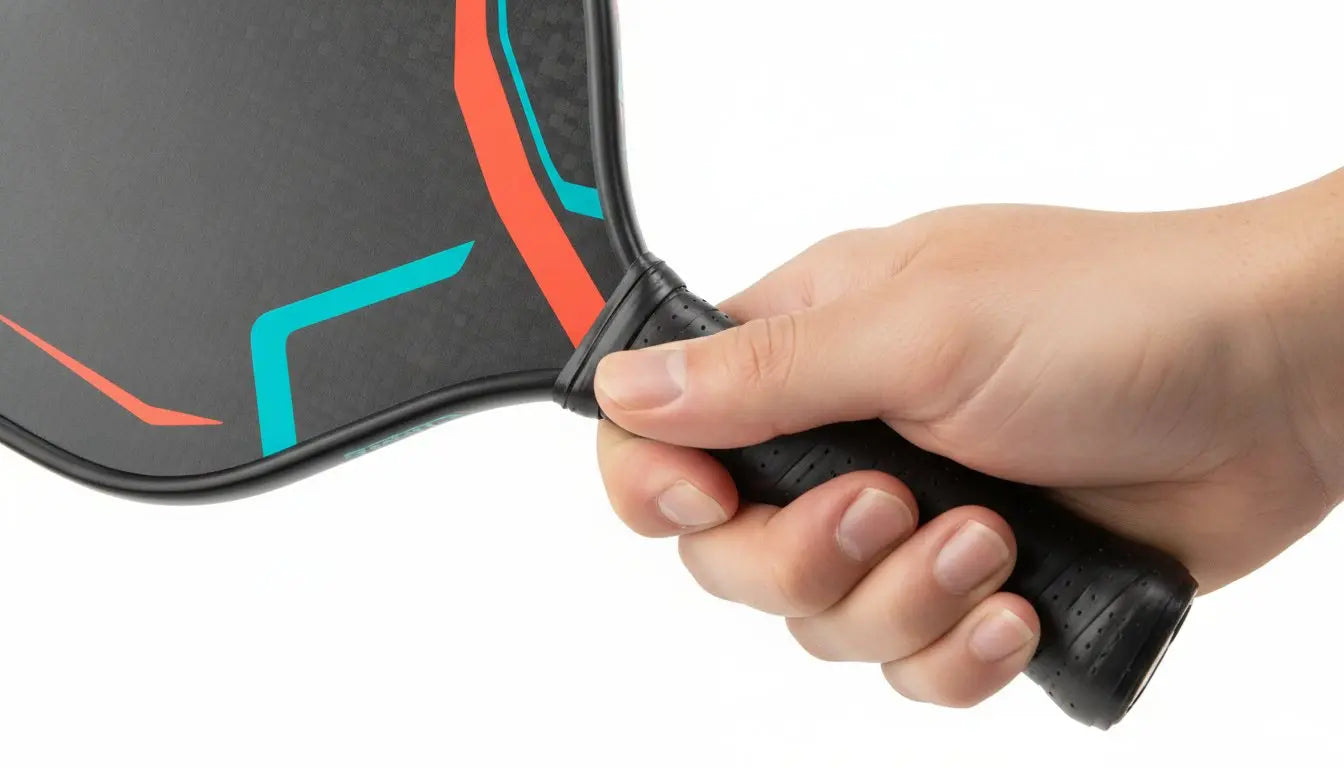
It's crucial to distinguish between grip size (circumference) and handle length. Grip size is all about how thick the handle feels in your hand. This dimension directly influences your grip pressure, wrist mobility, and overall stability. A handle that’s too thick or too thin will fundamentally change how you hold the paddle and engage the muscles in your forearm.
Handle length, on the other hand, is the measurement from the butt cap to where the handle meets the paddle face. A longer handle is primarily beneficial for players who use a two-handed backhand, providing the necessary space for both hands. While handle length is a key consideration for playing style, it’s the circumference that dictates the ergonomics and mechanics of your grip for every single shot. Understanding this difference is the first step toward optimising your equipment for your unique body mechanics.
The Consequences of an Ill-Fitting Grip
Using the wrong grip size can have immediate and noticeable consequences. If a handle is too small, your fingers will overlap your palm too much, forcing you to squeeze tightly to prevent the paddle from twisting. This creates the dreaded "death grip" syndrome, a state of constant muscle tension in your hand and forearm. Not only does this lead to rapid fatigue, but it also inhibits the fine motor control needed for delicate shots like dinks and drops.
Conversely, if a handle is too large for your palm, you'll struggle to wrap your fingers securely around it. This makes it difficult to control the paddle head, especially on off-centre hits. You’ll feel a loss of connection and "feel," as the paddle shifts and moves in your hand. An oversized grip also restricts wrist movement, robbing you of the snap needed for generating topspin and power. Both scenarios set the stage for inconsistent performance and, more alarmingly, an increased risk of strain and injury.
Performance Impact: How Grip Size Dictates Control and Power
The right grip size isn't just a matter of avoiding discomfort; it's a critical performance lever that directly influences your ability to generate power, execute shots with precision, and maintain control during intense rallies. The relationship between your hand and the handle governs the physics of every swing, from a powerful serve to a soft dink at the kitchen line.
At its core, the trade-off is between stability and manoeuvrability. A larger grip generally offers more stability, as it fills the hand more completely and provides a wider surface area to resist twisting. This is explained by the physics of torque—a larger diameter makes it harder for the paddle to rotate in your hand on impact. However, what you gain in stability, you may lose in wrist action. A smaller grip allows for greater wrist mobility, enabling the quick "snap" required for generating spin on aggressive rolls and serves. Finding your perfect size is about striking the right balance for your personal playing style.
The Science of Touch at the Kitchen Line
The "soft hands" required for a winning dinking game are born from a relaxed, confident grip. The nerve endings in your palm and fingers are constantly sending feedback to your brain, allowing you to feel the ball on the paddle face and make micro-adjustments. An ill-fitting grip disrupts this communication.
If your grip is too large, it acts as a dampener, dulling the subtle vibrations that signal a clean hit. This reduces your "feel" for the ball, making it difficult to execute delicate drop shots with consistency. Conversely, a grip that's too small forces you to tense your muscles, which overrides the sensory feedback needed for touch. A correctly sized grip allows you to hold the paddle with minimal pressure, keeping your muscles relaxed and your senses sharp. When exploring intermediate pickleball paddles, look for models with adaptable handle cores that can be easily customised to achieve this perfect connection.
Generating Power and Spin Through Wrist Lag
While power in pickleball comes from the entire body, the final burst of speed is often generated by the wrist. A smaller grip size provides a distinct mechanical advantage for creating topspin. It allows your wrist to move more freely and quickly, creating the "lag and snap" motion that whips the paddle head through the contact zone. This increased range of motion is what lets advanced players dip the ball aggressively at their opponents' feet.
However, pure power players often gravitate towards a slightly larger grip. The added stability helps them control the paddle face during powerful drives and overhead smashes, preventing the paddle from twisting on impact and ensuring energy is transferred efficiently to the ball. The fundamental relationship is this: a smaller grip diameter can increase potential paddle head speed through wrist action, while a larger diameter enhances stability for a more solid feel on powerful shots.
Ergonomics and Injury Prevention: Avoiding "Pickleball Elbow"
Perhaps the most critical reason to focus on pickleball paddle grip size is injury prevention. The repetitive motions of the sport can put significant stress on the tendons and joints of the arm, leading to common ailments like "pickleball elbow," known medically as Lateral Epicondylitis. While many factors can contribute to this condition, an incorrectly sized grip is a primary and often overlooked culprit.
The biomechanics are straightforward. A grip that is too small forces the small muscles in your forearm to work overtime. To keep the paddle from twisting in your hand, you instinctively clench your fingers, creating constant tension in the flexor and extensor tendons that run from your wrist to your elbow. Over time, this chronic overexertion can lead to inflammation and pain. A grip that is too large presents a different problem: it restricts your natural range of motion and forces your wrist into awkward angles to execute shots, leading to strain. Modern paddle designs increasingly focus on vibration dampening, but even the most advanced technology can't compensate for the poor ergonomics of a mismatched grip.
Over-Gripping and Muscle Fatigue
When you hold a paddle with a handle that feels too thin or "slippery," your physiological response is to squeeze harder. This is the root cause of over-gripping. This constant state of muscle contraction doesn't just make you tired; it has a cumulative damaging effect. The muscles in your forearm remain under load even between shots, preventing them from relaxing and recovering. This chronic tension restricts blood flow and can lead to micro-tears in the tendons where they attach to the bone at the elbow. What starts as a minor ache can quickly escalate into a persistent injury that keeps you off the court. Ensuring you have the right setup from the start is key, and it begins with a properly fitted paddle.
Impact Shock and Joint Protection
Every time you strike the ball, a shockwave of force travels from the paddle face, down the handle, and into your arm. A correctly sized grip is your first line of defence against this impact shock. It allows you to distribute the force of the impact evenly across your entire hand and palm, rather than concentrating it in your fingers and wrist. When the grip fits perfectly, you can maintain a relaxed hold—experts recommend a grip pressure of about 3 out of 10—which allows your arm muscles to act as natural shock absorbers.
High-quality grip materials also play a role in reducing the vibrations transmitted to your elbow and shoulder. However, the material can only do its job effectively if the size is right. A properly sized grip ensures maximum contact between your hand and the paddle, allowing the grip's dampening properties to work as intended and protecting your joints from the cumulative stress of thousands of impacts.
How to Measure Your Perfect Grip Size: Two Proven Methods
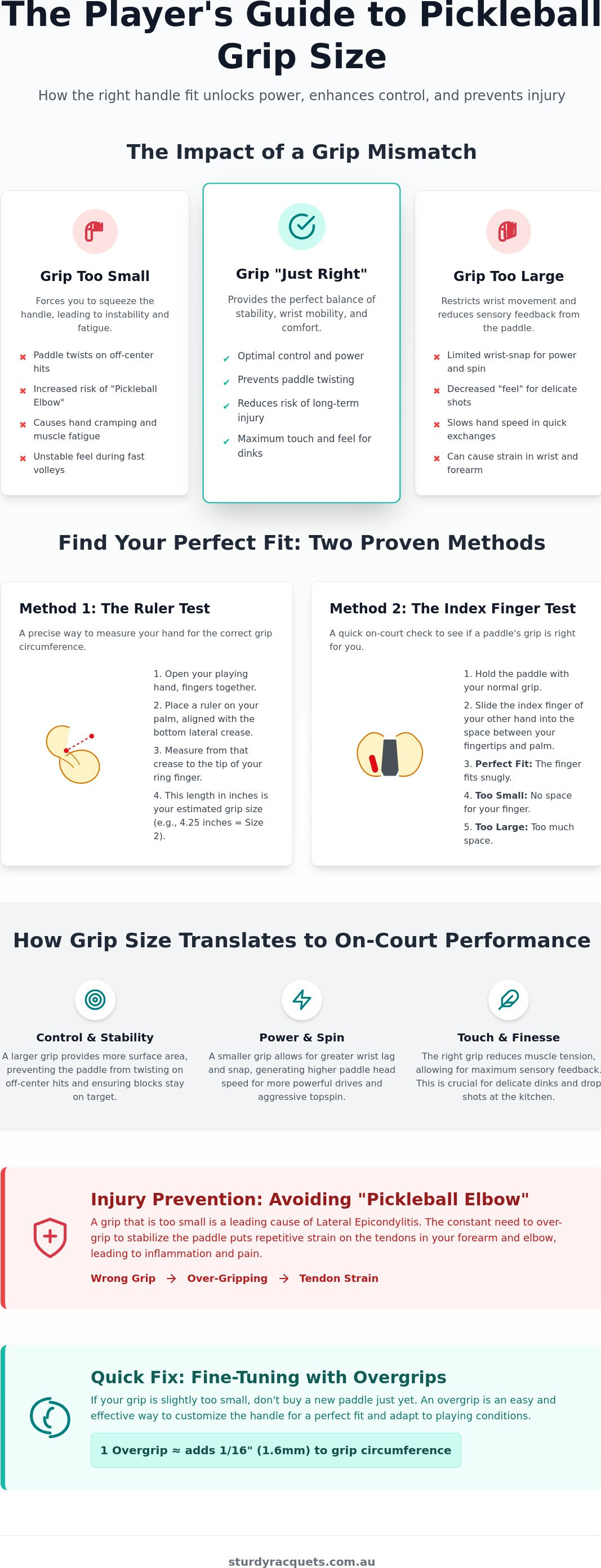
Now that you understand why grip size is so important, it's time to find your perfect fit. Determining your ideal handle circumference at home is simple and can be done in minutes. Performing this measurement before you start shopping for pickleball paddles for beginners can save you time, money, and a lot of potential frustration down the road. Below are the two most reliable methods to measure your grip size.
Pickleball paddle grips are typically measured in inches, with common adult sizes including 4", 4 1/8", 4 1/4", 4 3/8", and 4 1/2". If your measurement falls between two sizes, it is almost always better to choose the smaller one. A grip that is slightly too small can be easily and inexpensively built up with an overgrip, whereas a grip that is too large cannot be made smaller.
Method 1: The Index Finger Test
This is the quickest and most common method for checking the fit of a paddle you can hold in person. It provides an excellent general assessment of whether a grip is in the right ballpark for your hand size.
-
Step 1: Hold the pickleball paddle in your dominant hand using a standard "Eastern" grip (imagine you are shaking hands with the handle).
-
Step 2: With your fingers wrapped comfortably around the handle, take the index finger of your non-hitting hand and slide it into the gap between your fingertips and the heel of your palm.
-
Step 3: Evaluate the fit. The ideal grip size will leave just enough room for your index finger to fit snugly in this gap. If there is a large space, the grip is too big. If your finger doesn't fit at all and your fingertips are digging into your palm, the grip is too small.
Method 2: The Ruler (Precision) Method
For those shopping online or who want a more objective measurement, the ruler method is the gold standard. It provides a precise measurement you can use to compare against the specifications of any paddle.
-
Step 1: Open your dominant hitting hand with your fingers fully extended but held close together.
-
Step 2: Take a standard ruler and align the "0" mark with the bottom horizontal crease in your palm.
-
Step 3: Measure from that bottom crease to the tip of your ring finger. This measurement in inches directly corresponds to your ideal grip circumference.
-
Step 4: Match this measurement to the specifications listed for any professional pickleball gear to ensure you're selecting a paddle built for your hand. For example, a measurement of 4.25 inches means your ideal grip size is 4 1/4".
Adjusting Your Grip: Customisation for the Australian Climate
Even after you've chosen a paddle with the correct base grip size, your job isn't done. The handle's feel can be fine-tuned to perfection, and it needs to be adapted to the conditions you play in—a crucial consideration for players across Australia. High heat and humidity can dramatically affect grip security, making customisation with overgrips an essential part of your equipment management.
An overgrip is a thin, cushioned wrap applied over the top of your paddle's existing base grip. It's the primary tool for customisation. A single overgrip typically increases the handle's circumference by about 1/16 of an inch (or half a grip size). This makes it the perfect solution for a handle that feels just slightly too small. For more significant adjustments, options like heat shrink sleeves can be used to build up the core handle size before an overgrip is applied, though using more than two overgrips is generally not recommended as it can dull the feel of the paddle.
Tackiness vs. Absorption: The Humidity Factor
Grips generally fall into two categories: tacky or absorbent. A "tacky" grip has a sticky, rubbery feel that provides excellent traction in dry conditions. However, in high humidity, that same tackiness can mix with sweat and become incredibly slippery.
For players in tropical or coastal regions of Australia, an absorbent "dry" grip is often the superior choice. These grips have a softer, more cloth-like texture designed to soak up moisture and maintain a secure feel even when your hands are sweating heavily. Experimenting with different types of replacement grips and overgrips will help you find the perfect match for your body chemistry and local climate, ensuring your paddle never slips during a critical point.
Pro-Tips for Applying Overgrips
How you apply an overgrip can also change its final feel and thickness. The amount of overlap between each wrap is key. A wider overlap will result in a thicker, more cushioned feel, slightly increasing the final circumference. A narrower overlap will keep the grip thinner and preserve more of the handle's natural bevels, which many players prefer for better feel and control.
It's also important to know when to replace your base grip versus simply adding a new overgrip. Overgrips are designed to be replaced frequently—as soon as they lose their texture or absorption. The base grip, however, should only be replaced when it becomes compressed, worn down, or damaged. Regularly checking the condition of your grip is a simple but vital maintenance step to ensure consistent performance and safety on the court.
Frequently Asked Questions (FAQs)
What is the most common pickleball paddle grip size for adults?
The most common grip sizes for adults typically fall between 4 1/8 inches and 4 3/8 inches. Many paddles are sold with a "standard" 4 1/4-inch grip, which serves as a good middle ground. However, relying on the most common size is not recommended; always measure your hand for the best fit.
Can I make a pickleball paddle grip smaller if I bought the wrong size?
Unfortunately, making a grip smaller is very difficult and often impossible. The base grip is applied directly to the paddle's core handle (the pallet). While a professional racquet technician might be able to shave down the pallet, it's a complex and risky process. This is why it's always recommended to err on the side of a grip that is too small, as it can easily be built up with an overgrip.
How often should I replace the overgrip on my pickleball paddle?
A good rule of thumb is to replace your overgrip as many times per month as you play per week. For example, if you play three times a week, you should aim to replace your overgrip about three times a month. You should replace it immediately if it becomes slick, torn, or loses its cushioning.
Is there a difference between tennis grips and pickleball grips?
While the materials are often very similar, the main difference can be the shape and length. Pickleball handles are typically shorter and more octagonal than the oval-shaped handles of many tennis racquets. However, many players successfully use tennis overgrips on their pickleball paddles, as they offer a wide variety of textures and thicknesses.
How does a larger grip size help with "tennis elbow" symptoms?
For players suffering from tennis or pickleball elbow, a slightly larger grip can sometimes provide relief. A larger circumference allows you to hold the paddle with less finger pressure, reducing muscle tension in the forearm. It also provides more surface area to absorb and distribute impact shock, lessening the force transmitted to your elbow. However, this is only effective up to a point—a grip that is too large will cause other issues.
What happens if my pickleball grip is too small?
A grip that is too small forces you to squeeze the handle tightly to maintain control, leading to a "death grip." This causes rapid muscle fatigue, hand cramping, and increases the risk of developing pickleball elbow. It also restricts the fine motor control needed for touch shots like dinks and drops.
Should I use a different grip size for singles vs. doubles play?
No, your ideal grip size is based on your hand anatomy, not the game format. You should use the same correctly measured grip size for both singles and doubles to ensure consistent technique and prevent injury, regardless of how you are playing.
Does the type of grip material affect the actual circumference?
Yes, it can. A thick, cushioned replacement grip will create a larger final circumference than a thin, performance-oriented grip. Similarly, a thick, cushioned overgrip will add more size than an ultra-thin one. When customising your handle, always consider the thickness of the materials you are applying.
Share:
How Long Do Tennis Shoes Last on Hard Courts? The 2026 Durability Guide
Elongated vs Standard Pickleball Paddle: The Ultimate 2026 Comparison Guide