



That powerful-feeling paddle you love might be the very reason your dinks are popping up and your hands feel a step behind at the kitchen line. We get it. It’s completely normal to feel lost when you're staring at a wall of fantastic paddles, all promising a 'perfect blend' of power and control. You've probably felt that frustrating lack of 'pop' on a drive, or even that nagging twinge in your elbow after a long day of play, and wondered if your gear is to blame.
Well, wonder no more. This isn't just another list of popular equipment; this is your definitive pickleball paddle weight guide for 2026, designed to make you a smarter, more confident player. We promise to demystify the technical science so you can finally find a paddle that feels like a natural extension of your arm. Get ready to learn how a few grams can completely transform your game, giving you more ball speed without sacrificing control and protecting your joints for years to come.
Key Takeaways
- Learn the crucial difference between a paddle's static weight and its swing weight to understand how it will truly feel and perform during play.
- Identify whether a lightweight, midweight, or heavyweight paddle is the perfect match for your skill level, from beginners to seasoned pros.
- Discover the surprising link between paddle weight and pickleball elbow, and why a heavier paddle might actually be the safer choice for your arm.
- Use this pickleball paddle weight guide to master the key specifications that directly impact your power, control, and overall confidence on the court.
The Science of Pickleball Paddle Weight: Why Every Gram Matters
Of all the technical specifications you'll see on a pickleball paddle-from core thickness to grip length-one stands above the rest in its impact on your game: weight. It's the single most critical factor that shapes how a paddle feels and performs. Getting this right is the foundation of any good pickleball paddle weight guide. While the sport has a fascinating history, which you can read in this comprehensive overview of pickleball, understanding paddle science is your first step to playing better.
You'll often see weights listed in ounces (oz), with the typical range for paddles in Australia falling between 7.0oz (about 198 grams) and 8.5oz (about 241 grams), though some power-focused models can go even heavier. Don't underestimate these small numbers. A difference of just 15 grams can completely change your timing, power, and endurance on the court.
To see just how much of a difference a few grams can make, check out this fantastic video from Kevin Dong Pickleball.
The Power vs. Control Trade-off
The core conflict in paddle weight comes down to a classic physics principle: Force equals mass times acceleration (F=ma). A heavier paddle (more mass) generates more force on the ball with the same swing speed, resulting in more powerful drives and serves. A paddle's weight distribution also determines its Moment of Inertia, which dictates how stable the paddle feels through your swing and on impact. In contrast, a lighter paddle allows for faster acceleration, giving you lightning-quick hands for dink battles and rapid volleys at the kitchen line. Finding your 'sweet spot' is about balancing the stability and power of a heavier paddle with the speed and manoeuvrability of a lighter one.
Pickleball Paddle Materials and Their Weight Impact
A paddle's final weight isn't just a number; it's the result of its construction. The materials used for the core and face play a massive role in its overall feel and balance. Knowing what's inside helps you make a smarter choice.
- Core Materials: Most modern paddles use a polypropylene honeycomb core, which is fantastic for its durability and feel. Denser polymer cores are heavier and offer more power. Older or more specialised paddles might use a Nomex core, which is generally lighter but feels harder and louder on impact.
- Face Materials: The paddle's hitting surface adds its own weight profile. Carbon fibre and graphite faces are premium, lightweight, and stiff, offering exceptional control. Fibreglass (or composite) faces are slightly heavier but provide more pop, giving your shots an extra boost of power.
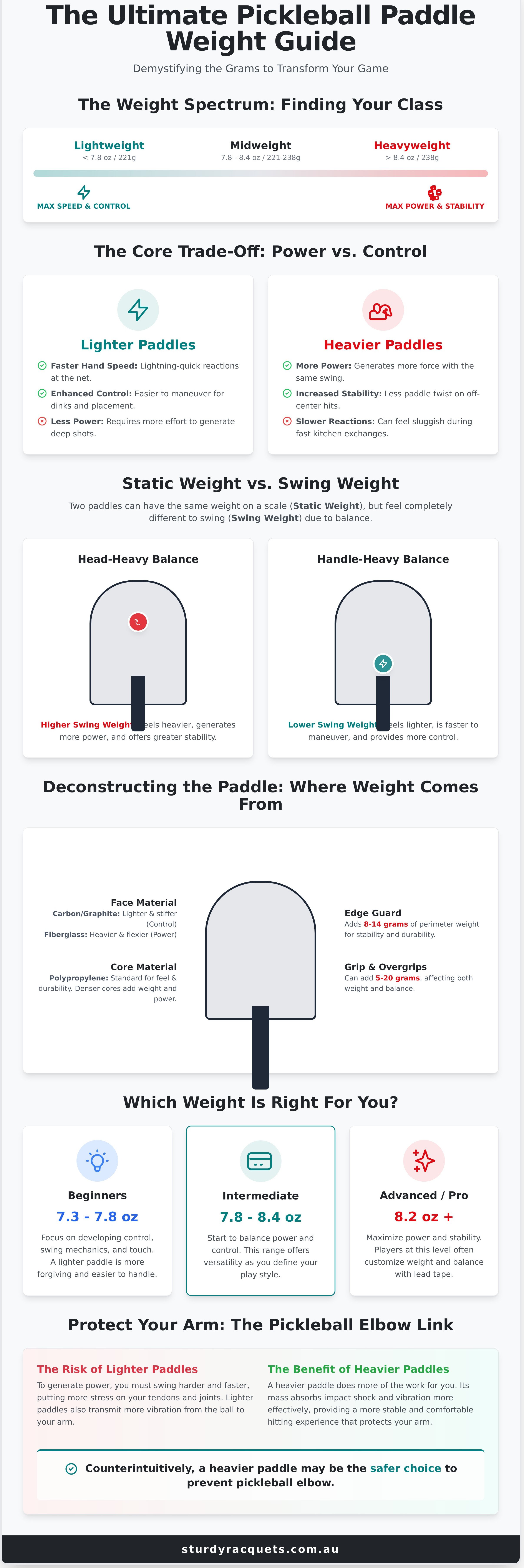
- 'Hidden' Weight: Don't forget the extras! A standard edge guard adds between 8 and 14 grams of perimeter weighting, which increases stability. Your grip setup, including overgrips, can add another 5 to 20 grams. These small additions are crucial for customising a paddle to perfection.
Static Weight vs. Swing Weight: The Secret to How a Paddle Really Feels
Ever picked up two paddles listed at 8.0 ounces, only to find one feels like a feather and the other like a brick? You're not imagining things. The number on the spec sheet, known as static weight, tells only half the story. The real magic lies in where that weight is placed, which determines its swing weight and, ultimately, how the paddle performs on the court. Understanding this difference is a crucial step in any good pickleball paddle weight guide.
Understanding Static Weight (The Total Mass)
Static weight is simple: it’s what a paddle weighs on a scale. When a manufacturer lists a paddle at 7.8oz, that's its total mass. Keep in mind that due to tiny variations in materials and construction, two identical models can differ by up to 0.2oz. While that sounds small, its impact grows over time. A heavier static weight provides more mass to absorb impact and generate power, but it can also lead to fatigue. Swinging a heavier object for two hours puts more strain on your arm, which is why experts often explore the link between paddle weight and pickleball elbow to help players stay healthy.
The Magic of Swing Weight (The Dynamic Feel)
Swing weight is all about how heavy a paddle feels when you swing it. This is dictated by the paddle's 'Balance Point'. Think of it like a seesaw. A paddle can be:
- Head-Heavy: More weight is distributed towards the top of the paddle face. This creates a higher swing weight, making it feel heavier in motion. Power players love this design because it puts more momentum behind the ball for blistering drives from the baseline.
- Handle-Heavy (or Head-Light): More weight is concentrated near the handle. This results in a lower swing weight, making the paddle feel quicker and more manoeuvrable for fast kitchen exchanges and rapid-fire volleys.
This is why an 8.2oz handle-heavy paddle can feel significantly faster than a 7.9oz head-heavy one. The weight distribution completely changes the effort needed to accelerate the paddle. You can get a rough feel for swing weight in-store by holding the paddle at the grip and gently flicking your wrist; a head-heavy paddle will offer more resistance.
Finally, there's a third, related concept: 'Twist Weight'. This measures a paddle's stability against twisting on off-centre hits. A paddle with a high twist weight feels more solid and forgiving, even when you don't strike the ball perfectly in the sweet spot. It provides that stable, confidence-inspiring feel every player craves. The best way to understand these dynamics is to get a few options in your hands, and you can explore a fantastic range of paddles with different balance points to find your perfect match.
Choosing Your Weight Class: Lightweight, Midweight, or Heavyweight?
Once you've got a budget in mind, the next big question is weight. It’s the single most important factor that shapes how a paddle feels, performs, and ultimately complements your game. Picking the right weight isn't just about hitting harder; it's about control, endurance, and protecting your body. This section of our pickleball paddle weight guide breaks down the three main categories you'll find across Australia's courts. For over 90% of players, especially those just starting, a midweight paddle is the perfect, no-fuss starting point.
Lightweight Paddles (Under 7.3oz): The Kitchen Specialists
These paddles are built for speed. If your game is all about lightning-fast reactions at the kitchen line and winning long dink rallies, a lightweight paddle is your best friend. They allow for incredible maneuverability and help reduce arm fatigue over long matches, making them a fantastic choice for seniors or players with pre-existing arm conditions.
- Pros: Incredible hand speed for quick volleys, faster resets at the net, and significantly less player fatigue.
- Cons: Sacrifices 'plow-through' power on drives and serves, and the lighter frame can transmit more vibration to your arm on off-centre hits.
- Best For: Players who prioritise a control and dink game, those with fast swing speeds, or anyone concerned about tennis elbow.
Midweight Paddles (7.3oz - 8.3oz): The Versatile All-Rounders
Welcome to the sweet spot. Midweight paddles are the undisputed champions of versatility and the go-to choice for the vast majority of players, from weekend warriors to seasoned pros. They offer a fantastic, reliable balance of power for your serves and drives, plus enough touch and control for precise dinks and drops. This perfect blend is why they dominate the growing Australian pickleball scene, adapting beautifully to any play style. While they don't max out any single attribute, their consistency is their greatest strength. If you're just getting started, we can't recommend this category enough. For a deeper dive, check out our complete guide on How to Choose the Best Pickleball Paddle for Beginners.
- Pros: The ideal blend of power and control, stable on impact, and suitable for almost every skill level.
- Cons: Doesn't truly specialise in one area; a classic 'jack of all trades'.
- Why it's the Gold Standard: This is the safest and most effective starting point for nearly every player.
Heavyweight Paddles (8.3oz+): The Baseline Power Hitters
If you're stepping onto the pickleball court from a tennis or squash background, a heavyweight paddle will feel right at home. These paddles are designed for one thing: power. The extra mass does the work for you, generating deep, powerful shots from the baseline with minimal effort. They are also incredibly stable, absorbing the pace of hard-hit shots and offering a huge, forgiving sweet spot. The trade-off is reaction time. While there are incredible health benefits of pickleball, using a paddle that's too heavy for your conditioning can lead to arm strain. Be honest about your physical strength before choosing a heavyweight option.
- Pros: Effortless power from the baseline, maximum stability against hard hitters, and very forgiving on mishits.
- Cons: Slower hand speed at the net, can cause arm and shoulder fatigue, and is generally less maneuverable.
- Best For: Physically strong players, former tennis players with well-conditioned arms, and aggressive baseline hitters.
Protecting Your Body: The Link Between Paddle Weight and Pickleball Elbow
Let's clear up the biggest myth about pickleball elbow right now: a lighter paddle is not always safer for your arm. In fact, for many players, switching to an ultra-light paddle is the very thing that causes nagging tendonitis and pain. It sounds counterintuitive, but the solution to arm pain often involves adding weight, not taking it away.
Think of your paddle as a shock absorber. A heavier object has more mass, and that mass is brilliant at absorbing and dispersing energy. When the ball hits your paddle, a heavier paddle soaks up a huge percentage of that impact vibration before it can travel up the handle and into the delicate tendons of your forearm. A lighter paddle does the opposite. It has less mass to absorb the shock, so the vibration shoots straight into your arm. It's the difference between driving a 4WD over a speed bump versus a go-kart; one feels smooth, the other rattles your bones.
A paddle that is too light forces your arm and grip muscles to absorb the ball's impact, leading directly to fatigue, tendon strain, and injury.
Vibration Dampening and Mass
The physics are simple. A heavier paddle is more stable at impact. It resists twisting in your hand on off-centre hits, a major source of jarring vibration. With a lightweight paddle, you instinctively squeeze the handle tighter-the classic "death grip"-to keep it stable. This constant muscle tension is a direct cause of lateral epicondylitis, or tennis elbow. The goal is to find your 'Goldilocks' weight: heavy enough to absorb shock, but light enough to swing comfortably for a full match.
Signs Your Paddle is the Wrong Weight
Your body often sends clear signals that your equipment isn't right. This part of our pickleball paddle weight guide is designed to help you listen to those cues. Watch for these common signs:
- Tingling or a sharp pain on your outer elbow: This is the classic symptom of excessive vibration, strongly suggesting your paddle is too light and isn't absorbing impact effectively.
- You're consistently late on fast kitchen volleys: If your reaction time feels slow and the paddle feels sluggish, it's likely too heavy for you to manoeuvre quickly.
- Your serves and deep shots lack power: Are you taking a full, proper swing but the ball seems to die? A paddle that's too light lacks the mass needed to drive the ball with depth and pace.
If you're experiencing pain or any of these symptoms, run through this quick diagnostic checklist before your next game.
Player Pain Checklist
- Check Your Weight: Is your paddle under 7.6 ounces (215 grams)? For many adults, this weight class can transmit too much vibration. Consider demoing a paddle in the 7.8 to 8.4 ounce range.
- Check Your Grip Size: Is your grip too small? A small grip forces you to clench your hand muscles constantly. When holding your paddle, you should be able to fit the index finger of your non-hitting hand snugly in the space between your fingertips and your palm.
- Check Your Technique: Are you "arming" the ball instead of using your core and shoulders? Poor mechanics put immense strain on your elbow, no matter the paddle weight.
Battling elbow pain can be frustrating, but the right equipment makes a world of difference. Don't guess and hope for the best. Chat with one of our paddle specialists to find a weight and grip combination that works for your body, not against it.
Finding Your Perfect Match at Sturdy Racquets
Reading about paddle weights is one thing; feeling the difference in your hand is another. This practical pickleball paddle weight guide wouldn't be complete without showing you how to apply this knowledge. At Sturdy Racquets, we're more than just a shop; we're a hub for players who are passionate about their game. We believe the right gear can transform your experience on the court.
There is simply no substitute for a 'feel test'. We invite you to visit our Brooklyn, Victoria store to get your hands on our extensive range. Holding a paddle, feeling its balance, and taking a few practice swings can tell you more than a dozen online reviews. Our team brings over 15 years of professional stringing and racquet customization expertise from the tennis world directly to pickleball. We understand the physics of swing weight, balance points, and stability on a level that helps you find a paddle that feels like a true extension of your arm.
We proudly stock the latest 2026 paddle innovations from leading manufacturers, offering a diverse range to suit every player's needs, including:
- Selkirk: A leader in power and performance technology.
- A wide selection of other top-tier paddles, designed for exceptional control, power, and feel.
For those in the local area, we highly encourage you to connect with the vibrant Melbourne pickleball community. Groups often host demo days at local courts, which are a fantastic opportunity to test different paddles in a real game environment before you commit.
Customizing Your Weight with Lead Tape
Found a paddle you love but wish it had a little more punch or stability? That’s where customization comes in. Our experts recommend starting with a lighter paddle and adding weight incrementally with lead tape. It’s a pro-level secret that's easy to master. Add 3-gram strips to the head (at 10 and 2 o'clock) for more power, or place them on the throat (at 3 and 9 o'clock) to expand the sweet spot and boost stability on off-centre hits.
The Sturdy Racquets Fitting Experience
Our friendly expert approach is designed to help you avoid unforced errors in your gear selection. We listen to your goals, understand your play style, and provide honest advice to match you with the perfect equipment. Can't make it to Brooklyn? Don't worry. Our online store offers fast shipping across Australia, with most orders reaching Sydney, Brisbane, and Adelaide within 2-4 business days. Let our passion and expertise serve your game.
Ready to feel the difference? Shop our 2026 Pickleball Paddle Range Now and find the perfect partner for your next game.
Step Onto the Court with Confidence in 2026
Choosing the right paddle weight is the secret to unlocking your best game and protecting your arm. It's the difference between raw power and pinpoint control, between quick volleys at the net and stable, confident drives from the baseline. Following this pickleball paddle weight guide is your first step toward playing smarter, not harder, and leaving pickleball elbow on the sidelines for good.
You don't have to make this critical decision alone. Our expert specialists in Brooklyn are ready to provide top-notch advice on the best 2026 paddles from leading brands like Selkirk, JOOLA, and Wilson. With fast, Australia-wide shipping, your perfect match is just a click away.
Avoid Unforced Mistakes - Shop the Best 2026 Pickleball Paddles at Sturdy Racquets
Your winning paddle is waiting. Let's find it together and make 2026 your best year on the court yet!
Frequently Asked Questions
What is the best pickleball paddle weight for a beginner?
The best pickleball paddle weight for a beginner is a mid-weight paddle, typically between 7.3 and 8.4 ounces. This range offers a fantastic balance of power and control, which is perfect while you're still developing your strokes and learning the game. It provides enough mass to help you generate power without being so heavy that it causes fatigue or affects your swing speed. A mid-weight paddle is a reliable starting point for almost every new player.
Does a heavier pickleball paddle cause elbow pain?
A heavier paddle can contribute to elbow pain if it’s too heavy for your strength or if you have poor swing mechanics. While a heavier paddle absorbs more shock, which can protect the arm, swinging it requires more muscle. If your muscles aren't conditioned, this can lead to strain. The key is finding a weight that you can comfortably manage for an entire match. Proper form and warming up are your best defence against pickleball elbow.
How do I know if my pickleball paddle is too light?
You'll know your paddle is too light if you feel a lack of power and stability. Common signs include the paddle twisting in your hand on off-centre hits, needing to swing much harder to get the ball over the net, or struggling with control during fast volleys at the kitchen line. A paddle that's too light can feel "flimsy" against powerful shots and may lead to over-swinging, which can throw off your timing and accuracy.
Is 8 oz considered a heavy pickleball paddle?
No, an 8 oz paddle is considered the heart of the mid-weight category. In most pickleball paddle weight guides, paddles are generally classified into three groups: lightweight (under 7.5 oz), mid-weight (7.5 to 8.4 oz), and heavyweight (over 8.5 oz). An 8 oz paddle is incredibly popular because it provides a versatile blend of power, control, and manoeuvrability, making it a top choice for a huge range of intermediate players.
Can I add weight to my pickleball paddle later?
Yes, you can absolutely add weight to your paddle. This is a common practice among players who want to customise their gear. You can use specialised lead or tungsten tape to add weight to specific parts of the paddle. Adding tape to the edges can increase the sweet spot and boost power, while adding it near the handle can make the paddle feel more balanced. It's a great, low-cost way to fine-tune your paddle's performance as your game evolves.
What is swing weight vs static weight in pickleball?
Static weight is simply how much the paddle weighs on a scale, for example, 8.0 ounces. Swing weight, however, is how heavy the paddle feels when you actually swing it. This is affected by the paddle's balance. A paddle with more mass towards the head (a head-heavy balance) will have a higher swing weight than a head-light paddle of the exact same static weight. Swing weight gives you a better idea of the paddle's power potential and manoeuvrability.
Do pro pickleball players use heavy or light paddles?
The vast majority of professional players use heavy paddles, often weighing between 8.5 and 9.5 ounces after customisation. They typically start with a stock mid-weight or heavyweight paddle and add lead tape to increase stability and power. This extra mass allows them to hit harder shots and better handle the pace of high-level play. They have the strength and technique to wield these heavier paddles effectively without sacrificing hand speed at the net.
What weight paddle should a former tennis player use?
A former tennis player should start with a mid-weight to heavyweight paddle, generally in the 8.2 to 9.0 ounce range. Tennis racquets are significantly heavier than pickleball paddles, so a heavier paddle will feel more familiar and stable in their hands. This weight class allows them to leverage their existing swing mechanics for powerful drives and serves. Starting too light can feel unstable and lead to a frustrating lack of "plow-through" on their shots.
Share:
Best Pickleball Paddles for Beginners in Australia: 2026 Buyer's Guide
Indoor vs Outdoor Pickleball Balls: The Ultimate 2026 Comparison Guide