


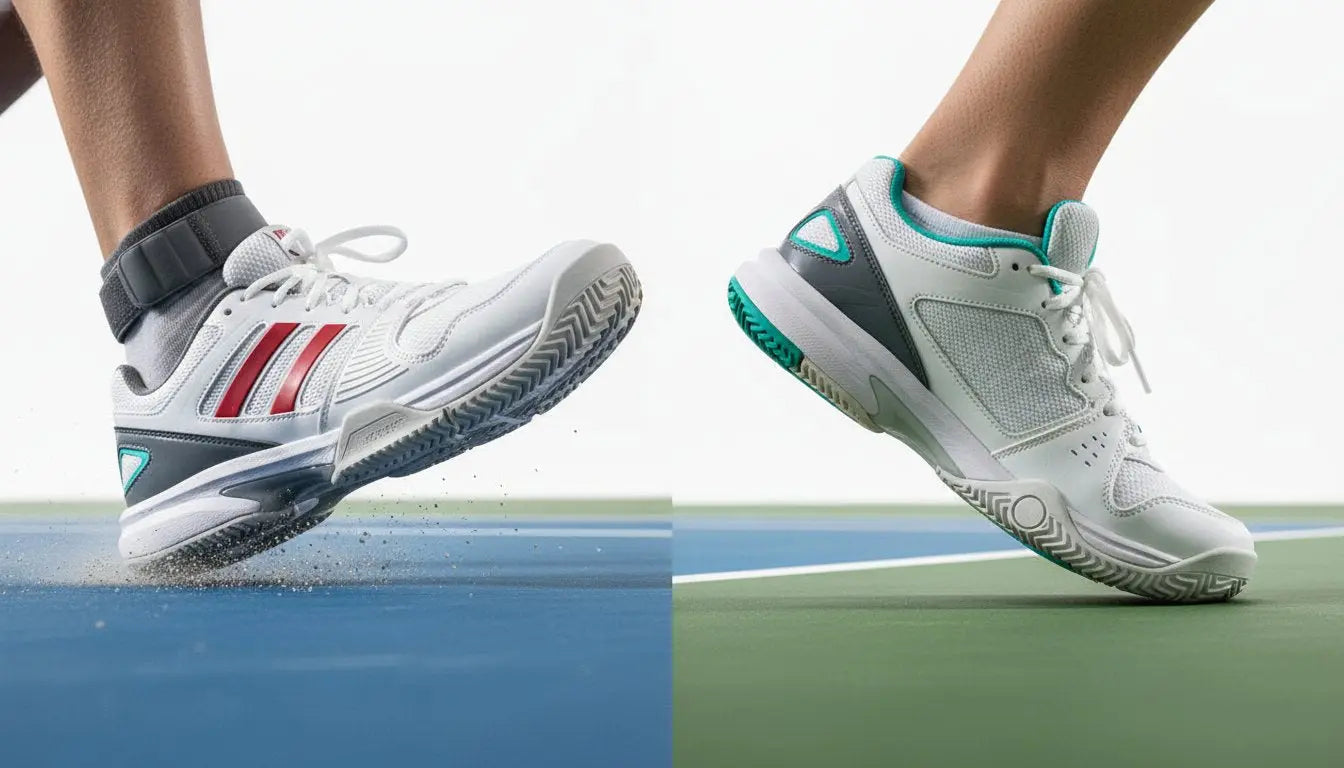
With Pickleball Australia reporting a 50% membership surge to over 24,000 members in early 2026, thousands of players are facing a high-stakes decision every time they lace up. You might assume any standard "court shoe" provides enough support, especially since 67% of pickleball players also spend time on the tennis court. However, overlooking the pickleball shoes vs tennis shoes difference can lead to unnecessary foot fatigue or even a painful ankle roll during a quick lateral pivot.
It's common to feel overwhelmed by technical jargon, but your footwear must match the unique movement patterns of your sport to keep you performing at your peak. We promise to help you identify the critical structural variations that will boost your agility and prevent common court injuries. We'll explore whether you truly need a dedicated second pair of shoes and how to extend the life of your equipment on Australian hard courts. From [stable tennis shoes for hard courts] to [flexible footwear for pickleball], you're about to discover exactly what your feet need to stay in the game.
Key Takeaways
- Understand why standard running shoes lack the lateral support needed for court sports and how proper footwear prevents common ankle rolls.
- Identify the core pickleball shoes vs tennis shoes difference, specifically how weight and midsole flexibility impact your agility at the kitchen.
- Learn how to choose the right outsole pattern to handle the abrasive nature of Australian acrylic hard courts and high-temperature play.
- Discover how sport-specific cushioning reduces "shearing" forces on your knee joints and helps manage conditions like plantar fasciitis.
- Find out how to select [specialised pickleball gear](https://www.sturdyracquets.com.au/collections/pickleball-gear-all) that balances durability with the quick-burst movement required for modern play.
Are Pickleball Shoes and Tennis Shoes the Same?
As the popularity of racquet sports continues to skyrocket, many players find themselves standing in front of a wall of footwear wondering if there's a real pickleball shoes vs tennis shoes difference. With Pickleball Australia reporting over 24,000 registered members as of January 2026, a 50% increase from the previous year, the demand for clear answers is higher than ever. At first glance, both types of footwear fall under the broad "court shoe" category. They share a common goal: providing lateral stability and featuring non-marking outsoles that won't scuff up expensive court surfaces. However, labeling a shoe as "all-court" can be misleading. While you can technically wear tennis shoes on a pickleball court, the specific demands of each sport mean that a one-size-fits-all approach often leads to compromised performance.
Understanding the nuances of Pickleball equipment is essential for anyone transitioning from the baseline to the kitchen. While both sports require side-to-side movement, the intensity and frequency of those movements vary. Tennis often involves long, linear sprints and sliding, whereas pickleball is defined by rapid-fire volleys and constant, short-burst pivots. This shift in movement is why specialized footwear has become a staple for serious players across Australia.
To better understand this concept, watch this helpful video:
The Anatomy of a Court Shoe
A true court shoe is built differently than your standard gym trainer. It features a low-to-the-ground profile, which lowers your center of gravity and improves your balance during sharp turns. You'll also notice reinforced toe caps. These are vital for players who drag their back foot during serves or lunges at the net. Inside the sole, rigid midfoot shanks provide a backbone for the shoe. This prevents the arch from twisting painfully when you're forced to change direction in a split second. Whether you are browsing [tennis shoes](https://www.sturdyracquets.com.au/collections/tennis-shoes) or [pickleball gear](https://www.sturdyracquets.com.au/collections/pickleball-gear-all), these features are non-negotiable for safety.
Why Running Shoes are Dangerous on Court
It's tempting to grab your favorite pair of runners for a quick match, but this is a recipe for injury. Running shoes are designed for forward motion. They have high stack heights and soft, squishy foam that creates a "wobble" effect during lateral lunges. This instability is a leading cause of ankle rolls on the court. Additionally, the soft rubber compounds used in running outsoles are no match for abrasive Australian hard courts. They'll wear down in weeks, losing the traction you need to stay upright. Proper court footwear uses denser, more durable rubber designed to withstand the heat and friction of a high-intensity match.
Key Structural Differences: Weight, Flexibility, and Traction
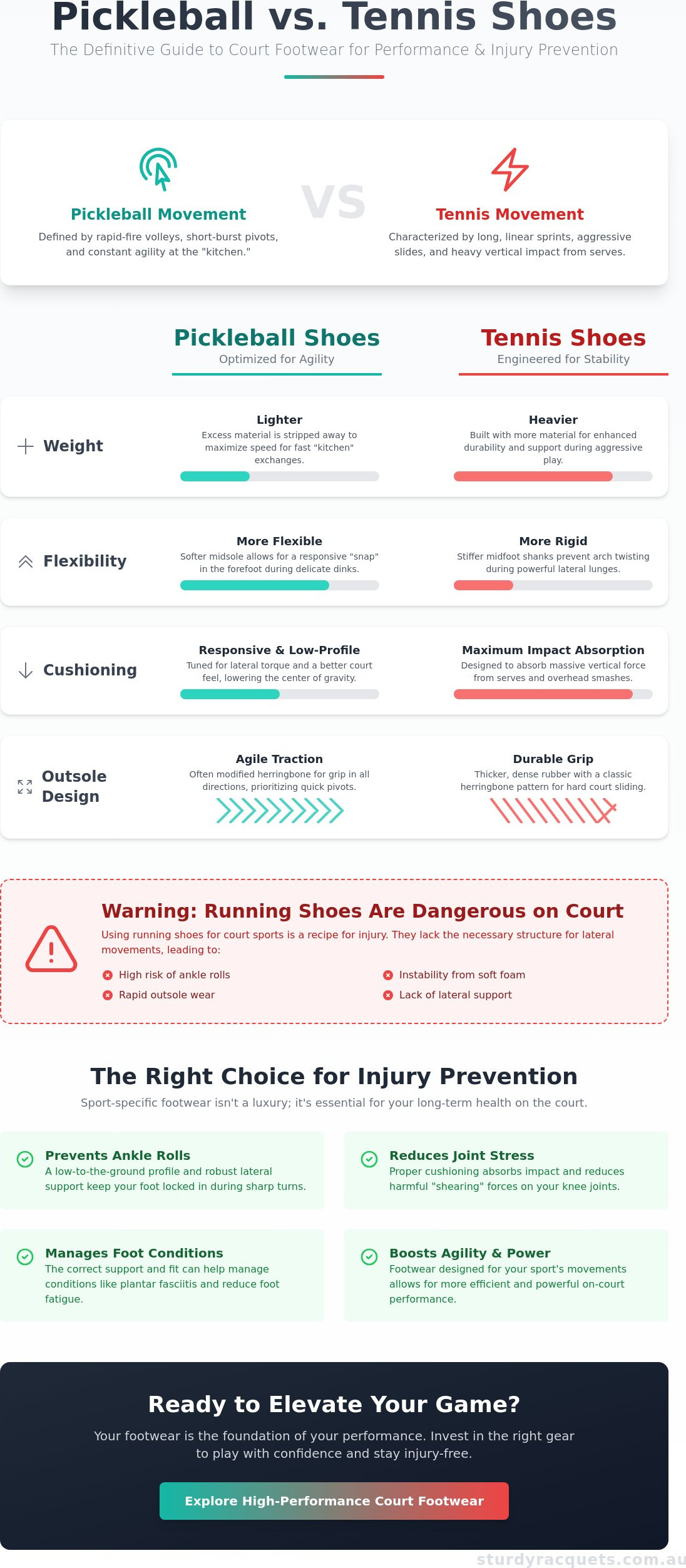
While the previous section established that court shoes are a category of their own, the specific pickleball shoes vs tennis shoes difference becomes obvious when you look at the technical hardware. Tennis is a game of high-speed, linear sprints and heavy vertical impact during serves. Pickleball, by contrast, is a game of inches played on a much smaller court (6.1m x 13.4m). This compact space requires a shoe that prioritizes lightness and rapid-fire agility over the heavy-duty armor needed for a five-set baseline grind.
Weight is the most immediate factor you'll notice. Manufacturers often strip away excess material in pickleball models to ensure you can move your feet fast enough for "kitchen" exchanges. If your shoes are too heavy, you'll feel like you're stuck in mud during a fast-paced volley. Midsole cushioning also differs; tennis shoes are built to absorb the massive vertical force of a serve or overhead smash. Pickleball midsoles are tuned to handle constant lateral torque, providing a more responsive feel that allows for a "snap" in the forefoot during delicate dinks.
- Tennis Shoes: Heavier build, maximum vertical shock absorption, rigid lateral "cages."
- Pickleball Shoes: Lightweight construction, high forefoot flexibility, optimized for rapid pivots.
- Tennis Outsoles: Tight herringbone patterns designed for controlled sliding on hard courts.
- Pickleball Outsoles: Modified pivot points and wider tread to grip the surface during short-burst turns.
Traction Patterns and Grip
The way a shoe grips the ground changes based on the sport's movement patterns. Tennis outsoles frequently use a herringbone pattern, which is the gold standard for sliding into a shot on a hard court without catching an edge. Pickleball outsoles are often more aggressive. They feature circular pivot points under the ball of the foot to facilitate the 180-degree turns common in doubles play. Because Australian court temperatures can soar, the rubber density in [durable tennis shoes](https://www.sturdyracquets.com.au/collections/tennis-shoes) is usually higher to prevent the sole from becoming "gummy" and losing its predictable slide.
Lateral Support and Bracing
Stability is vital, but the method of delivery varies. Tennis shoes often feature heavy-duty TPU "cages" or stability wings that wrap around the midfoot. These are designed to keep your foot on the footbed during a high-speed sprint to the sideline. Pickleball shoes use lighter overlays to maintain agility without adding unnecessary bulk. You'll also find that ankle collars in [specialised pickleball gear](https://www.sturdyracquets.com.au/collections/pickleball-gear-all) are sometimes slightly lower to allow for a greater range of motion during quick, low-profile lunges. If you're unsure which support level matches your playing style, you can always ask our expert team for a personalised footwear recommendation.
Durability and Surface: How Australian Courts Impact Your Gear
The Australian sun doesn't just challenge your fitness; it eats through your outsoles. Most outdoor courts in Australia are acrylic hard courts, similar to the high-performance surfaces seen during the record-breaking 2026 Australian Open. These surfaces are designed for consistent ball bounce but act like high-grit sandpaper on footwear. Understanding the pickleball shoes vs tennis shoes difference in relation to these surfaces is vital for your wallet and your safety. While a tennis shoe is built to survive hours of sliding on this "sandpaper," a shoe designed specifically for indoor pickleball will disintegrate rapidly if taken outside.
Heat is the silent enemy of court footwear. On a 35-degree day in Melbourne or Perth, court surface temperatures can soar much higher, softening the rubber on your soles. This leads to "chunking," where small pieces of the tread break off during sharp pivots. To maximize the lifespan of your durable court shoes, always store them in a cool, dry place. Avoid leaving them in a hot car between matches, as this can degrade the specialized glues holding the midsole together.
Hard Court vs. Composite Surfaces
Tennis shoes remain the gold standard for durability on rough outdoor courts. They feature dense rubber compounds and thick outsoles that can handle the friction of a long match. Many pickleball courts in Australia are now being built with modular tiles or synthetic grass, which offer more cushioning but require different traction. If you're playing on these softer composite surfaces, you can get away with a lighter pickleball shoe. However, using an indoor-specific shoe on an outdoor hard court is dangerous. The soft gum rubber will provide too much "bite," which can lead to a stuck foot and a nasty ankle injury. Keeping your gear clean with the right tennis court accessories, such as court brushes or shoe cleaners, ensures that grit doesn't settle into the tread and accelerate wear.
Toe Drag and Outsole Longevity
Where your shoes wear out tells a story about your playing style. Tennis players often show heavy wear on the medial (inner) side of the shoe due to sliding into shots or dragging the back foot during a serve. Consequently, tennis footwear often includes a thick "drag guard" in this area. Pickleball wear patterns are usually concentrated on the ball of the foot and the inner toe, reflecting the high-frequency pivots required at the kitchen line. You should replace your shoes the moment you see "smooth spots" where the tread pattern has disappeared. Once the tread is gone, you've lost the ability to stop safely, significantly increasing your risk of a slip.
Injury Prevention and Performance: Making the Right Choice
Choosing the right footwear isn't just about shaving seconds off your sprint; it's about staying on the court for years to come. Many players ignore the pickleball shoes vs tennis shoes difference until they wake up with a burning sensation in their heel or a throbbing Achilles tendon. Common injuries like plantar fasciitis and Achilles tendonitis often stem from footwear that lacks the specific support required for your chosen sport. While tennis requires heavy-duty bracing for baseline slides, pickleball demands a shoe that can handle constant, small-scale pivots without placing excessive "shearing" force on the knee joint. If your shoe has too much grip on an outdoor court, your foot stays planted while your knee continues to turn, leading to potential ligament strain.
Using performance tennis shoes can help maintain proper court posture during high-intensity matches. A common myth among club players is that you need to "break in" new court shoes over several weeks. In reality, modern synthetic materials are designed to be ready for play immediately. If a shoe feels tight or rubs your heel in the shop, it'll likely continue to do so on the court. Modern designs prioritize out-of-the-box comfort to ensure you don't lose playing time to blisters.
Foot Biometrics and Arch Support
Your foot type dictates which shoe will serve you best. Players with flat feet often need shoes with more rigid midfoot support to prevent overpronation. High-arched players require extra cushioning to absorb impact. Interestingly, your choice of equipment beyond shoes matters too. Using quality tennis strings can reduce the overall vibration traveling through your body, which complements your footwear in preventing joint fatigue. If you use custom orthotics, ensure they fit properly in both types of shoes. Pickleball models sometimes have shallower heel cups, which might cause your foot to slip if the orthotic is too thick.
The Movement Pattern Test
The easiest way to decide if you need a dedicated pair of shoes is to analyze how you move. Tennis is a game of explosive vertical leaps and long lateral sprints. You need a shoe that acts like a stabilizer. Pickleball is characterized by short, choppy steps and constant weight shifting at the net. This is why the best pickleball gear for beginners should always include a shoe that prioritizes forefoot flexibility. If you find yourself playing both sports three times a week, a single "hybrid" pair will likely wear out too fast and fail to protect you in either discipline.
If you're struggling with foot pain or aren't sure which support level you need, contact our expert team for a professional footwear assessment.
Finding the Perfect Fit at Sturdy Racquets
Our team in Brooklyn, Victoria, lives and breathes court sports. We understand that the pickleball shoes vs tennis shoes difference isn't just a marketing gimmick; it's a fundamental shift in how your body interacts with the ground. Whether you're a local dropping into our store or a player browsing from Melbourne, Sydney, or Brisbane, we've curated a range of specialised pickleball gear and high-performance tennis footwear to keep you moving safely. We're committed to being more than just a retailer. We're a community hub where passion for the game meets professional expertise.
In-Store Fitting vs. Online Selection
Getting the right fit is about more than just your standard shoe size. For court sports, you need a "performance fit" that allows for a thumb's width of space at the toe while locking your heel firmly in place. When you visit us, we always recommend testing shoes with the exact socks you play in. Thick, cushioned athletic socks can change your size by half a grade. If you're shopping online, use our digital tools to compare widths and arch support levels. Many players find that as they transition to intermediate tennis racquets and faster play, their footwear needs to become more supportive to match their increased swing speed and court coverage.
Why Shop with Local Specialists?
Choosing a local specialist means you're getting advice from people who actually play on Australian hard courts. We understand the grit, the heat, and the specific wear patterns discussed earlier in this guide. Our knowledge goes beyond the shelf. We can provide insights into restringing tennis racquets to match your new footwear's vibration dampening or explain the nuances of what is pickleball for those just starting their journey. Supporting a community-focused Australian business ensures you get gear that is fit for our unique climate and playing conditions. We ship across the country, ensuring every player has access to the best tools for their game, regardless of their postcode. Don't settle for "close enough" when it comes to your health and performance. Let us help you find the perfect pair to take your game to the next level.
Step Onto the Court with Confidence
Understanding the pickleball shoes vs tennis shoes difference is the first step toward a safer and more agile game. You now know that while tennis footwear provides the heavy-duty bracing needed for long baseline sprints, pickleball models prioritize the lightweight flexibility required for fast exchanges at the net. Matching your shoes to the abrasive Australian hard courts won't just extend the life of your gear; it'll also protect your knees and ankles from unnecessary stress. It's about more than just comfort. It's about giving your body the specific support it needs to stay in the match longer.
Our team in Brooklyn, Victoria, is ready to help you find that perfect fit with expert advice tailored to your unique playing style. We offer specialist knowledge across tennis, pickleball, and badminton to ensure you're always equipped for success. Whether you're local or shopping from across the country, we provide reliable Australia-wide shipping on all our professional gear. Don't let improper footwear hold you back from your best performance.
Contact our team for expert fitting advice on professional court shoes and get ready to dominate your next match. We're here to support your journey and help you play with total confidence.
Frequently Asked Questions
Can I wear tennis shoes for pickleball?
Yes, you can certainly wear tennis shoes for pickleball, as they provide the lateral stability needed for court sports. Many players find that the heavy-duty support of a tennis shoe is helpful for preventing ankle rolls. However, you might notice they feel a bit heavy during the rapid-fire exchanges at the kitchen line where a lighter shoe would offer more agility.
Are pickleball shoes more expensive than tennis shoes?
Pickleball and tennis shoes generally sit in the same price category as they use similar high-performance materials. While some top-tier tennis models designed for professional tournament play might have a higher price point due to advanced durability features, most club-level shoes for both sports are comparable. The best value comes from choosing a shoe that matches your specific frequency of play.
What is the main difference between a court shoe and a running shoe?
Lateral support is the defining factor that separates court shoes from running trainers. Running shoes are built for forward motion and have thick, squishy midsoles that can be unstable during side-to-side lunges. Court shoes have a lower profile and reinforced sidewalls to keep your foot secure during sharp turns. This design is essential for preventing common court injuries like sprained ankles.
Do I need different shoes for indoor and outdoor pickleball?
You should ideally use different shoes if you switch between gym floors and outdoor courts regularly. Indoor shoes often feature soft gum rubber outsoles for maximum grip on polished timber or composite surfaces. Outdoor shoes require a much denser rubber compound to withstand the abrasive nature of Australian acrylic hard courts. Using indoor shoes outside will cause the tread to wear out in just a few sessions.
How long should a pair of court shoes last for a regular player?
A standard pair of court shoes usually lasts between four to six months for someone playing two or three times a week. You'll know it's time for a replacement when the tread pattern goes smooth or you feel less "spring" in the cushioning. Playing in worn-out shoes significantly increases your risk of slipping or developing foot pain like plantar fasciitis.
Can I use basketball shoes for pickleball or tennis?
Basketball shoes are a viable alternative because they are designed for lateral movement and jumping. They offer excellent ankle support and non-marking soles that work well on most courts. The downside is that they are often much heavier and bulkier than racquet-specific footwear. This extra weight can lead to faster leg fatigue during a long morning of matches.
Why do my feet hurt after playing pickleball in tennis shoes?
Foot pain often occurs because tennis shoes are typically stiffer and heavier than specialized pickleball models. This pickleball shoes vs tennis shoes difference matters because pickleball requires constant, choppy footwork rather than long baseline sprints. If your shoes are too rigid, your feet have to work harder to flex during those quick pivots at the net, leading to arch strain or general fatigue.
What should I look for in a pickleball shoe if I have wide feet?
Look for models that feature a wide toe box and flexible mesh uppers that can expand slightly during play. Many specialist brands now offer 2E or 4E width options specifically for court sports. A proper fit ensures your toes aren't pinched during sudden stops, which prevents painful "tennis toe" or bruising under the nails. Always test your shoes with the thick athletic socks you intend to wear on court.
Share:
Is My Racquet Causing My Shoulder Pain? A 2026 Guide to Shoulder-Safe Tennis
Best Tennis Strings for Durability in Australia: 2026 Player Guide