




What if the secret to winning more matches isn't more power, but actually having less of it? Many competitive players across Australia find that modern, thick-beam racquets offer plenty of zip but zero predictability. It's frustrating when a slight mis-hit sails long because your frame is too stiff. This is precisely why advanced players love the Wilson Blade Series. You likely already know that a "connected" feel is the holy grail for baseline grinders. If you've struggled with arm fatigue or felt disconnected from your shots, you're not alone.
This guide will show you how the latest 2026 technology maintains its status as the most popular racquet on the pro tour. You'll learn how to choose between the spin-friendly 16x19 and the laser-accurate 18x20 string patterns so you can swing with total confidence. We'll also help you find a local Melbourne expert for high performance racquet customization to ensure your gear matches your game perfectly. Get ready to stop guessing and start hitting your targets with precision.
Key Takeaways
- Explore how the 2026 evolution of carbon-mapped technology provides the elite ball feedback and precision required for high-level competitive play.
- Understand the technical innovations driving the 8. Wilson Blade Series: Why Advanced Players Love It, specifically how FortyFive technology aids stability during modern vertical swings.
- Compare the most popular models in the range, from the spin-friendly 16x19 string pattern to the pinpoint directional control of the 18x20 spec.
- Learn why trading a massive sweet spot for enhanced feel is the secret to reducing unforced errors and dominating the court from the baseline.
- Discover how [professional racquet customisation and stringing](https://www.sturdyracquets.com.au) at our Melbourne specialist store can help you fine-tune your frame for peak performance.
What defines the Wilson Blade series in 2026?
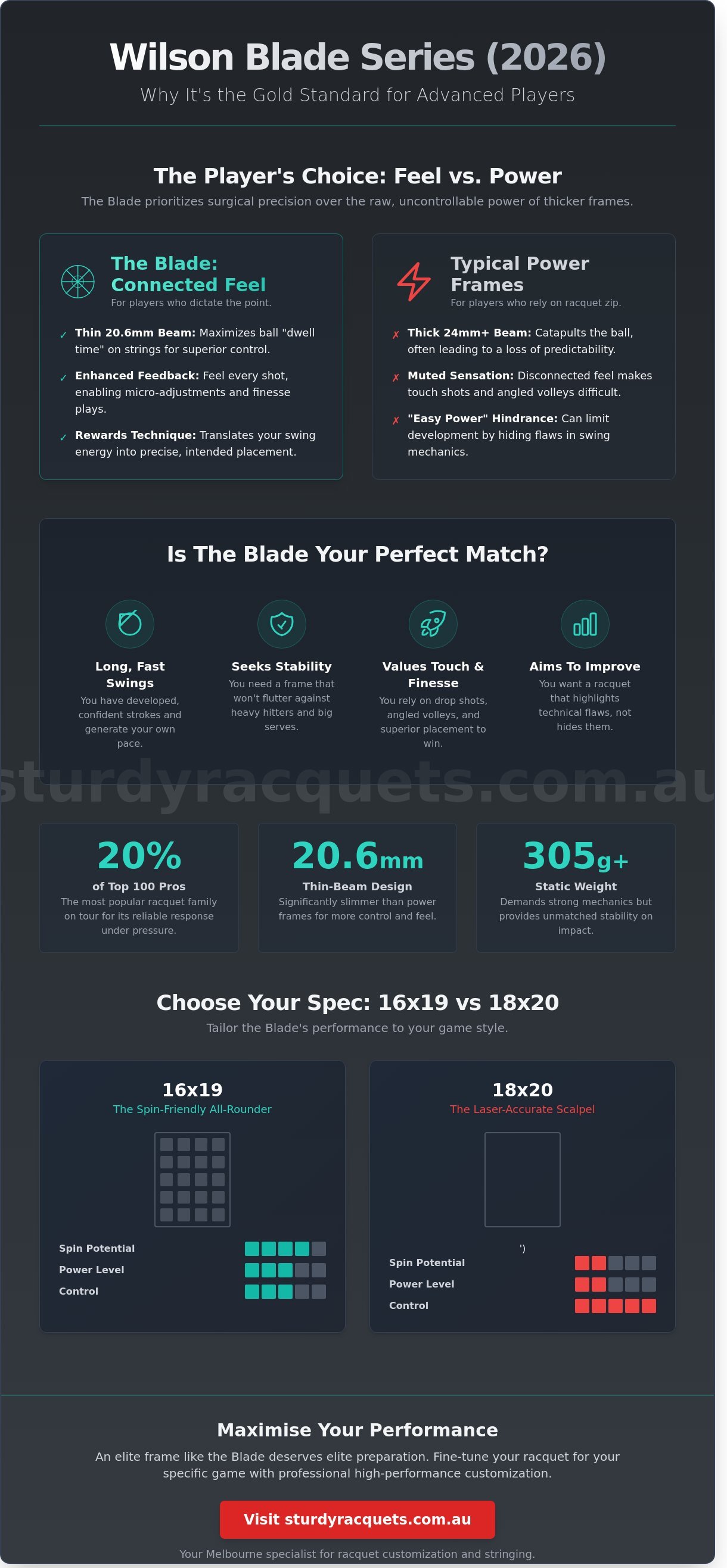
The Wilson Blade has firmly established itself as the gold standard for what experts call a "player?s frame." In 2026, this series continues to prioritise surgical precision and intimate ball feedback over the raw, often uncontrollable power found in beginner racquets. While other frames rely on thick beams to catapult the ball, the Blade uses a thinner, more flexible geometry. This design ensures that the energy you put into your swing is translated accurately onto the court. It is a racquet built for those who want to dictate play rather than just react to it.
The journey of the Blade is a fascinating look at engineering evolution. It has moved from the stiff, traditional feel of the classic K-Factor models to the sophisticated carbon-mapping technologies seen in recent versions. Modern iterations use proprietary layup techniques to allow the frame to bend in ways that complement the modern, vertical swing path. Understanding the Wilson Sporting Goods history helps players appreciate how this specific line became a staple. Today, it stands as the most used racquet family on professional tours globally, with roughly 20% of top 100 players choosing it for its reliable response under pressure.
To better understand this concept, watch this helpful video:
The 8. Wilson Blade Series: Why Advanced Players Love It comes down to the core philosophy of a "connected feel." This isn't just marketing jargon; it's a physical sensation where the vibrations from the string bed travel clearly to the hand. This feedback loop allows competitive players to make micro-adjustments during a match. When you hit a drop shot or a sharp-angled volley, the Blade tells you exactly how much of the ball you caught. This level of communication between equipment and athlete is why it remains a top-tier choice at clubs across Australia.
The "Connected Feel" philosophy
The "Connected Feel" is achieved through a distinct thin-beam construction, usually measuring around 20.6mm. This is significantly slimmer than power-oriented frames which often exceed 24mm. A thinner beam provides more dwell time, meaning the ball stays on the strings for a fraction of a second longer. For players who already generate massive head speed, this extra millisecond is vital for control. The 8. Wilson Blade Series: Why Advanced Players Love It because it bridges the gap between the wooden racquets of the past and the explosive graphite technology of the present. It offers the soul of a traditional frame with the stability required for the modern game.
Targeting the competitive player profile
As players move past the beginner stage, they often find that "easy power" racquets actually hinder their progress. This is when many transition to high-performance tennis racquets for advanced players to gain better placement. However, the Blade is physically demanding. It typically features a static weight of 305g or more, requiring a strong arm and clean technique to maneuver effectively. You should consider the Blade if:
- You have a long, fast, and loopy swing style.
- You prefer to generate your own pace rather than relying on the racquet's trampoline effect.
- You value "feel" and "touch" at the net and on finesse shots.
- You are looking for a stable platform that won't flutter when facing heavy serves.
Identifying if your swing style matches a precision-first racquet is the first step toward improving your UTR or tournament ranking. The Blade doesn't offer shortcuts; it rewards sound mechanics with unparalleled accuracy.
The technical innovations driving the latest generation
The release of the v9 generation in early 2024 marked a significant shift in how these frames handle high-intensity rallies. It's easy to see why the 8. Wilson Blade Series: Why Advanced Players Love It remains a staple at Australian tennis clubs and tournament circuits. This latest iteration isn't just a cosmetic update; it's a structural overhaul designed to meet the demands of the 2026 competitive cycle. Players who swing fast and heavy need a racquet that doesn't "flutter" when the ball impact isn't perfectly centred. By focusing on how the frame twists and bends during the millisecond of contact, the latest design provides a level of predictability that helps reduce unforced errors during pressure points.
FortyFive technology explained
The standout feature of the modern Blade is the patent-protected FortyFive layup technology. This innovation addresses the reality of the modern game where players use a vertical swing path to generate heavy topspin. While older racquet designs were built for flat, horizontal strokes, FortyFive allows the frame to flex more naturally with an upward motion. This flexibility doesn't come at the cost of power; instead, it increases the "dwell time," giving you the sensation that the ball is staying on the strings for a fraction longer. This extra millisecond is vital for directing the ball into tight corners.
The balance between comfort and stability is achieved through a relatively low stiffness rating. Most models in this range sit at an RA rating of 61, which is significantly softer than the 70+ RA found in many power-oriented frames. For the dedicated club player who hits the court four or five times a week, this lower stiffness is a massive benefit. It significantly reduces the shock and vibration sent to the arm, which helps mitigate the risk of tennis elbow. You get a plush, classic feel without sacrificing the "pop" needed to finish points at the net.
Stability without the bulk
One of the biggest complaints with flexible racquets is that they can feel "noodle-like" or unstable when facing big hitters. To solve this, the latest generation uses DirectConnect technology. This involves extending the carbon fiber handle all the way to the butt cap and fusing them together. In previous versions, the butt cap was a separate plastic piece that could lead to a disconnected feel. This change has resulted in a 16% increase in torsional stability, meaning the racquet resists twisting much better on off-centre hits. Even with a smaller 98-square-inch sweet spot, the frame feels incredibly solid.
The precision of these racquets is further enhanced by specific internal engineering. Carbon mapping is a method of placing graphite at specific angles to control frame torsion. This allows engineers to make the hoop stiffer in certain areas for power while keeping the throat flexible for feel. When you combine this with the choice of string beds, the customisation options are fantastic. Understanding how string patterns influence control is a key part of the process for any advanced player looking to fine-tune their setup for the Australian summer season. Whether you choose the 16x19 for more spin or the 18x20 for ultimate placement, the underlying carbon mapping ensures the frame performs consistently.
If you're looking to upgrade your current setup, you can browse our range of high performance tennis gear to find the perfect match for your swing style. The 2024 and 2025 models have proven that you don't need a heavy, stiff frame to dominate from the baseline. You just need the right technical innovations working in your favour.
Why advanced players choose control over power
Advanced players often hear the same objection when considering this frame: "Isn't that racquet too hard to use?" It is a valid question. If you aren't hitting the center of the strings consistently, a control-oriented frame can feel demanding. However, for those with developed technique, this trade-off is the secret to high-level performance. When the ball is coming at you at 120 km/h, accuracy beats raw power every single time.
The 8. Wilson Blade Series: Why Advanced Players Love It is built on the philosophy that the player provides the power while the racquet provides the guidance. A smaller sweet spot, typically found on a 98-square-inch head, means there is less "trampoline effect" compared to oversized frames. When you swing with full intensity, you know exactly where the ball will land. This gives you the psychological freedom to aim for the lines rather than just playing it safe in the middle of the court.
Hitting a winner from the baseline requires more than just speed; it requires "plow-through." This refers to the racquet's ability to resist twisting and maintain its path through the contact zone. In high-level Australian club matches, you'll face heavy hitters who test your stability. A frame that lacks mass will flutter, but a precision-weighted racquet drives through the ball. This allows for aggressive, full-swing confidence even when you're pulled out wide on the defensive.
Precision in a high-velocity game
Advanced players need to feel the ball. They need to know exactly where it sits on the string bed for that split second of contact. Unlike many intermediate tennis racquets that feature thick beams and lightweight builds, these frames often sit around 305g to 320g unstrung. This extra mass is essential for redirecting pace.
The latest technical innovations in the V9 generation have improved torsional stability by 15% compared to previous iterations. This ensures the ball doesn't "hot launch" or fly long unexpectedly. You get a predictable launch angle every time you swing. This reliability is why the 8. Wilson Blade Series: Why Advanced Players Love It remains a staple on the professional tour and in competitive local tournaments.
The arm-friendly nature of thin beams
Competitive longevity is a major concern for serious players. Playing three sets on a hard court under the Australian sun takes a toll on the body. Many power-focused racquets have a stiffness rating (RA) above 70, which sends harsh vibrations directly into the elbow and wrist. This series typically maintains a lower RA rating, often measured between 60 and 64, which is significantly more forgiving on the joints.
A 21mm beam provides a flexible feel that dampens shock without losing the necessary feedback. You don't want a racquet that feels "mushy"; you want to feel the ball so you can execute delicate drop shots or sharp angles. When you're investing between A$380 and A$420 in a performance frame, you're investing in your ability to play pain-free for years. This series manages vibration through advanced carbon mapping, ensuring that players with joint sensitivity can still compete at their highest level without sacrificing the crisp feel required for elite play.
- Predictable Response: No sudden power surges during full swings.
- Enhanced Stability: The racquet stays firm against heavy serves.
- Joint Protection: Lower stiffness ratings reduce the risk of tennis elbow.
- Feedback: Clear communication from the strings to your hand.
Choosing your spec: 16x19 vs. 18x20 vs. 100
Selecting the right frame configuration is the most critical decision you'll make when upgrading to the latest 2026 models. The Blade isn't a one-size-fits-all racquet. It's a precision tool designed to be fine-tuned to your specific swing path and contact point. This versatility is a core reason for the 8. Wilson Blade Series: Why Advanced Players Love It, as it allows for a professional level of customisation straight off the shelf. Whether you're grinding out points from the baseline at your local Australian club or attacking the net, your choice of string pattern and head size will dictate your success on court.
The 16x19 version remains the most sought-after spec for the modern game. It provides a higher launch angle and easier access to depth, which is vital when you're pushed back deep behind the baseline. If you rely on heavy topspin to keep your opponents moving, this open pattern allows the strings to bite into the ball more effectively. In contrast, the 18x20 variant is the traditionalist's dream. It offers a denser, more consistent response across the entire hitting zone. This is the ultimate "flat" hitter?s tool for maximum directional control; it's designed for players who provide their own power and simply need the racquet to put the ball exactly where they aim.
For those who find the 98 square inch head size too demanding, the 100 square inch variant offers a 15% larger sweet spot. It's a more forgiving entry point for rising juniors or competitive club players who want the Blade feel without the high "shanking" penalty of a smaller head. It maintains the same 300g to 305g weight range but provides that extra bit of stability on off-centre hits during fast-paced rallies.
String pattern showdown
The 16x19 pattern increases the "snap-back" effect, where the main strings slide and spring back to generate massive topspin. This extra movement does mean you'll go through sets faster. Conversely, the 18x20 pattern offers superior string bed durability because the strings move less, reducing the friction that causes premature breakage. To get the most out of either setup, you must select the right high-quality strings for tennis players to complement the pattern. A thinner gauge poly works wonders in the 18x20, while a thicker, textured string suits the 16x19 perfectly.
Weight and balance considerations
Most advanced players gravitate toward the standard 305g unstrung weight, but the 2026 series also offers lighter 285g variants for easy customisation with lead tape. The 1-2 points head-light balance is a standout feature; it aids in net-play and quick volleys by making the frame feel "whippy" in the hand. You won't feel bogged down during long three-set matches in the Australian heat. We've seen that a swingweight hovering around 325 kg�cm� provides the best balance of stability and speed. This specific weight distribution reduces the impact of swingweight on late-match fatigue, ensuring your technique doesn't crumble when the score reaches 5-5 in the final set.
The 8. Wilson Blade Series: Why Advanced Players Love It comes down to this ability to match a frame to a player's physical needs and tactical style. When you find that perfect marriage of weight and string density, your confidence at the baseline will skyrocket.
Ready to upgrade your game with the latest 2026 technology? Shop the best performance tennis racquets in Australia and find your perfect spec today.
Maximising your performance with Sturdy Racquets
Buying a high-end frame is only half the battle. To see the real benefits of the 8. Wilson Blade Series: Why Advanced Players Love It, you need a setup that matches your specific swing mechanics. Stock racquets are excellent out of the box, but professional customisation is what separates a club player from a tournament competitor. Our Brooklyn store in Victoria acts as a central hub for Melbourne tennis enthusiasts who want more than just a racquet off the shelf. We provide the technical expertise needed to fine-tune every specification, from balance points to swing weights. It's about making the equipment an extension of your arm.
Expert stringing in Melbourne
The 98 square inch head size common in this series demands absolute precision. Even a slight 2 pound deviation in tension can drastically alter the control you feel on full-blooded groundstrokes. We typically suggest tensions between 48 and 54 pounds for these frames. Victorian weather adds another layer of complexity that many players overlook. Melbourne's 15 degree temperature swings during a single match can cause polyester strings to lose up to 12% of their tension in just 60 minutes of play. We help you select strings that maintain tension stability despite these harsh local fluctuations. Our in-store services include:
- Digital swing weight measurements to ensure your pair of racquets feel identical within 1 gram.
- Internal handle weighting to shift the balance point for better manoeuvrability at the net.
- Strategic lead tape application to add 3 to 7 grams of stability for better plow-through against heavy hitters.
Our expert stringers don't just pull tension; they consider your style of play. If you're a heavy topspin player, we'll recommend a setup that enhances snap-back. If you're a flat hitter, we'll focus on a string bed that provides a predictable response across the entire surface.
The Sturdy Racquets community
Choosing the right gear shouldn't feel like a guessing game. While generic big-box retailers focus on sales volume, we focus on the trajectory of your game. We want to help you "Avoid Unforced Mistakes" before you even step on the court. Our staff are active players and certified stringers who understand the nuances of the 8. Wilson Blade Series: Why Advanced Players Love It. We can explain exactly how a 16x19 pattern differs from an 18x20 in real-world conditions.
If you're in the western suburbs, come visit us in Brooklyn for a professional consultation. We'll analyse your current setup, check the wear patterns on your strings, and recommend a configuration that maximises your natural strengths. For those living outside of Melbourne, we provide reliable shipping within 2 to 5 business days for premium tennis gear from top manufacturers. We ensure every item is packed with professional care so it arrives ready for the match. You aren't just another transaction here; you're part of a community that values performance and technical knowledge. Let's get your gear sorted so you can focus on hitting your spots and winning your next set.
Take Command of the Court with Precision Tech
The 2026 generation of this iconic frame proves that control remains king for competitive hitters. Technical innovations in the latest release focus on stability, giving you the confidence to swing big without losing the lines. Whether you opt for the surgical precision of the 18x20 string pattern or the spin-friendly 16x19 spec, it's clear that the right setup transforms your tactical game. We've explored the 8. Wilson Blade Series: Why Advanced Players Love It to show how these frames reward clean ball striking and aggressive placement.
Sturdy Racquets is here to help you dial in your performance. Our passionate specialists provide expert advice and professional in-store stringing at our Brooklyn, VIC location to get your gear match-ready. We provide fast shipping across Australia, so your next weapon arrives at your door without delay. Don't leave your results to chance. You can explore the latest high-performance tennis racquets and find the perfect partner for your playing style. It's time to step onto the court with total confidence and play the best tennis of your life.
Frequently Asked Questions
Is the Wilson Blade 98 suitable for intermediate players?
Yes, the 98 is a fantastic choice for intermediate players with a 3.5 to 4.0 NTRP rating. While it's a "player's frame," the 305g weight is manageable for those developing their swing. You'll get incredible feedback from the ball, which helps you refine your technique faster than using a stiff power frame.�
What is the difference between the 16x19 and 18x20 string patterns?
The 16x19 pattern has larger gaps between strings to grip the ball for 15% more spin. In contrast, the 18x20 pattern is denser, offering a flatter trajectory and 20% better string longevity.�
Does the latest Wilson Blade series come with a cover?
No, the latest V9 series released in early 2024 doesn't include a cover. Manufacturers have removed covers from 90% of performance models to cut down on plastic waste. We recommend browsing our tennis racquet bags and covers to protect your investment from the harsh Australian sun. A dedicated bag also provides thermal protection for your strings, which is vital in high temperatures.
Which pro players currently use the Wilson Blade in 2026?
In 2026, top stars like Stefanos Tsitsipas, Aryna Sabalenka, and Madison Keys continue to headline this series. Statistics show that over 35 players in the top 100 rankings use this specific line for its reliable feedback. It remains one of the most popular choices for professional player tennis gear on both the ATP and WTA tours. These athletes rely on the frame's stability during high-speed exchanges.
How often should I restring a control-oriented racquet like the Blade?
You should restring your racquet as many times per year as you play per week. If you're on the court 3 times a week, aim for a fresh set of strings every 4 months. High-performance polyester strings lose about 10% of their tension within the first 48 hours of play. Our tennis stringing services can help you maintain that crisp, professional feel throughout the season.
Is the Wilson Blade 100 better for club players than the 98?
Definitely, the 100 square inch head size offers a sweet spot that's 12% larger than the 98 model. This makes it a fantastic option for club players who want the classic feel without the punishing nature of a smaller head. It's one of the most forgiving tennis racquets for weekend warriors across Australia who want a blend of power and control.
What tension is recommended for the Wilson Blade 98?
We recommend a tension range of 48 to 54 pounds, which is approximately 22 to 24.5 kilograms. Dropping your tension by 2 or 3 pounds can increase your depth by 5% without changing your swing style.�
How does the Wilson Blade compare to the Wilson Ultra for power?
The Ultra is built for explosive speed, offering roughly 25% more power on serves and volleys. The Wilson Blade Series: Why Advanced Players Love It prioritises a connected-to-the-ball feel and 100% precision instead. If you find yourself overhitting the baseline, switching from power tennis racquets to a control-focused frame will transform your consistency. It's the difference between raw strength and refined accuracy.
Share:
Tennis Racket Buying Guide: Expert Tips & Top Picks
How Wilson Tennis Strings Are Made: A 2026 Material Science Deep-Dive